
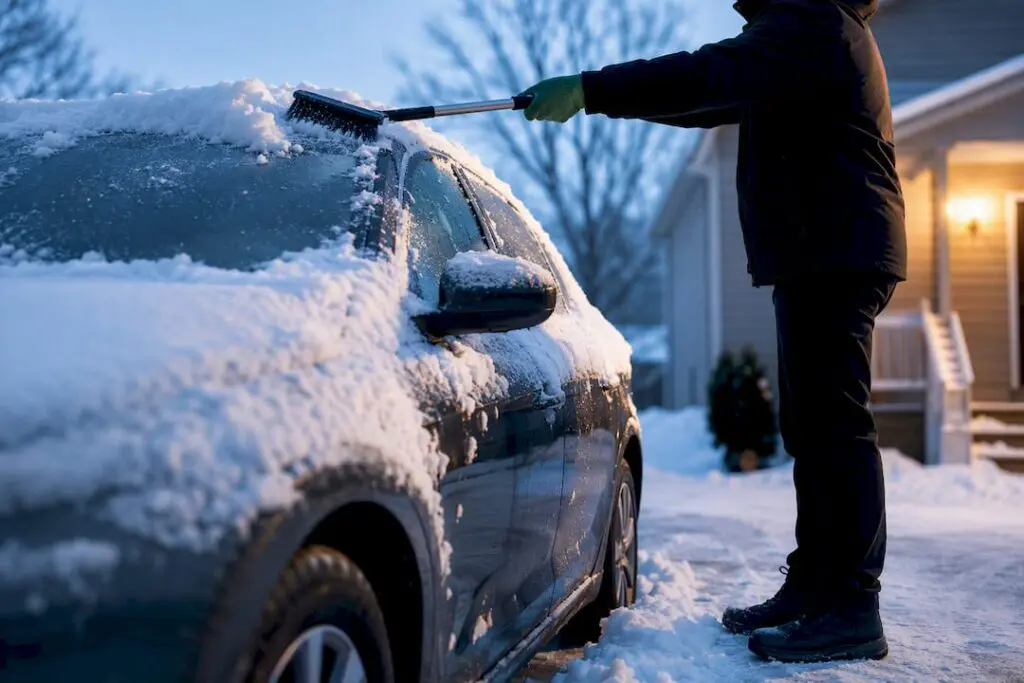
In New Jersey, drivers must remove snow and ice from exposed vehicle surfaces before driving, and property owner duties depend on whether the owner is residential or commercial and on local ordinances. Residential homeowners generally face no civil liability for natural snow and ice accumulation unless their actions make the hazard worse. Commercial property owners carry a higher standard of care, and most municipalities set their own cleanup windows, often 12 to 24 hours after a storm ends, with fines or liens for noncompliance.
TL;DR:
- Commercial property owners are liable if their actions worsen snow or ice hazards, but residential owners are only liable if they actively create or increase the danger.
- Drivers must clear snow and ice from their vehicles before driving; failure to do so can result in fines between $25 and $75 per offense, with higher penalties for damages or injuries.
- Most municipalities set sidewalk snow clearance deadlines of 12 to 24 hours after a storm, with enforcement through fines, towing, or liens rather than lawsuits.
- Landlords are responsible for snow removal if lease terms assign duties to tenants or if they control shared walkways; proper documentation and clear contracts are key.
- Hiring professional snow removal services can be a practical solution for large or high-traffic properties, especially when meeting local clearance deadlines is challenging.
Table of Contents
- What New Jersey law requires of property owners
- The state statute that governs drivers
- How local ordinances affect snow removal obligations
- Landlord and tenant responsibilities in rentals
- Key exceptions courts apply during storms
- Practical steps to limit your liability
- Balancing safety, fairness, and practical compliance
- When it makes sense to hire a snow removal contractor
- Where to verify the law yourself
- Sources
- FAQ
What New Jersey law requires of property owners
New Jersey courts have long treated residential and commercial property owners differently when it comes to snow and ice. Under the framework described in Mirza v. Filmore Corp., commercial owners have a duty to maintain sidewalks abutting their property and can be held liable for injuries tied to snow and ice, depending on what a court considers reasonable under the circumstances. Residential owners are generally insulated from tort liability for natural accumulation, unless their own conduct worsens the condition.
That distinction between “natural” and “artificial” hazards matters more than most homeowners realize. Courts look for evidence that an owner actively created or increased the danger, not simply that snow existed.
- Piling shoveled snow into a mound that later melts and refreezes across a walkway.
- Clearing snow in a way that leaves a thin, hard-to-see ice glaze behind.
- Allowing gutter runoff or a broken downspout to create repeat icing in one spot.
A 2025 appellate opinion reinforced this same natural versus artificial distinction, noting that residential owners usually avoid liability absent proof they made a hazard worse. For a plaintiff, that means proving more than “there was ice.” They need evidence the owner’s own action, not the weather, created the danger.
The state statute that governs drivers
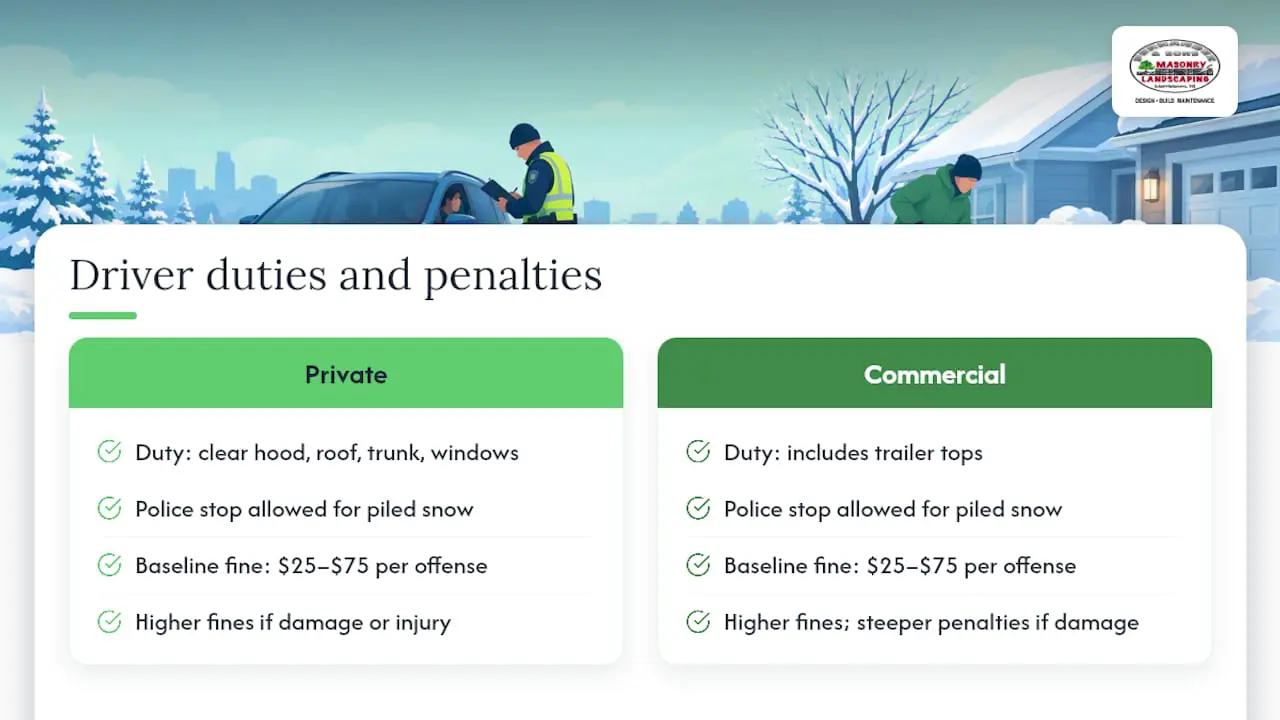
N.J.S.A. 39:4-77.1 creates an affirmative duty for drivers to clear accumulated snow and ice from a vehicle’s hood, roof, trunk, windows, and any exposed surface before getting on the road, including the tops of trailers on commercial trucks. This is not a suggestion. A police officer can stop a vehicle solely because snow or ice remains piled on top of it.
The NJ Attorney General’s Division of Highway Traffic Safety advises drivers to clear all snow and ice before driving and lists baseline fines of $25 to $75 per offense. When flying snow or ice from a vehicle causes injury or property damage, the same guidance points to higher fines, with steeper penalties for commercial vehicles. Each day a vehicle is driven uncleared can count as a separate violation, though total penalties are capped. The law generally applies once a storm has ended, giving drivers reasonable time to clear a vehicle rather than penalizing someone caught mid-storm.
How local ordinances affect snow removal obligations
State law sets the floor, but individual towns fill in the rest through municipal ordinances that specify how quickly sidewalks must be cleared. A municipal code example on ecode360 shows a common structure: property owners must clear sidewalks within 12 to 24 hours after snow stops falling, with the municipality authorized to step in and remove snow itself, billing the property owner or placing a lien on the property if the fine goes unpaid.
Homeowners rarely end up in civil court over a slip-and-fall. Municipal enforcement, fines, town-ordered removal, and liens happen far more often and far faster.
- Call or visit your municipal clerk’s office to ask for the current snow removal ordinance.
- Search your town’s ecode360 listing if it’s available online, since many New Jersey municipalities publish their codes there.
- Check your town’s official website for a winter weather or public works page, which often summarizes the deadline in plain language.
Landlord and tenant responsibilities in rentals
Lease language carries real weight in New Jersey when it comes to snow removal duties. When a lease clearly assigns sidewalk and walkway maintenance to the tenant, courts typically respect that allocation. But a written lease doesn’t erase every risk for the landlord. Courts also examine who actually controlled the property, and a landlord who retains control over common areas or shared walkways can face a duty that a lease alone cannot fully hand off, a point echoed in court opinions addressing landlord and tenant responsibility for maintenance.
Indemnity clauses in contractor agreements help, but they are not a complete shield. A poorly worded clause can leave gaps that surface only after an incident.
- Assign snow removal duties explicitly in the lease, naming the specific areas covered.
- Require proof of contractor insurance before any snow removal work begins.
- Keep dated photos or logs showing when walkways and lots were cleared.
- Review indemnity language with an eye toward gaps, not just its presence.
Key exceptions courts apply during storms
New Jersey’s ongoing storm rule, addressed in Pareja v. Princeton International Properties, generally relieves commercial landowners of any duty to clear snow while precipitation is still falling. The reasoning is straightforward: nobody can be expected to keep a surface perfectly clear while it’s actively snowing. But that protection has limits.
- The rule can fail when the owner’s own conduct increased the risk during the storm.
- The rule can fail when a pre-existing hazard, like a known drainage problem, contributed to the injury.
- Courts apply a reasonableness standard, weighing weather records, timestamps, and photos of the scene.
Pro Tip: Keep a phone photo timestamped at the start and end of any snow removal effort. It becomes evidence of reasonable timing if a dispute ever arises.
Practical steps to limit your liability
Small, consistent habits do more to reduce legal exposure than any single grand gesture after a storm.
- Drivers: Clear the entire vehicle, roof to bumper, before pulling out, and keep a brush and scraper in the car at all times.
- Homeowners: Clear walkways within your town’s window, avoid piling snow near curbs or storm drains, and spread sand or salt when full removal isn’t practical yet.
- Landlords and property managers: Put snow removal responsibilities in writing, collect contractor insurance certificates before the season starts, and keep an inspection log for high-traffic areas.
Pro Tip: Photograph your cleared sidewalk or lot right after finishing. A few seconds of documentation can settle a dispute months later.
Balancing safety, fairness, and practical compliance
Residential and commercial owners live under different rules for good reason. A single homeowner clearing one driveway cannot be held to the same standard as a business managing an acre of parking lot, and New Jersey law reflects that gap. What closes the gap in practice is documentation: photos, timestamps, and a written contract turn “we think we complied” into proof. For owners who would rather hand the whole job to someone else, a local professional service can provide peace of mind.
— BG
When it makes sense to hire a snow removal contractor
Homeowners and property managers across Morris and Somerset Counties often reach a point where clearing snow themselves stops making sense, whether that’s a steep driveway, a commercial lot with tenant traffic, or simply not wanting to be out at 5 AM with a shovel. Professional snow removal services are built to accommodate both situations.

- Residential and commercial snow plowing for driveways, walkways, and parking areas.
- Seasonal contracts as well as one-time or emergency call-outs during major storms.
- Free estimates and a satisfaction guarantee on every job.
Hiring a professional crew is especially worth considering for commercial properties with public foot traffic, rental properties where a landlord retains control of shared areas, or any homeowner who can’t reliably meet a town’s 12 to 24 hour cleanup window, and exploring options like seasonal vs. per-push commercial snow removal contracts can help determine the best approach. Visit our snow plowing services page to get a free estimate before the next storm hits.
Where to verify the law yourself
For readers who want to check the underlying rules directly, these are the primary sources behind this guide.
- N.J.S.A. 39:4-77.1 and the OAG Ice & Snow guidance for driver duties.
- Court opinions on the ongoing storm rule and your town’s municipal code, such as this ecode360 example, for local deadlines.
This article is general information, not a substitute for advice from a qualified lawyer. Consult a qualified legal professional about your own circumstances before acting on anything here.
Sources
- N.J. Statutes Title 39 § 4-77.1
- Ice & Snow palm card — NJ Office of the Attorney General / Division of Highway Traffic Safety
- A-4-20 – Angel Alberto Pareja v. Princeton International Properties (opinion addressing ongoing storm rule)
- Municipal ordinance example (ecode360)
FAQ
What are the legal requirements for snow removal in New Jersey?
Drivers must clear snow and ice from exposed vehicle surfaces before driving, under N.J.S.A. 39:4-77.1. Property owners face separate rules: residential owners typically have no civil duty over natural accumulation, while commercial owners and most municipalities set their own sidewalk clearance windows.
Can I be sued if I don’t shovel my sidewalk?
Residential homeowners are generally protected from lawsuits over natural snow and ice accumulation unless their own actions made the hazard worse, as described in case law summarizing Mirza v. Filmore Corp… The more likely consequence is a municipal fine or town-ordered removal billed to you, rather than a civil suit.
What new snow removal rules take effect in New Jersey in 2026?
There is no statewide change to N.J.S.A. 39:4-77.1 scheduled to take effect in New Jersey in the near future. Enforcement and specific deadlines still depend on each municipality’s own ordinance, so check your town’s current code for any local updates.
Is it illegal to leave snow on your car in New Jersey?
Yes. New Jersey requires drivers to remove snow and ice from a vehicle’s hood, roof, windows, and other exposed surfaces before driving, with baseline fines of $25 to $75 under state guidance. Fines rise to $200 to $1,000 when snow or ice that flies off a vehicle causes injury or property damage.