
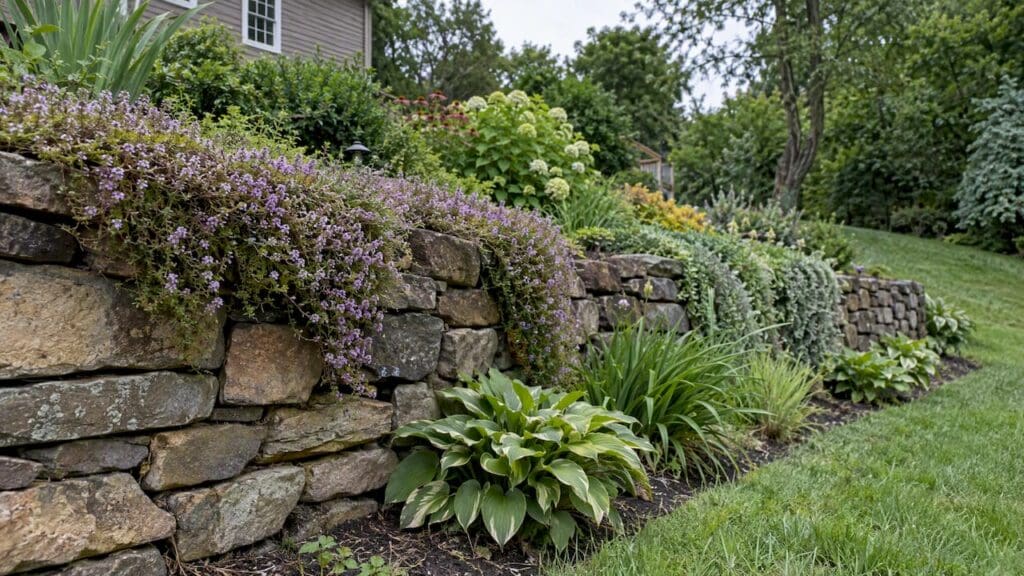
The best retaining wall plantings are tough, shallow-rooted plants matched to the wall’s sun and drainage. Think native shrubs and sedges above the wall, trailing perennials spilling over the cap, and low groundcovers or crevice plants at the face. In New Jersey, the plant list matters less than three things: drainage behind and inside the wall, soil volume for winter survival, and whether the wall needs a permit before you plant anything.
This guide walks through each planting zone of a wall, what works in Morris and Somerset County yards, and the mistakes that cost homeowners plants (and sometimes the wall).
Quick answer: what to plant on a retaining wall
-
Above the wall: native shrubs such as inkberry holly, northern bayberry and sweet pepperbush, or ornamental grasses and sedges, to soften the top edge and hold soil.
-
Over the cap: trailing perennials such as creeping veronica, candytuft, creeping phlox and sedum, which cascade down the face.
-
In the face: only if the wall was built with planting pockets or crevices, and then with plants that like sharp drainage.
-
At the base: groundcovers, ferns, hostas or perennials that frame the wall and hide the transition to the lawn or patio.
-
Before you buy anything: confirm drainage is built into the wall, and check permit rules if the wall is near or over 4 feet.
Think in four planting zones
A retaining wall is not one planting bed. It is four small environments, and each wants different plants.
-
The top (behind the cap). Soil here is the deepest and most stable. It gets the most sun and the most wind.
-
The cap edge. Plants here are exposed on one side. Roots dry out faster, and trailing habits work in your favor.
-
The face. Only planting pockets, crevices or a dry-stacked wall give you room. Soil is thin and drains fast.
-
The base. Cooler, often shadier, and sometimes wetter where water exits the wall.
Walk the wall at midday and again in late afternoon. A south-facing wall in Parsippany can bake in July, while the same wall on the north side of a house stays damp and shaded. Plant for what you see, not for the picture on the tag.
Start with natives that fit New Jersey
For the bed above the wall, native plants are the most dependable starting point. Rutgers NJAES recommends native species for residential landscapes because they handle local conditions and tend to need less long-term care than non-native alternatives. Their fact sheet points to plants such as northern bayberry (Morella pensylvanica), inkberry holly (Ilex glabra) and sweet pepperbush, along with various sedges.
Here is how those fit a wall:
| Plant | Typical height | Where it works on a wall |
|---|---|---|
| Northern bayberry | 5 to 12 ft | Top of a taller wall, as a background screen |
| Inkberry holly | 5 to 8 ft | Top of the wall, evergreen structure that stays green through winter |
| Sweet pepperbush | 6 to 10 ft | Damp or part-shade spots at the top or base |
| Native sedges | Low, clumping | Cap edge and base, where they knit into the soil |
Those heights come from the Rutgers fact sheet. Notice how large they get. A bayberry planted two feet back from a three-foot wall will eventually overpower it. Leave room for mature size, and keep large shrub roots well back from the wall’s drainage zone.
The Rutgers fact sheet also suggests checking the NJ Native Plant Society for species suited to your county. It is worth doing before a big planting day.
Trailing and cascading plants for the cap
What homeowners usually picture is a wall with plants spilling over the top. That look comes from a short list of reliable trailers. A roundup of plants for retaining walls names creeping rosemary, rock soapwort, candytuft and sedum as good cascading choices, and notes that creeping veronica is hardy in USDA zones 4 to 8, likes full sun and well-drained soil, and forms a flowering mat.
A few practical notes for our area:
-
Sedum (stonecrop): handles heat, thin soil and dry spells. Good for sunny south and west walls.
-
Creeping phlox and candytuft: spring color that cascades over the edge. Both want sun and drainage.
-
Creeping thyme and veronica: low mats that tolerate light foot traffic if a path runs along the top.
-
Ornamental sedges: a softer, grassier spill that holds up in part shade.
-
Ferns and hostas: better at the base of a shaded wall than on top.
Mix two or three trailers rather than ten. Repeating a plant every few feet reads as design. A different plant every foot reads as a clearance shelf.
Vines for retaining walls: climbing up, trailing down
Vines can work in either direction on a wall. Planted at the top, they trail down the face. Planted at the base, they climb, if the wall has a surface they can grip or a trellis or wire system to hold them.
Three cautions before you choose a vine:
-
Aggressive vines can damage mortar joints. Self-clinging vines that grip with rootlets can work into joints on mortared stone or brick. On dry-stacked or segmental block walls, they are less of a concern but can still lift caps.
-
Some vines are invasive in New Jersey. Check any vine against the Rutgers native plant resources before buying. Native options are safer for the wider landscape.
-
Plan the maintenance. A vine on a wall means pruning on a ladder. If you will not do that, pick a mounding perennial instead.
For a clean look with less upkeep, a trailing perennial over the cap is usually the better trade than a vine on the face.
Planting the face: pockets, crevices and what actually survives
Planting directly into a wall face works only if the wall was built for it. Planting pockets, open joints in natural stone, or deliberate gaps between blocks give roots somewhere to go. Without them, you are forcing plants into joints that will crumble or clog.
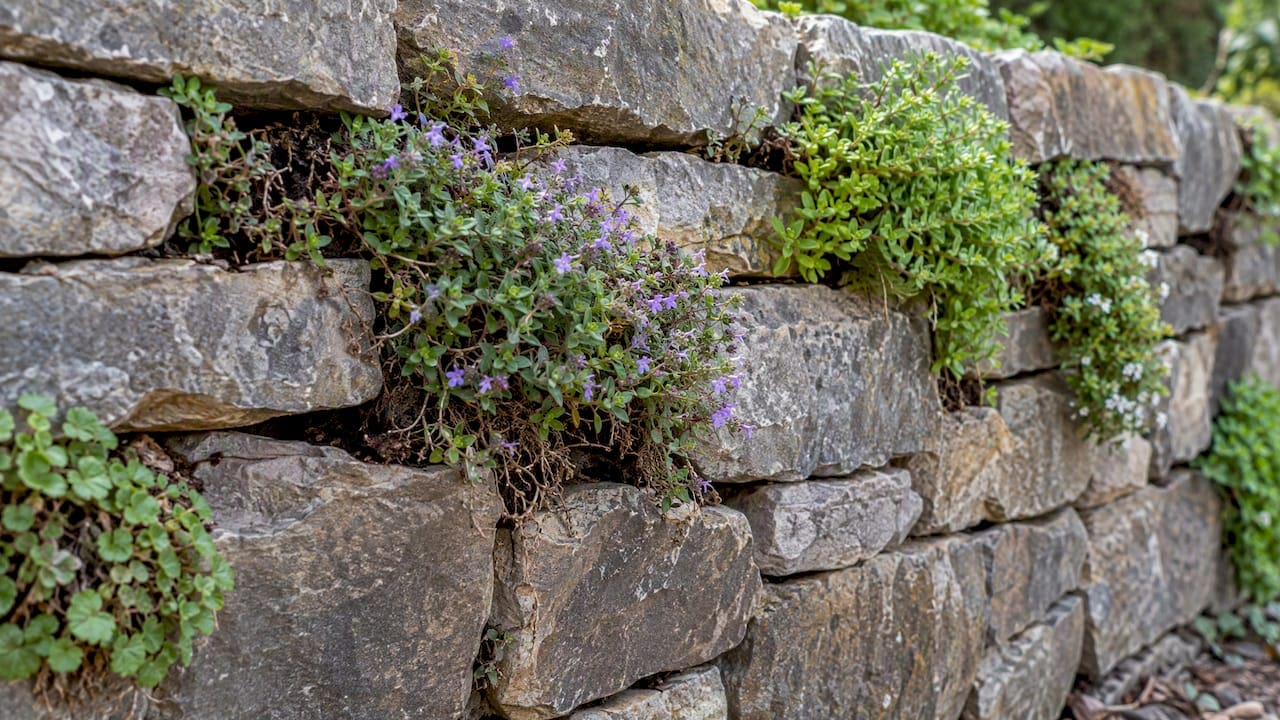
The soil in these pockets matters more than the plant. Crevice gardeners favor sharply draining mixes of sand and fine stone for alpine-type plants, because rich garden soil holds water around the crown and invites rot. The idea, borrowed from Penn State Extension’s crevice garden guidance, is to mimic the tight, fast-draining spaces between rocks.
Good candidates for pockets in a sunny wall face:
-
Sedum and sempervivum (hen and chicks)
-
Creeping thyme
-
Rock cress and basket-of-gold
-
Small dianthus
For a shaded face, look at small ferns and moss-friendly conditions. Moss grows on its own where the wall stays damp.
Drainage first: why gravel in pockets is a myth
The most common planting mistake on retaining walls is a drainage mistake. Many people put a layer of gravel at the bottom of a planting pocket and assume water will exit faster. Penn State Extension says the opposite: that layer can hold water above it and keep roots wet, which leads to rot. The better approach is a planting mix that drains well all the way through the pocket, and a drainage system that works for the wall as a whole.
That second part is not a gardening job. A properly built wall has a drainage layer of clean stone behind the face and a perforated pipe at the base that leads water to a safe outlet. A cost guide for 2026 retaining walls describes a typical build with a 4-inch perforated drain pipe wrapped in geotextile and at least 12 inches of clean angular stone behind the wall.
What this means for your plants:
-
Do not irrigate heavily at the top of the wall. Water that soaks behind the face adds load.
-
Do not block weep holes, outlets or the base drain with mulch or groundcover.
-
Keep roots of large trees and shrubs away from the drainage stone and pipe.
-
If you see water staining, bulging or leaning, call a wall professional before adding more plants.
A wall that is wet behind the face is under more pressure. As a structural engineering firm explains, soil pressure on a wall rises when the soil is wet. Planting should never make that worse.
Winter survival in narrow pockets and raised soil
New Jersey winters are harder on wall plants than on plants in the ground. University of Minnesota Extension notes that raised soil structures can freeze faster and deeper than the surrounding ground, which can stress perennial roots that normally sit in protected earth. Narrow wall pockets behave the same way, only more so.
What to do about it:
-
Choose hardy plants, and stay well within your zone rather than at its edge.
-
Give roots volume. Deeper, wider planting areas at the top of the wall buffer cold better than a thin pocket in the face.
-
Favor plants that tolerate lean, dry soil, since they also tolerate the freeze-and-thaw swings in a wall.
-
Expect some losses in face pockets the first winter, and replace with what survived.
This is also why we steer most homeowners toward planting the top and base generously, with a smaller number of face accents.
Containers and planters as an alternative
If your wall has no pockets, or if you want color without committing to roots in the structure, planters along the cap or on a landing give you the same visual effect. They can also be swapped each season. For general container planting basics, this guide to container gardening in small spaces covers pot sizing and plant choices that carry over well to a wall-top setting.
Keep heavy planters back from the edge of the wall. A full container is a point load on the soil behind the wall, and it adds weight right where the wall is least supported.
Before you plant: is the wall built right, and does it need a permit?
Plants cannot fix a wall that is failing. They can hide the problem until it is expensive.
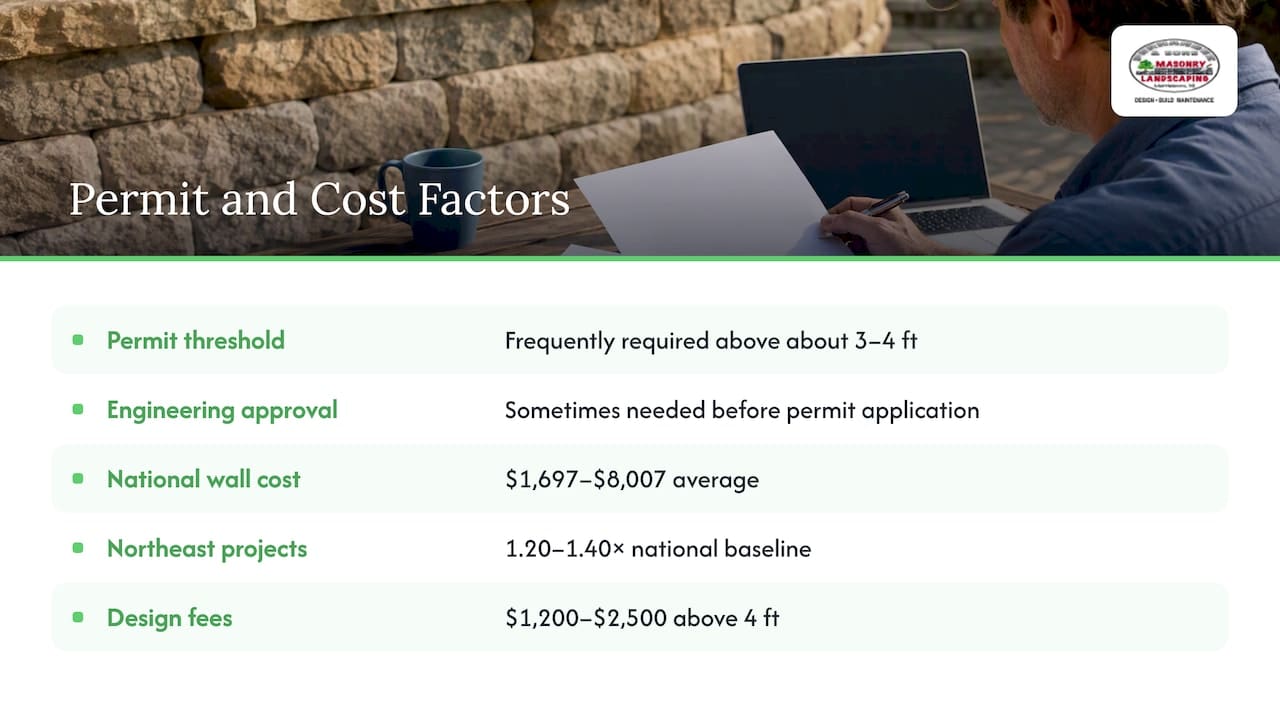
In Morris County and nearby towns, retaining walls are generally handled as structural elements, not decoration. Land-use offices often ask for a grading plan or survey, and a building permit is frequently required for walls taller than about 3 to 4 feet, with engineering approval sometimes needed before the permit application is accepted. Rules vary by town, so always check with your municipality. We have written more on this in our guides to NJ retaining wall permit triggers and engineers, the permit checklist for the 4-foot rule and soil conservation steps, and permits in East Hanover.
Cost jumps at that threshold too. One 2026 cost guide puts the national average for a residential wall between $1,697 and $8,007, says Northeast projects can run 1.20 to 1.40 times the baseline, and notes that engineering design fees alone are often $1,200 to $2,500 once a wall passes 4 feet. Those are national estimates, not our prices. For budgeting detail, see our retaining wall cost guide.
The practical lesson: plan planting at the same time as the wall. Leaving pockets, setting soil depth at the top, and routing irrigation are cheap decisions at design stage and expensive afterward.
Our perspective: plant the wall as part of the design
We build and landscape walls across Morris and Somerset Counties, and the same pattern repeats. A wall that looks bare after construction gets planted in a rush, with whatever is on sale, and the plants fail by the second winter. The fix is not better plants. It is deciding on planting before the first block is set.
Here is how we approach it:
-
Walls are structure first. Drainage, base and height drive every other choice. Plants support the wall’s look, never its performance.
-
Plant the top and the base generously. That is where soil volume, moisture and winter protection are best.
-
Use face pockets sparingly. A few well-placed accents beat a face full of struggling plants.
-
Match plants to how you live. A wall beside a patio where the family gathers wants fragrance and seasonal color. A wall along a driveway wants tough, low-care plants that tolerate snow plow spray and de-icing salt.
-
Think about the whole yard. A wall is often one level of a larger plan. Our multi-level retaining wall garden designs show how terraces and planting beds work together.
That last point on salt deserves attention. Walls beside driveways and walks take winter abuse, so choose plants with that in mind and set the wall back where possible.
A simple planting plan by wall type
Low garden wall (under 2 feet), sunny: a row of sedum and creeping phlox over the cap, ornamental grass at the back, thyme in the joints if the wall allows.
Terrace wall (2 to 4 feet) beside a patio: native sedges and a low shrub at the top, trailing veronica or candytuft over the cap, a ribbon of ferns or hostas at the base if shaded.
Taller engineered wall (over 4 feet): keep plantings light on the face. Use native shrubs such as inkberry set back from the edge, groundcover at the top, and a clean base for drainage access.
Shady north-facing wall: ferns, hostas, native sedges and woodland groundcovers. Moss is welcome.
When installing any of these, set plants into well-draining mix, water them deeply the first season, and add mulch lightly, keeping it off drain outlets.
How we can help
If you want a wall that is built to hold and planted to look established, we handle both. Our team designs and builds retaining walls, plans plantings through our landscaping and design services, and keeps the result looking good through seasonal landscape maintenance. We offer free estimates and a satisfaction guarantee. Start with the Fernandez & Sons home page to see our services across Morris and Somerset Counties.
Frequently asked questions
What plants are good to plant next to a retaining wall?
Choose plants for the zone: native shrubs and sedges above the wall, trailing perennials over the cap, and shade-tolerant groundcovers or ferns at the base. Keep large shrubs back from the wall so roots stay out of the drainage layer. Match each plant to the sun your wall actually gets.
Can I plant directly into a retaining wall?
Only if the wall has planting pockets, open joints or deliberate gaps. Use a fast-draining mix rather than rich garden soil, and expect some winter losses in narrow pockets. Do not drill or chip into a finished wall to make space, since that can weaken it.
Are vines safe to grow on a retaining wall?
Trailing vines planted at the top are usually fine. Climbing vines that cling to the surface can work into mortar joints and add maintenance, so they suit trellises or wires better than the wall itself. Check that any vine is not invasive in New Jersey before you buy.
Do I need a permit before planting or building a retaining wall?
Planting alone does not need one, but building the wall often does once it reaches about 3 to 4 feet, depending on your town. Call your municipal land-use or building department before work starts, and ask whether an engineer’s design is required.
References for planting and permitting
-
Rutgers NJAES, Incorporating Native Plants in Your Residential Landscape
-
Penn State Extension, Crevice Gardens: Life Between the Cracks
-
University of Minnesota Extension, perennials in raised beds