Front Yard Landscaping Ideas for NJ Homes That Work
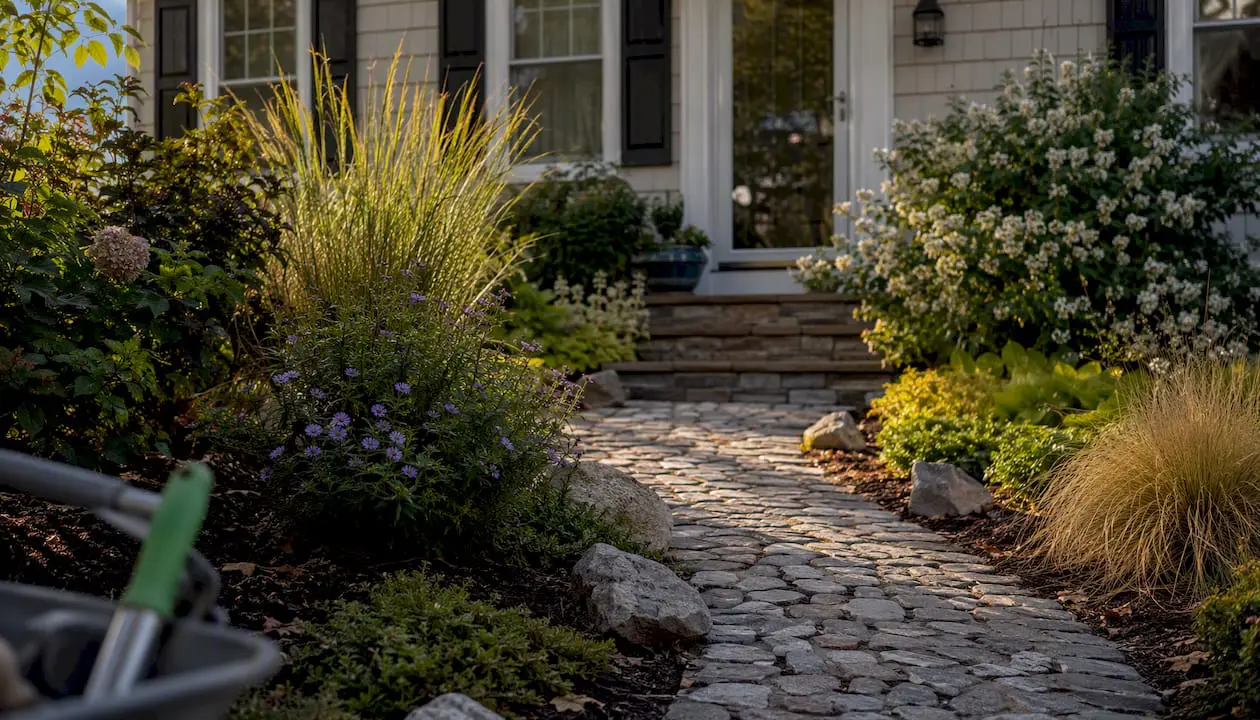
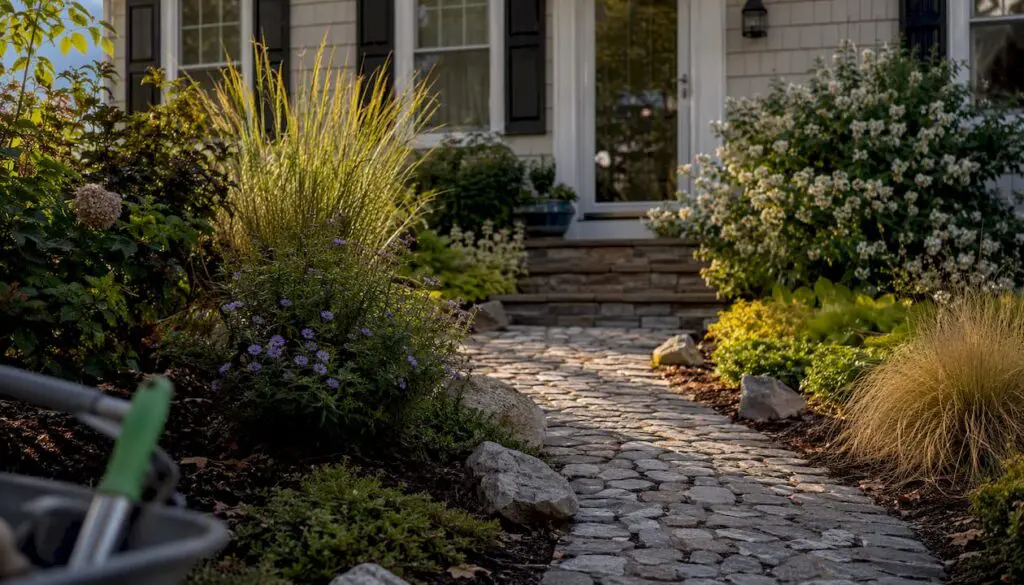
The most effective front yard landscaping ideas for New Jersey homeowners come down to four moves: a quick site assessment, layered native plantings, a water-wise feature or two, and purposeful hardscape accents. Get those right, and curb appeal follows naturally.
Here is a prioritized shortlist you can act on today or bring to a contractor:
- Assess your site first. Spend 15 minutes mapping sun exposure, noting wet spots, and photographing your yard from the street. Rutgers Cooperative Extension calls this the “Right Plant for the Right Place” foundation.
- Layer native plantings. Replace a strip of turf with a mix of native shrubs, perennials, and grasses. Jersey-Friendly Yards offers a searchable plant database filtered by county and physiographic region.
- Add one water-wise feature. A small rain garden or a permeable stone path captures runoff and adds visual interest with almost no ongoing cost.
- Anchor with hardscape. A defined walkway, low stone wall, or simple step sequence gives your planting beds a finished, intentional look. Fernandez & Sons handles exactly this kind of masonry and hardscape work across Morris and Somerset Counties.
- Quick action today: Measure the shaded and sunny zones in your front yard, snap photos at midday, and bookmark the Jersey-Friendly Yards plant list for your county.
Key Takeaways
The most durable front-yard landscaping results in New Jersey come from matching plants to site conditions first, then building hardscape that supports drainage and frames the planting.
| Point | Details |
|---|---|
| Assess before you plant | Map sun, soil drainage, and deer pressure before selecting any species. |
| Prioritize native plants | Aim for more than 70% native cover by biomass to reduce maintenance and support local wildlife. |
| Add one water-wise feature | A small rain garden or permeable path captures runoff and cuts irrigation needs across NJ’s 38–54 inch rainfall range. |
| Build hardscape on a proper base | Freeze-thaw cycles demand compacted gravel bases; trees belong at least 20 feet from foundations. |
| Fernandez & Sons for hardscape | Fernandez & Sons handles walkways, walls, and masonry in Morris and Somerset Counties with free estimates. |
Table of Contents
- 1. How to assess your front yard before choosing any plants
- 2. Front yard design patterns that work across NJ property types
- 3. Native and adapted plant picks for common NJ front-yard conditions
- 4. Water-wise features that reduce runoff and boost curb appeal
- 5. Hardscape choices that complement planting and handle NJ winters
- 6. Realistic maintenance expectations and budget ranges for NJ front-yard projects
- 7. A phased project checklist you can hand to a contractor
- What contractors actually see in NJ front yards
- Fernandez & Sons brings your front-yard plan to life
- Useful NJ resources for deeper reading
- Sources
1. How to assess your front yard before choosing any plants
Rutgers Cooperative Extension frames “Right Plant for the Right Place” as the single most important step in any NJ landscaping project. Skip the assessment, and you will spend years replacing plants that never had a chance.
Sun mapping is the starting point. Walk your front yard at 9 AM, noon, and 3 PM on a clear day and note which areas receive full sun (6+ hours), part shade (3–6 hours), or deep shade. A north-facing foundation bed and a south-facing slope are completely different growing environments, even on the same property.
Soil texture and drainage matter just as much. The jar test is simple: fill a quart jar one-third with soil, top it with water, shake it, and let it settle for 24 hours. Sand settles in minutes, silt in an hour, and clay stays suspended. If water pools on the surface for more than 30 minutes after a rain, drainage is poor and plant choices need to reflect that.
Deer pressure is a real factor across much of Morris and Somerset Counties. Look for browse lines on existing shrubs (clean diagonal cuts at deer-mouth height, roughly 3–4 feet), hoof prints in soft soil, and droppings near beds. High deer pressure narrows your plant palette significantly and may require temporary fencing around new plantings until they establish.
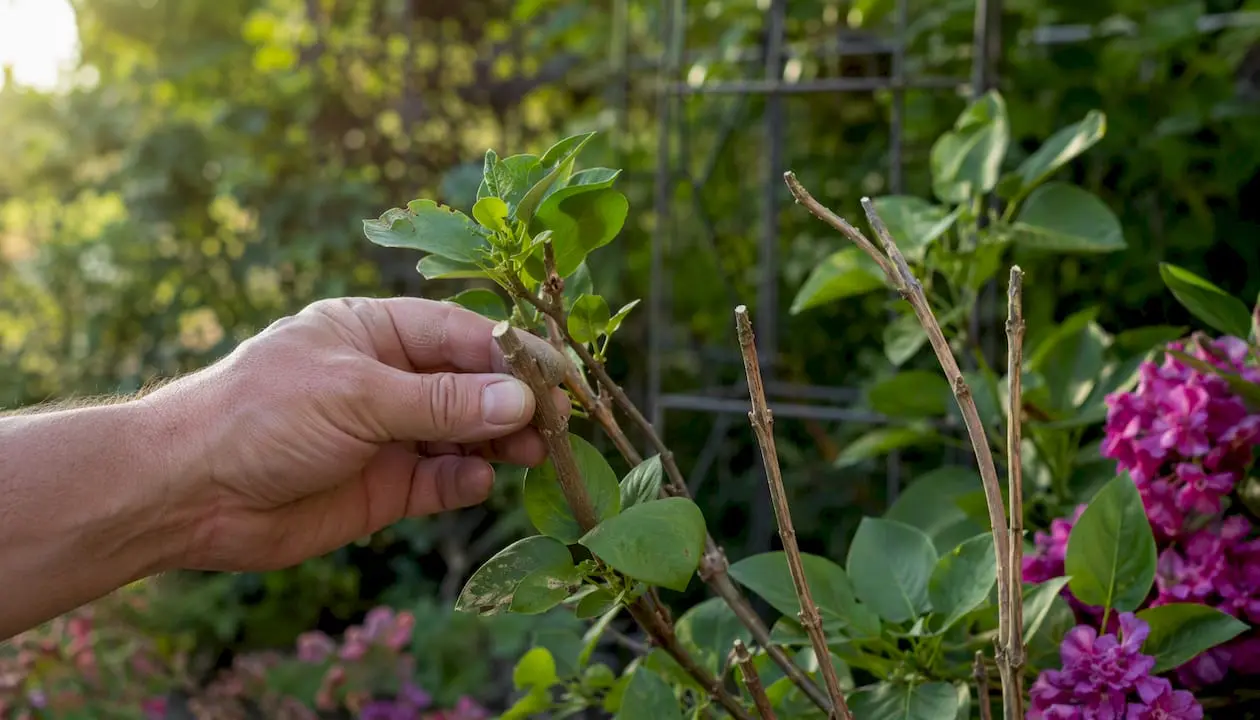
Microclimates in NJ go well beyond USDA hardiness zones. A bed against a south-facing brick wall can run a full zone warmer than the surrounding yard. A low spot near a driveway may collect cold air and frost earlier in fall. Hardiness zone tells you the winter low; it says nothing about summer heat, humidity, or reflected heat from masonry surfaces.
Pro Tip: Visit your planting area at 2 PM on a hot July afternoon. Stand where a new shrub would go and feel the radiant heat from any nearby paving or wall. A spot that reads “part shade” in the morning can be punishing by mid-afternoon, and most plant tags do not account for that.
2. Front yard design patterns that work across NJ property types
Choosing the right layout pattern before buying a single plant saves time, money, and frustration. The patterns below cover the most common NJ front-yard situations, from tight suburban lots to larger colonial-style properties with long foundation runs.
| Design Pattern | Curb-Appeal Impact | Maintenance Level | Relative Water Use | Deer Resilience |
|---|---|---|---|---|
| Formal foundation beds | Medium | High | Medium | Low |
| Layered cottage-style planting | High | Medium | Low–Medium | Medium |
| Native meadow pocket | High (seasonal) | Low (after yr 2) | Low | Medium–High |
| Low-maintenance shrub matrix | Medium | Low | Low | Medium |
| Defined path + focal point | High | Low | Low | High |
| Hardscape-forward entry with planted edges | High | Low | Low | High |
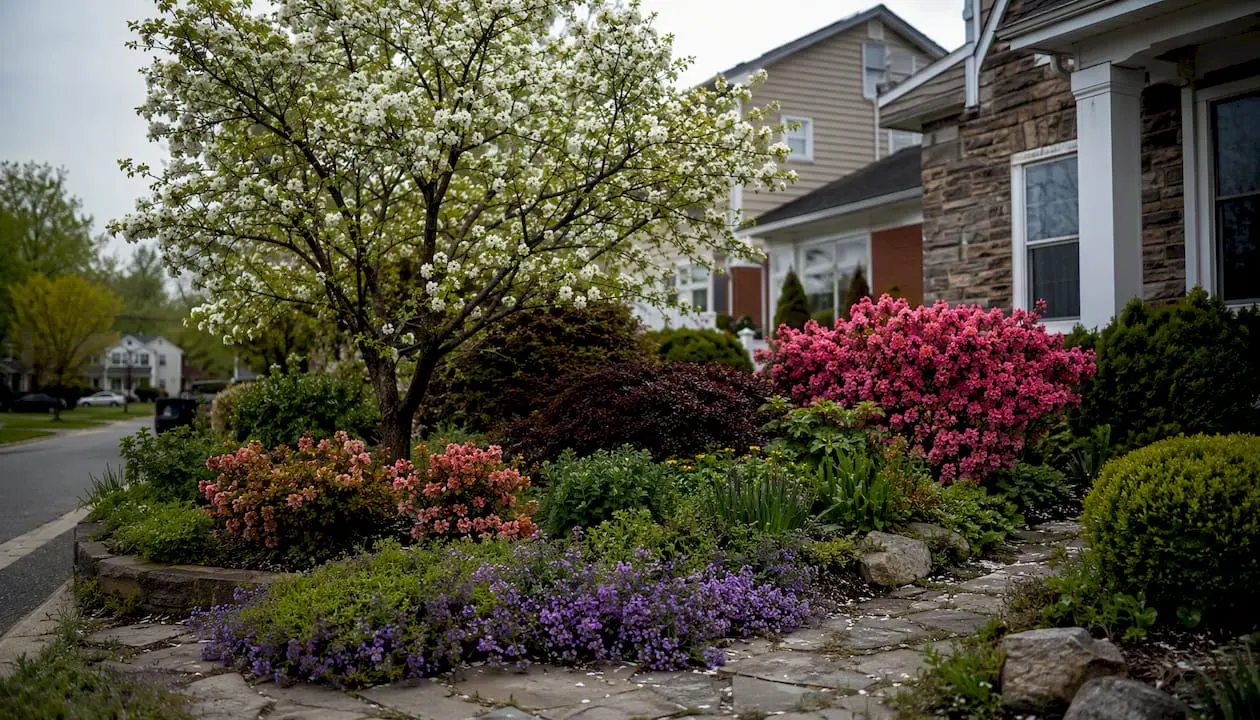
Formal foundation beds line the house with clipped evergreens and seasonal annuals. They photograph well but demand regular shearing, irrigation, and replanting. Better suited to homeowners who enjoy hands-on maintenance or who hire a regular maintenance crew.
Layered cottage-style planting mixes a small ornamental tree, mid-height shrubs, and low perennials in a naturalistic arrangement. The depth creates strong visual focal points from the street and supports pollinators. A good fit for most NJ suburban lots.
Native meadow pockets replace a defined section of turf with native grasses and wildflowers. The Native Plant Society of NJ’s Going Native guide recommends starting small and converting incrementally, which reduces upfront cost and lets you learn what thrives in your specific microclimate.
Low-maintenance shrub matrix uses three to five species of native or adapted shrubs planted in repeating drifts. Dense canopy coverage suppresses weeds after the second year, and most native shrubs need little supplemental water once established.
Defined path + focal point pairs a clean walkway with a single specimen tree or large ornamental grass at the end. Simple, high-impact, and almost maintenance-free once installed correctly.
Hardscape-forward entry with planted edges suits smaller lots or homeowners who prefer minimal planting. Stone, brick, or concrete does the heavy lifting; planted edges soften the lines. Plant medium to large trees at a sufficient distance from the foundation to prevent root conflicts to prevent root conflicts, per Rutgers Green Manual guidance on energy-efficient landscaping.
For a visual sense of how these combinations look at full scale in NJ neighborhoods, project galleries from local landscape firms are worth browsing before you commit to a layout.
3. Native and adapted plant picks for common NJ front-yard conditions
Rutgers Cooperative Extension recommends aiming for more than 70% native plant cover by biomass to meaningfully support pollinators and birds. That does not mean ripping out everything at once. A plant-by-plant replacement approach works well for most homeowners.
Sourcing matters as much as species selection. Buy from nurseries that carry locally adapted provenance stock, and always ask whether plants have been treated with systemic pesticides (neonicotinoids). Treated stock can harm the pollinators you are trying to attract. Straight species generally outperform cultivars for wildlife value, though some cultivars are acceptable when the straight species is unavailable.
The NJ Green Building Manual’s native and adapted plants section provides detailed site-selection and installation steps for Mid-Atlantic landscapes.
| Condition | Tree/Large Shrub | Mid Shrub / Perennial | Grass / Groundcover |
|---|---|---|---|
| Sunny/dry slope | Serviceberry (Amelanchier canadensis, 15 ft) | Little bluestem (Schizachyrium scoparium) | Pennsylvania sedge (Carex pensylvanica) |
| Moist/part-shade foundation | Spicebush (Lindera benzoin, 6–12 ft) | Wild blue phlox (Phlox divaricata) | Wild ginger (Asarum canadense) |
| Compacted clay | Swamp white oak (Quercus bicolor, —) | Buttonbush (Cephalanthus occidentalis, 5–12 ft) | Soft rush (Juncus effusus) |
| Coastal/salt-exposed | Bayberry (Morella caroliniensis, 5–10 ft) | Beach plum (Prunus maritima, 6 ft) | Seaside goldenrod (Solidago sempervirens) |
| High deer pressure | Eastern red cedar (Juniperus virginiana, —) | Inkberry (Ilex glabra, 5–8 ft) | Ferns (Osmunda spp.) |
A few caveats worth noting: Eastern red cedar is genuinely deer-resistant and provides excellent winter structure, but it does spread aggressively in open areas. Inkberry tolerates wet clay and is one of the most reliable deer-resistant shrubs in NJ. For coastal yards, bayberry fixes nitrogen and handles salt spray better than almost any other native shrub.
Use the Jersey-Friendly Yards plant database to filter by your specific county and physiographic region before finalizing your list.
4. Water-wise features that reduce runoff and boost curb appeal
New Jersey’s annual precipitation ranges from 38 to 54 inches, yet Rutgers still recommends water-wise landscaping to protect potable water supplies and aquifers during drought periods. The goal is not to conserve rainfall but to slow it down, let it soak in, and reduce the irrigation your plantings need.
Statistic to know: New Jersey averages 38–54 inches of annual precipitation, but much of that runs off impervious surfaces rather than recharging groundwater. Rain gardens and permeable paths intercept that runoff at the source.
Three features work well in NJ front yards:
- Small rain garden. Choose a low spot at least 10 feet from the foundation. Dig a shallow bowl 6–8 inches deep, amend with compost, and plant with native species that tolerate both wet and dry conditions (swamp milkweed, blue flag iris, cardinal flower). Direct downspout water toward it with a gravel channel or buried pipe.
- Permeable path with stone joints. Lay flagstone or pavers with 1–2 inch gaps filled with gravel or low-growing groundcovers like creeping thyme. Water passes through the joints rather than sheeting off toward the street. If your property has an irrigation system, check NJ backflow prevention compliance requirements before connecting any new irrigation lines.
- Turf-to-native conversion using sheet mulching. Lay cardboard over existing turf, top with 4–6 inches of wood chip mulch, and plant native plugs directly through the layers. The Going Native guide from NPSNJ recommends this method as a low-cost, low-disturbance alternative to sod removal.
First-year maintenance note: All three features need supplemental watering during the first growing season, especially during dry periods. After establishment, maintenance drops sharply. Keep rain garden inlets clear of debris each spring, and top-dress sheet-mulched beds with a thin layer of wood chips every two to three years.
5. Hardscape choices that complement planting and handle NJ winters
Good hardscape does more than look attractive. It manages foot traffic, controls drainage, and frames your planting beds so they read as intentional design rather than scattered greenery. In NJ, material selection has to account for freeze-thaw cycles, occasional road salt drift, and the weight of wet snow.
Material guidance by condition:
- Bluestone and natural flagstone handle freeze-thaw well and age gracefully. They pair naturally with native plantings and work for both formal and informal styles.
- Brick and concrete pavers offer more color and pattern options. Choose pavers rated for freeze-thaw (look for ASTM C902 Class SX for severe exposure) and set them on a properly compacted gravel base to prevent heaving.
- Permeable pavers are worth considering for driveways or wide entry paths where runoff is a concern. They require a deeper aggregate base but eliminate most surface sheeting.
- Natural stone walls (dry-laid or mortared) add structure and visual weight. A low wall at 12–18 inches creates a planting terrace and reduces maintenance by keeping mulch and soil in the bed.
Safety and accessibility deserve attention on any front-yard project. Low-voltage path lighting (12V LED systems) improves safety and adds evening curb appeal without significant energy cost. Grade changes should be gradual; a single step with a 6-inch rise and a 12-inch tread is safer than a steep slope. Non-slip surfaces matter most on north-facing paths that stay shaded and damp.
Safety note: Never plant trees or large shrubs directly under utility lines, and keep all plantings at least 18 inches from the foundation wall to allow air circulation and prevent moisture buildup against the structure.
Combining hardscape with planting edges is easier when you build a low stone curb or edging strip along the bed perimeter. It keeps mulch in place, gives the mower a clean line to follow, and makes the bed look finished year-round. For more on combining hardscape and planting at scale, poolside and outdoor living project examples show how these pairings translate across different property types.
When the project involves significant grading, a retaining wall, or a new walkway from the street, bring in a masonry professional. Ask specifically about base preparation depth, drainage provisions behind any wall, and foundation setback compliance.
6. Realistic maintenance expectations and budget ranges for NJ front-yard projects
Setting honest expectations before you start saves a lot of frustration. Native plantings are genuinely lower-maintenance than traditional landscapes, but “lower maintenance” does not mean “no maintenance,” especially in the first two years.
Establishment timeline:
- Planting week through month 3: Water deeply two to three times per week if no significant rain. Stake any trees over 6 feet. Keep mulch at 2–3 inches, pulled back from stems.
- Months 4–12: Reduce watering to once per week during dry periods. Pull weeds before they set seed. Check deer protection monthly.
- Years 2–5: Most native shrubs and perennials are self-sustaining by year three. Trees may need occasional formative pruning. Grasses can be cut back hard in late winter.
Seasonal maintenance checklist:
- Spring: Cut back ornamental grasses, remove winter-killed stems, top-dress beds with compost, check mulch depth
- Summer: Water during dry stretches (especially new plantings), deadhead spent flowers to extend bloom, monitor for pest pressure
- Fall: Leave seed heads and leaf litter for overwintering insects, plant new trees and shrubs (fall is the preferred window for woody plants in NJ), divide overcrowded perennials
- Winter: Protect young trees from deer with wire cages, avoid piling road salt near planted beds, check that drain inlets are clear
For more detailed seasonal guidance, fall landscaping tips for NJ yards covers cleanup and prep steps specific to the region.
Ballpark cost ranges depend heavily on site complexity, access, and scale. Small native planting beds (100–200 sq ft) typically run a few hundred to a couple thousand dollars installed, depending on plant size and site prep needed. A modest permeable flagstone path runs more per square foot due to base preparation. Low retaining walls in natural stone are among the higher-cost items per linear foot. For affordable landscaping options in NJ, getting two or three contractor estimates with itemized scope is the most reliable way to compare true costs.
Questions to bring to an estimate appointment:
- What is included in site prep, and how deep will the base go for any hardscape?
- How will drainage be handled behind retaining walls or along the path edge?
- What is the warranty on plants and hardscape installation?
- Will you provide a maintenance plan for the first year?
7. A phased project checklist you can hand to a contractor
This checklist moves from idea to installed and cared-for in a logical sequence. Use it yourself for a phased DIY approach, or hand it to a contractor as a scope outline.
- Site survey and documentation. Photograph the yard from the street and from each corner. Note utility line locations (call 811 before any digging). Measure the yard and sketch a rough base plan with dimensions.
- Choose your palette and layout. Select a design pattern from Section 2. Use the Jersey-Friendly Yards database to build a plant list matched to your site conditions. Confirm deer pressure level and adjust selections accordingly.
- Prepare the site. Remove invasive species first (Japanese barberry, burning bush, English ivy are common NJ offenders). Sheet-mulch or sod-cut turf areas to be converted.
- Install hardscape first. Paths, walls, and steps go in before planting. This protects plants from construction traffic and lets you finalize drainage before soil is disturbed.
- Plant in the right order. Trees first, then large shrubs, then mid-size shrubs, then perennials and grasses, then groundcovers. Space for mature size, not current size.
- Immediate post-install care. Water thoroughly at planting. Apply 2–3 inches of wood chip mulch. Install deer protection on all new trees and vulnerable shrubs.
- 12-month checkpoints. Check at 30 days (watering adequacy, mulch depth), 90 days (plant health, weed pressure), 6 months (summer stress check), and 12 months (overall establishment, any replacements needed).
Seasonal sequencing for NJ: Fall planting (mid-September through early November) is the preferred window for trees and shrubs. Roots establish during the cool months, and plants enter spring with a head start. Spring planting (April through May) works well for perennials and grasses. Avoid planting woody material in July and August unless you can commit to daily watering. For current-season design ideas, 2026 spring landscape trends in NJ highlights what is working well in the region right now.
Documents to collect before hiring:
- Utility markup from 811
- Photos of existing conditions (all four sides of the yard)
- A reference plant list from Jersey-Friendly Yards or Rutgers Extension sustainability resources
- Any HOA guidelines on plant height or hardscape materials
What contractors actually see in NJ front yards
Three patterns show up repeatedly in front-yard projects across Morris and Somerset Counties, and all three are avoidable with a little upfront planning.
The first is over-mulched, mounded beds. Homeowners pile mulch 6–8 inches deep in a volcano shape around tree trunks, which traps moisture against the bark and invites rot and disease. The fix is simple: pull mulch back 6 inches from the trunk and keep the total depth at 2–3 inches. Beds should be concave, not convex. A concave bed holds moisture and leaf litter where native plants actually want it, rather than shedding both away from the root zone.
The second pattern is trees planted too close to the foundation. A 15-foot ornamental tree looks fine at planting but creates real problems at maturity. Roots can reach and stress foundations; canopy can trap moisture against siding. Medium to large trees belong at least 20 feet from the building, and that placement also delivers the energy savings that properly sited shade trees provide. According to Rutgers’ energy-efficient landscaping guidance, shade trees sited appropriately can reduce cooling loads meaningfully over time.
The third pattern is underestimating deer. Homeowners plant a beautiful mix of hostas, arborvitae, and yews, and deer browse it to the ground within a season. Deer pressure in many NJ communities is severe enough that temporary wire cages are not optional for new plantings; they are standard practice. Physical barriers remain the most reliable protection until plants are large enough to withstand browsing.
For hardscape work specifically, asking whether a contractor has masonry experience matters. A walkway that heaves after one winter usually traces back to inadequate base preparation, not the surface material. Fernandez & Sons brings over a decade of masonry and hardscaping experience to front-yard projects in Morris and Somerset Counties, which means the base work gets done right the first time.
Fernandez & Sons brings your front-yard plan to life
Planning a front-yard renovation is satisfying. Getting the hardscape installed correctly is where professional experience pays off.

Fernandez & Sons Masonry & Landscaping works with homeowners across Morris and Somerset Counties to design and build the hardscape elements that give front yards their finished, polished look: walkways, low stone walls, steps, and planted edges that hold up through NJ winters. The team handles base preparation, drainage planning, and material selection for brick and stone masonry projects and full masonry and hardscaping services across the region. Free estimates are available, and every project comes with a satisfaction guarantee. Ask for references and a maintenance plan when you call. Contact Fernandez & Sons to schedule your free estimate.
Useful NJ resources for deeper reading
- Jersey-Friendly Yards plant database — Searchable by county and physiographic region; the fastest way to build a site-appropriate plant list for any NJ front yard.
- Rutgers Cooperative Extension: Incorporating Native Plants — The “Right Plant for the Right Place” framework with site-assessment guidance and native plant recommendations.
- Rutgers NJAES: Landscaping for Water Conservation (E341) — Covers rain gardens, permeable surfaces, and water-wise planting strategies for NJ conditions.
- Going Native: Northern NJ Guide (NPSNJ) — Step-by-step turf conversion, invasive removal, and native plant lists for northern New Jersey.
- NJ Green Building Manual: Native and Adapted Plants — Mid-Atlantic site-selection and installation steps for native landscaping.
- Rutgers Extension: Home, Lawn & Garden Sustainability — Practical sustainable-care resources, pest management, and seasonal guidance for NJ gardeners.
- Fernandez & Sons Masonry & Landscaping — Local professional service for hardscape, masonry, and landscape design in Morris and Somerset Counties, NJ.
Sources
- Landscaping for Water Conservation (Rutgers NJAES, Publication E341)
- FS1140: Incorporating Native Plants in Your Residential Landscape (Rutgers NJAES)
- NC Energy-Efficient Landscaping | NJ Green Building Manual (Rutgers)
- A Guide to Landscaping with Native Plants in Northern New Jersey (Native Plant Society of NJ)
- NR Native and Adapted Plants | NJ Green Building Manual (Rutgers)
- Home, Lawn & Garden: Sustainability (Rutgers Extension)
- Jersey-Friendly Yards plant database
- Landscape project pictures in New Jersey (Susan Schlenger Landscape Architecture)