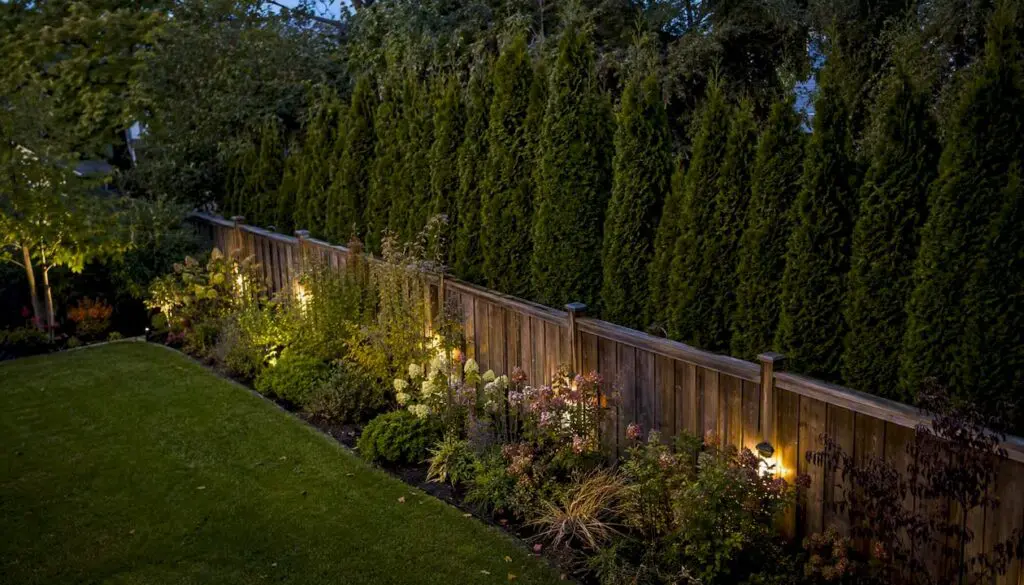
The fastest reliable ways to add backyard privacy combine a living screen of fast-growing evergreens, an instant hardscape or prefab panel solution, and a layered planting plan that pairs quick fill-in plants with long-term screening trees. For most homeowners, the right answer is not one approach but a sequence: get coverage now, then grow something permanent.
Here is a quick shortlist to orient your planning:
-
Green Giant arborvitae row: Grows 3–5 feet per year and reaches effective screening height within 2–3 years. Best for year-round, low-maintenance evergreen coverage in USDA Zones 5–8.
-
Wax Myrtle (warm zones): Up to 5 feet of growth per season in Zones 7–10. Effective screening in 1–2 seasons in favorable conditions. Best for coastal and southern yards.
-
Prefab privacy panels or wood fence: Instant coverage from day one. Best when you need screening this season and cannot wait for plants to establish.
-
Raised planting beds with tall ornamental grasses or bamboo: Effective summer screening in weeks. Best as a temporary or supplemental solution while permanent screens grow in.
-
Layered combination (evergreen trees + mid-height shrubs + hardscape): Takes 3–5 years to reach full maturity but delivers the most resilient, visually appealing result long-term.
If you need privacy by this weekend, start with a prefab screen or fence panel. If you want something that looks like it belongs in your yard five years from now, plant Green Giant arborvitae and layer in shrubs and structure around it.
What to Keep in Mind
The most reliable backyard privacy strategy pairs a fast-growing evergreen screen like Thuja ‘Green Giant’ with a hardscape element for immediate coverage, layered with mid-height shrubs and designed around your actual sightlines and site conditions.
| Point | Details |
|---|---|
| Start with sightlines | Measure where unwanted views originate before choosing plants or structures. |
| Green Giant arborvitae leads for evergreens | Grows 3–5 feet per year; reaches effective screening height within 2–3 years in Zones 5–8. |
| Avoid Leyland cypress and running bamboo | Both create serious long-term problems; choose clumping bamboo and disease-resistant species instead. |
| Check permits and call 811 first | Local fence height limits, setbacks, and utility locates must be confirmed before any digging or building. |
| Fernandez & Sons for full-service installs | Masonry walls, hardscaping, and planting design for Morris and Somerset Counties, NJ, with free estimates. |
Table of Contents
-
Which plants actually create effective backyard privacy landscaping?
-
How do layered planting and design principles create better privacy?
-
How do you plan and install a backyard privacy screen step by step?
-
When should you hire a professional for your privacy project?
-
Fernandez & Sons brings privacy landscaping expertise to Morris and Somerset Counties
What types of privacy barriers work best for a backyard?
Backyard privacy solutions fall into three categories: living screens (plants), hardscape structures (fences, walls, panels), and hybrid combinations that blend both. Each performs differently depending on how fast you need coverage, how much maintenance you want to take on, and what your budget looks like.
| Feature | Living Screens | Hardscape Structures | Hybrid Combination |
|---|---|---|---|
| Speed to full privacy | 1–5 years | Immediate | Immediate partial + grows in |
| Year-round coverage | Yes (evergreens) | Yes | Yes |
| Noise reduction | Moderate | Low–Moderate | Good |
| Maintenance | Pruning, watering | Painting, staining, repairs | Both, reduced over time |
| Cost range | Low–Medium upfront | Medium–High upfront | Medium–High |
| Visual warmth | High | Low–Medium | High |
Living screens tend to cost less upfront than a solid fence for the same linear footage, but they require consistent care during establishment and periodic pruning once mature. Hardscape structures deliver instant results and a defined boundary, but a solid fence without softening plantings can feel stark and wall-like; outdoor living spaces from Bucks County offer design ideas to balance hardscape and privacy installations seamlessly. The most effective privacy designs blend hardscape and plantings, using fences or masonry as the backbone and vines, shrubs, and beds to integrate them into the yard’s character.
Pro Tip: Combining a 6-foot fence with a row of arborvitae planted 3 feet in front of it gives you immediate screening plus a living buffer that will eventually stand on its own if the fence ever needs replacement.
Which plants actually create effective backyard privacy landscaping?
Plant selection is where most homeowners either get it right or spend years correcting a mistake. The table below covers the most reliable screening species, including growth rates, mature sizes, zone suitability, and honest maintenance expectations.
Privacy screening plants fall into distinct categories — annual vines, perennial vines, tall herbaceous plants, deciduous shrubs, and evergreen shrubs — each offering different seasonal coverage and long-term commitment levels. Annual vines like morning glory give you a summer screen for almost nothing; evergreen shrubs like boxwood give you a permanent, shaped hedge that takes a decade to mature.
⚠️ Warning: Species to approach with caution
Leyland Cypress grows fast but is highly susceptible to Seiridium canker and Botryosphaeria dieback, diseases that can devastate an established hedge row. Many homeowners who planted Leyland cypress screens in the 1990s and 2000s have spent years replacing dead sections. It is not a reliable long-term investment.
Running bamboo (Phyllostachys spp. and related genera) spreads aggressively via underground rhizomes and can invade neighboring properties, crack hardscape, and become nearly impossible to eradicate. Always choose clumping bamboo (Bambusa spp. or Fargesia spp.) instead. Clumping varieties expand slowly from a central root mass and stay where you plant them.
Both species also create root and utility conflicts near foundations, underground pipes, and driveways.
Spacing guidance: Plant screening trees and shrubs at roughly half to two-thirds of their mature width apart for a solid hedge effect. For Green Giant arborvitae, that means spacing plants 5–6 feet apart in a single row. When space permits, a staggered double row with 8–10 feet between rows and plants offset by half a spacing interval creates a denser, more wind-resistant screen faster.
Hybrid poplar can add 5–8 feet per year as a temporary fill-in screen, while Green Giant arborvitae at 3–4 feet per year is the fastest reliable evergreen worth keeping for a durable long-term result.
How do layered planting and design principles create better privacy?
A single row of tall trees solves one sightline problem but rarely creates the sense of enclosure that makes a backyard feel like a private retreat. Layered planting addresses this by stacking plants at different heights so the view is blocked from multiple angles simultaneously.
A typical layered cross-section looks like this, from back to front:
-
Back layer (tall): Evergreen trees 20–60 feet at maturity (Green Giant arborvitae, Eastern red cedar, or clumping bamboo). These block elevated sightlines from neighboring second-story windows and create the primary screen.
-
Middle layer (mid-height): Evergreen or semi-evergreen shrubs 6–12 feet tall (Wax Myrtle, viburnum, inkberry holly). These fill the visual gap between the ground and the canopy of the back layer.
-
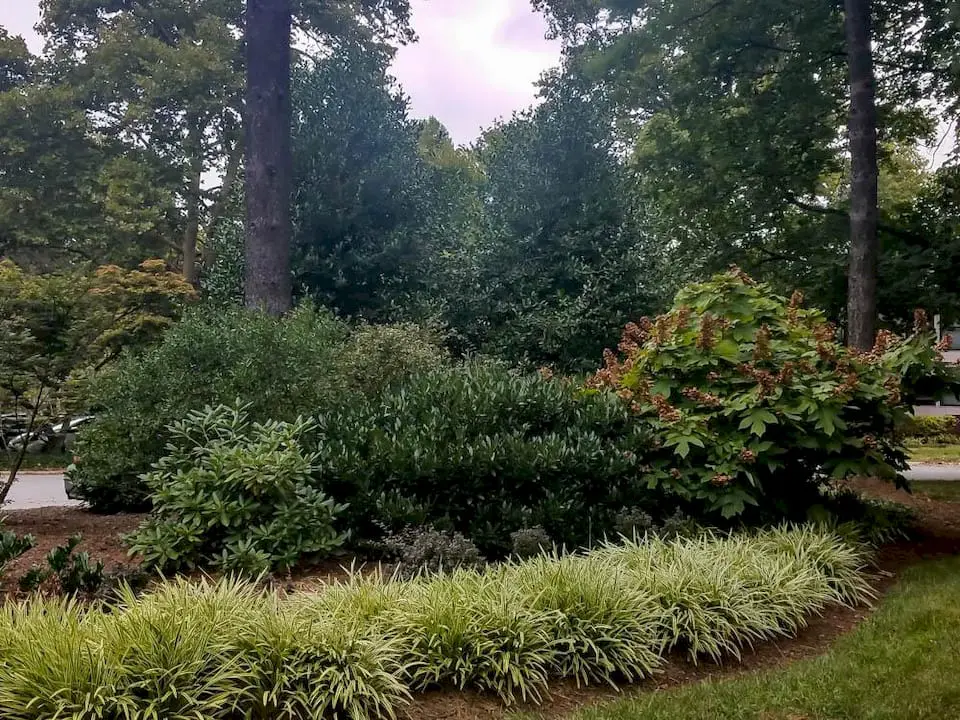
Front layer (low): Ornamental grasses, perennials, or low shrubs 2–4 feet tall. These soften the base, add seasonal interest, and prevent the planting from looking like a wall.
Sightlines: Before you plant anything, stand at the spots in your yard where you most want privacy — your patio, pool deck, or outdoor dining area — and identify exactly where the unwanted views are coming from. A neighbor’s second-floor window requires a taller back layer than a ground-level view across a fence line. Measure the height of the obstruction and the distance to your planting zone to calculate the minimum mature height you need.
Drifts vs. rows: A straight single-species row of trees reads as a fence substitute and can look institutional. Planting in drifts — loose, flowing masses of three to five plants of the same species — creates a more natural, designed appearance. The Rule of 3 is a useful compositional guide for anchoring focal points and plant groupings, but designers caution against applying it rigidly across an entire yard. Use odd-number groupings as a starting point, then adjust based on your actual space and sightline needs.
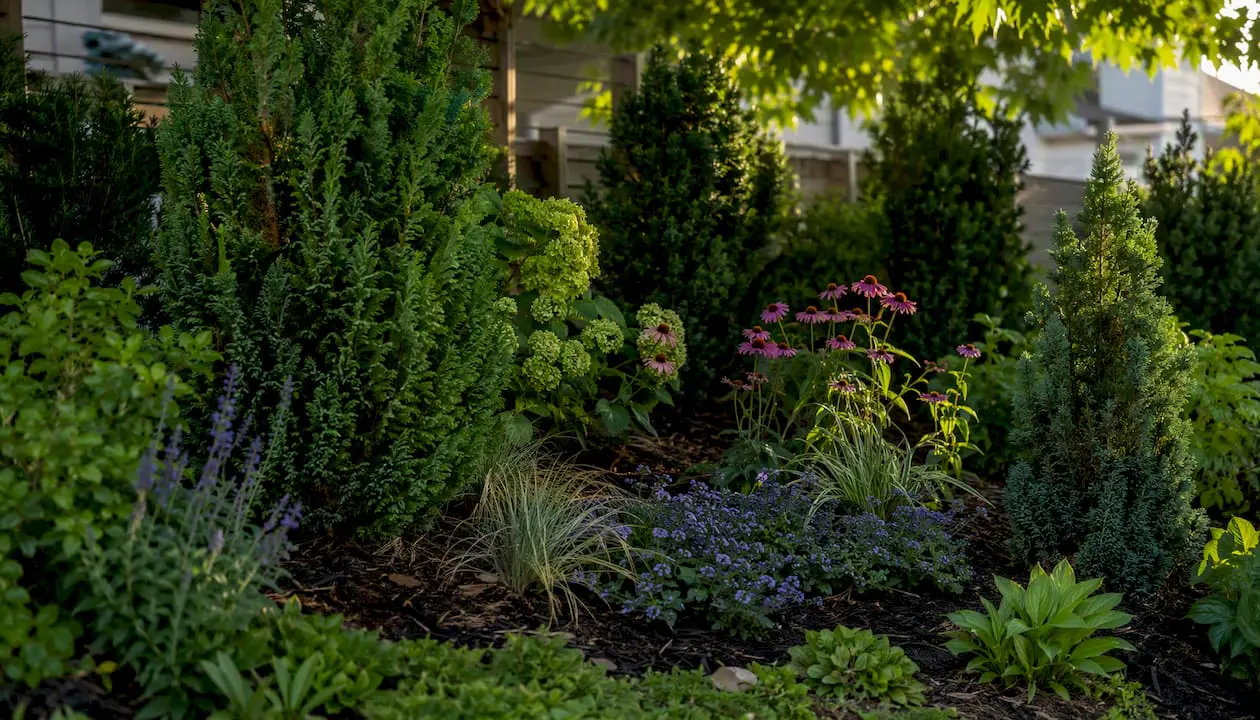
Pro Tip: Plant masses rather than single specimens wherever possible. One arborvitae does almost nothing for privacy. Three planted together at proper spacing create a visual anchor within two growing seasons. Five create a screen.
A quick visual balance checklist:
-
One strong focal point (a specimen tree, a masonry wall, or a pergola)
-
Two to three supporting elements at mid-height (shrubs, raised beds, or a trellis)
-
A third layer at low height to ground the composition and soften edges
What hardscape options give you instant outdoor privacy?
Plants take time. Hardscape structures give you privacy from the moment installation is complete, which is why most well-designed backyards use at least some combination of fencing and landscaping together.
Common hardscape privacy solutions
-
Wood privacy fence: The most common choice. Cedar and redwood resist rot naturally; pressure-treated pine costs less. Expect 10–20 years of life with proper maintenance (staining or sealing every 2–3 years).
-
Composite panels: Low maintenance, consistent appearance, and resistant to rot and insects. Higher upfront cost than wood, but the lifecycle cost often comes out lower.
-
Prefab privacy screens: Freestanding or post-mounted modular panels in wood, metal, or composite. Good for targeted screening of a specific area without a full fence line.
-
Masonry walls: Stone, brick, or concrete block walls offer the most permanent and noise-reducing option. They require professional installation and permits for walls above a certain height, but they last generations with minimal maintenance.
-
Pergolas with curtains or shade sails: Define a space and create overhead enclosure. Less effective for lateral privacy but excellent for creating a sense of room in an outdoor living area.
-
Trellises for vines: A trellis alone provides no privacy, but paired with a fast-growing vine like clematis or star jasmine, it becomes a living wall within one to two seasons.
-
Living wall systems: Modular panel systems with integrated planters. Effective for small spaces and urban yards where ground planting is limited.
Permits and local code checklist
Before you build any fence or wall, verify the following with your municipality:
-
Maximum fence height in rear yard vs. front yard (commonly 6 feet rear, 4 feet front, but this varies widely)
-
Required setbacks from property lines
-
Whether the finished side must face the street or neighbor
-
Permit requirements for fences above a certain height and for any freestanding masonry wall
-
HOA rules and architectural review requirements if applicable
Municipal planning and zoning codes commonly set fence height limits, setback requirements, and permit triggers for walls and significant grading. Skipping this step can result in a stop-work order or a required teardown.
Key insight: A masonry privacy wall costs more upfront than a wood fence but requires almost no ongoing maintenance and adds measurable property value. For homeowners planning a long-term outdoor living space, the per-year cost of a masonry wall often beats the per-year cost of a wood fence that needs staining, repairs, and eventual replacement. Brick and stone masonry is one of the most durable privacy investments available.
Material trade-offs at a glance:
Quick privacy fixes you can install this weekend
Sometimes you need screening now, not in two growing seasons. These short-term solutions work as placeholders while living screens establish, or as permanent solutions for smaller spaces.
Prefab and freestanding options:
-
Freestanding privacy screens: Modular panels in wood, bamboo, or metal that stand independently with weighted bases or ground stakes. Set up in an afternoon, repositionable as needed.
-
Shade sails: Triangular or rectangular fabric panels tensioned between posts or anchor points. Excellent for overhead privacy and sun control; less effective for lateral screening.
-
Outdoor curtains on a pergola or cable system: Create a soft, adjustable privacy wall. Use UV-resistant, weather-treated fabric for durability.
-
Lattice panels with fast vines: Install a lattice panel on a post system and plant annual vines (morning glory, black-eyed Susan vine) at the base. Full coverage in 6–8 weeks during the growing season.
-
Tall container plantings: Large planters (24 inches or larger) with columnar evergreens like Sky Pencil holly or Emerald arborvitae, ornamental grasses, or tall bamboo create movable privacy screens for patios and decks.
Installation tips for stability and safety:
-
Anchor freestanding screens with ground stakes or weighted bases rated for your wind exposure. A 6-foot panel acts as a sail in high wind and can tip or blow over without proper anchoring.
-
For container plantings, use heavy ceramic or concrete planters rather than lightweight plastic to prevent tipping. Group containers together for a more stable, visually cohesive arrangement.
-
Ensure lattice panels are set in post-hole concrete or secured to an existing fence structure, not just leaned against a surface.
-
Check drainage under raised planters to prevent waterlogging, which shortens plant life significantly.
Temporary solutions work best as a bridge while permanent plants establish. A row of tall ornamental grasses in containers alongside newly planted arborvitae gives you privacy this summer while the trees grow toward their permanent screening height over the next few years.
What should you check before starting a privacy project?
Getting the site assessment right before you spend money on plants or materials prevents the most common and costly mistakes in privacy landscaping.
Pre-installation checklist:
-
Call 811 before any digging. This free service marks underground utilities (gas, electric, water, cable) and is legally required in most states before excavation. Skipping it risks serious injury and expensive repairs.
-
Confirm property lines. Do not assume your fence or planting is on your property. A survey or recorded plat map confirms the boundary. New Jersey property line and fence laws outline neighbor responsibilities and local ordinance considerations that apply to shared boundaries.
-
Check HOA and municipal rules. Fence height limits, setback requirements, and permit triggers vary by municipality. Verify before purchasing materials.
-
Assess soil, sunlight, and drainage. Most screening plants prefer well-drained soil and at least 6 hours of direct sun. Wet, compacted, or heavily shaded sites narrow your plant options considerably.
-
Evaluate wind exposure. A yard exposed to prevailing winds needs species that tolerate wind stress. Green Giant arborvitae handles wind well; Leyland cypress is more susceptible to wind damage as it ages.
Biological considerations:
Deer pressure is a significant factor in many suburban and semi-rural areas of New Jersey and across the Northeast. Green Giant arborvitae has moderate to good deer resistance, but no plant is completely deer-proof in a high-pressure area. Boxwood and privet are frequently browsed. If deer are a known problem in your neighborhood, prioritize species with documented resistance or plan to use deer fencing during establishment.
Root spread matters near structures. Clumping bamboo stays contained, but running bamboo rhizomes can travel 15–20 feet from the original planting and crack hardscape or invade neighboring yards. Large trees planted too close to foundations, driveways, or underground utilities create long-term structural problems.
Pro Tip: Before finalizing your plant list, walk your yard after a heavy rain and note where water pools. Planting a moisture-sensitive species like arborvitae in a drainage low spot is one of the most common reasons new screens fail in the first two years.
How do you plan and install a backyard privacy screen step by step?
A clear sequence keeps the project on track and prevents the most common installation errors.
-
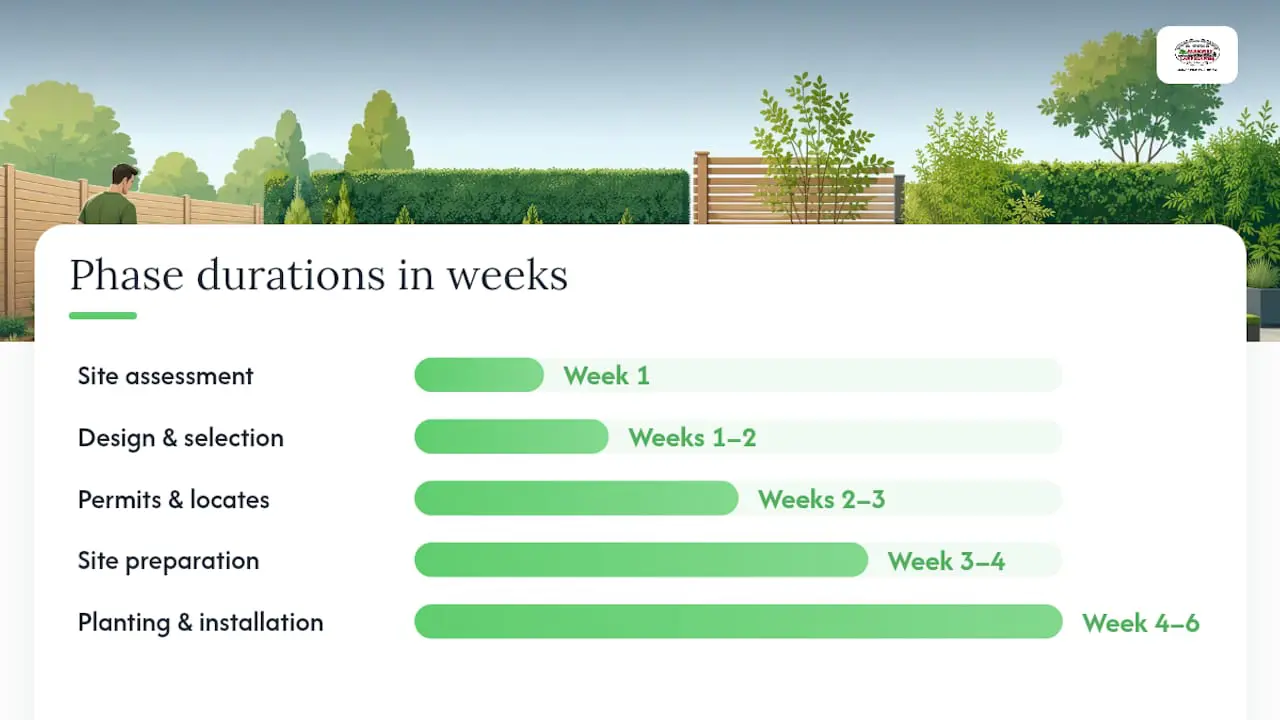
Site assessment (Week 1): Walk the yard and identify every sightline you want to block. Mark the source of each unwanted view (neighbor’s window, street, adjacent property) and measure the distance and height. Photograph the problem areas from your patio or seating zone.
-
Design and plant/material selection (Weeks 1–2): Choose your barrier type (living screen, hardscape, or hybrid) based on your timeline, budget, and site conditions. Select species appropriate for your USDA hardiness zone, soil type, and sun exposure. For most New Jersey yards (Zones 6–7), Green Giant arborvitae is the default fast evergreen; Wax Myrtle works in the warmer pockets of Zone 7 with protection.
-
Permits and utility locates (Weeks 2–3): Submit any required fence or wall permits. Call 811 at least three business days before digging.
-
Site preparation (Week 3–4): Mark planting locations with stakes and string. Amend soil as needed (compost for clay-heavy soils; organic matter for sandy soils). For hardscape, excavate post holes or foundation footings per plan.
-
Planting and installation (Week 4–6): Dig planting holes two to three times the width of the rootball and the same depth. Set the rootball so the top sits at or slightly above grade. Backfill with native soil, tamp gently, and water thoroughly. Apply 3–4 inches of mulch in a ring around each plant, keeping mulch away from the trunk.
-
Irrigation setup (Week 4–6): Install drip irrigation or soaker hose along the planting row. TreeGator slow-release watering bags work well for individual trees during the first two summers. Consistent moisture during the first growing season is the single biggest factor in establishment success.
-
First-year care (Months 1–24): Water deeply once or twice per week during dry periods. Do not fertilize heavily in the first year; let roots establish. Monitor for deer browse, insect pressure, and disease. Stake tall trees in exposed locations for the first 12–18 months.
Sample timeline:
-
0–3 months: Hardscape and prefab screens fully functional; newly planted trees 3–5 feet tall with minimal screening effect.
-
1–2 years: Green Giant arborvitae reaches 8–12 feet; partial screening effective from most angles.
-
3–5 years: Mature screen established; full year-round privacy from living plants.
Pro Tip: Plant fast-growing deciduous trees like hybrid poplar or river birch as temporary fill-in screens alongside your permanent evergreens. They give you summer privacy immediately while the arborvitae grows. Once the evergreens reach screening height, you can remove the temporaries or let them coexist.
For low-maintenance landscaping approaches that reduce long-term upkeep, choose species matched to your site conditions rather than fighting soil or sun exposure with high-maintenance plants.
When should you hire a professional for your privacy project?
Some privacy projects are straightforward DIY work. Others involve enough complexity, permitting, or physical risk that hiring a professional saves money in the long run.
Triggers for hiring a pro:
-
The project involves masonry walls, retaining walls, or significant grading
-
You need permits and are unfamiliar with the local application process
-
The site has drainage problems, steep slopes, or utility conflicts
-
You want an integrated design that combines hardscape, planting, and irrigation
-
The project is large enough that plant or material mistakes would be expensive to correct
Questions to ask any contractor before signing:
-
Can you provide a portfolio of completed privacy projects similar in scope to mine?
-
Are you licensed and insured in New Jersey? Can you provide certificates?
-
Will you pull the required permits, and is that included in the quote?
-
What is the planting or installation warranty, and what does it cover?
-
Who will be on-site daily, and how do you handle unexpected site conditions?
-
What is the payment schedule, and do you provide a written contract?
A note on contractor selection: The cheapest quote is rarely the best value for masonry or large-scale planting projects. A contractor who pulls permits, carries liability insurance, and provides a written warranty protects you from costs that can far exceed the difference in price. Ask for references from projects completed in the past 12–24 months, not just a portfolio of photos.
For homeowners in Morris and Somerset Counties, Fernandez & Sons’s Morristown landscaping services offer a local reference point for what a professional privacy installation looks like from design through completion.
DIY vs. hire a pro:
-
DIY is reasonable for: planting a row of arborvitae on flat ground, installing prefab fence panels, setting up container screens, and basic lattice trellis work.
-
Hire a pro for: masonry walls, retaining walls on slopes, integrated irrigation systems, projects requiring permits, and any work near utilities or property lines in dispute.
What most homeowners get wrong about privacy landscaping
The biggest mistake is treating privacy landscaping as a one-time purchase rather than a multi-year project. Homeowners who plant a single row of fast-growing trees and expect a finished result in one season often end up with a patchy, uneven screen that requires constant intervention. The species that grow fastest — Leyland cypress, running bamboo, hybrid poplar — are also the ones most likely to create problems within a decade.
The more durable approach is to accept that a living screen takes time and to design for the end state, not the first year. Plant at proper spacing for mature size, not for immediate density. Use temporary screens or fast deciduous fill-in plants to bridge the gap. Choose species that fit your actual soil, sun, and deer conditions rather than the ones that look best at the nursery in spring.
Site-specific planning matters more than any plant list. A yard with heavy deer pressure, clay soil, and partial shade needs a completely different species selection than a sunny, well-drained yard in a low-deer suburb. HOA rules and local fence height limits can eliminate options before you even get to plant selection. Getting those constraints on paper first, before spending money, is the step most homeowners skip.
Fernandez & Sons brings privacy landscaping expertise to Morris and Somerset Counties
For homeowners in Morris and Somerset Counties, NJ who want a privacy solution that is built to last, Fernandez & Sons delivers the full range of services this kind of project requires: masonry privacy walls, hardscape panel installation, retaining wall designs for sloped sites, landscape planting and design, and integrated outdoor living spaces that combine screening with patios, fire pits, and gathering areas.
What sets Fernandez & Sons apart is the ability to handle every layer of a privacy project under one contract. Rather than coordinating a mason, a landscaper, and a fence contractor separately, you get a single team with over a decade of experience designing and building outdoor living spaces that function beautifully year-round. Every project starts with a free estimate and is backed by a satisfaction guarantee.
If you are ready to stop looking at your neighbor’s yard and start enjoying your own, contact Fernandez & Sons to schedule your free on-site estimate. The team serves homeowners across Morris and Somerset Counties and brings the same craftsmanship to a single masonry wall as to a full backyard transformation.
Supporting Resources
The sources below back the plant growth rates, design principles, and permit guidance covered in this article. Use them to verify zone-specific plant selections, confirm local zoning requirements, and explore design approaches in more depth.
Pro Tip: For zone-specific plant selection, cross-reference the Missouri Botanical Garden’s plant finder with your USDA hardiness zone map. The USDA Plant Hardiness Zone Map is available free at planthardiness.ars.usda.gov and was updated in 2023 to reflect current climate data.
For homeowners in New Jersey: Local zoning rules vary significantly between municipalities. The Wayne Township FAQ is a useful model for what to look for, but always verify fence height limits, setback requirements, and permit triggers directly with your own town’s planning or zoning office before starting any project.