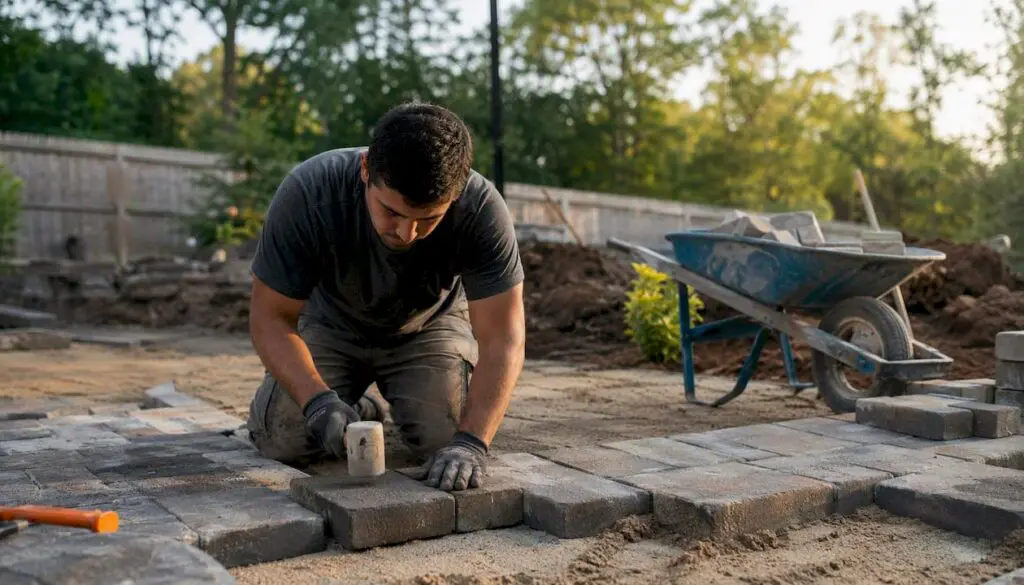
Professionally installed paver patios in New Jersey typically run $12–$59 per square foot, with most suburban backyard projects landing in the $15–$40 per square foot range once base prep, labor, and edging are included. That spread is wide because the variables are real: material choice, site conditions, and design complexity each move the number meaningfully.
To put that in practical terms:
-
Small patio (~200 sq ft): Roughly $3,000–$8,000 installed, depending on material tier and site prep needs.
-
Medium patio (~400 sq ft): Most commonly $6,000–$16,000, with mid-range concrete pavers and standard base prep landing near the middle of that band.
Two immediate next steps before you call a single contractor: check your township’s zoning ordinance for impervious surface limits (more on this in the permits section), and plan to collect at least two written, line-item bids so you can compare scope, not just price.
At a Glance
Installed paver patio costs in New Jersey typically run $12–$59 per square foot, with most mid-range suburban projects landing between $15–$40 per square foot depending on material, base prep, and site conditions.
| Point | Details |
|---|---|
| NJ cost range | Installed paver patios run $12–$59/sq ft; most mid-range projects land $15–$40/sq ft. |
| Biggest cost driver | Base depth and quality matter more than any other line item for long-term patio performance in NJ. |
| Permit requirement | Most NJ towns require zoning review for ground-level patios; check impervious surface limits before finalizing size. |
| Comparing bids | Normalize quotes by specifying the same paver product, base depth, edge restraint, and permit responsibility across all bids. |
| Fernandez & Sons | Provides free line-item estimates with permit guidance, satisfaction guarantee, and over a decade of experience in Morris and Somerset Counties. |
Table of Contents
-
What Factors Drive Your Total Paver Patio Cost in New Jersey?
-
Paver Patio vs. Concrete Patio: Which Makes More Sense for NJ Homeowners?
-
How to Compare Paver Patio Estimates and Choose the Right NJ Contractor
-
What Is the Typical Installation Timeline for a Paver Patio in NJ?
-
Fernandez & Sons Brings Local Expertise to Your Patio Project
What Does a Paver Patio Cost in NJ? Ranges by Project Size
New Jersey paver pricing runs roughly 18% above the national average, driven by regional labor rates and material supply costs, particularly in towns close to the NYC metro corridor. Morris and Somerset County homeowners generally see mid-range pricing compared with shore communities or Bergen County.
The installed cost ranges by material tier and common project sizes vary significantly depending on materials and design complexity. What each tier typically includes:
-
Budget: Standard concrete interlocking pavers, 4–6 inch compacted gravel base, basic running-bond pattern, plastic edge restraint, jointing sand.
-
Mid-range: Brick or premium concrete pavers, 6–8 inch base, more complex pattern (herringbone or basket weave), steel edge restraint, polymeric jointing sand, optional sealant.
-
Upscale: Natural stone (bluestone, flagstone, travertine), engineered base, custom pattern or inlay, full sealant, integrated drainage, and often added features like seat walls or steps.
Per-square-foot costs drop slightly on larger projects because mobilization, delivery, and base-prep costs spread across more square footage. A 1,000 sq ft job rarely costs five times a 200 sq ft job from the same crew.
Mid-range paver patios in New Jersey commonly fall between $4,000 and $8,000 for modest projects, while upscale builds with seat walls, fire features, or steps can exceed $8,000–$20,000 depending on size and complexity.
How Does Material Choice Affect Paver Patio Prices in NJ?
Material selection is the single fastest way to move your per-square-foot number up or down. Here is how the main options break down for New Jersey homeowners, keeping in mind that installed costs in Newark model around $22 per sq ft with a practical range of $16–$35 per sq ft depending on tier and base prep.
-
Concrete pavers: The most popular choice for NJ backyards, typically $12–$22 per sq ft installed. They come in a wide range of colors, textures, and formats, hold up well through freeze-thaw cycles, and are easy to replace individually if one cracks. Large-format concrete pavers (24×24 inches and up) add labor cost because each piece requires more precise leveling.
-
Brick pavers: Often priced moderately higher than concrete pavers. Brick offers a classic, warm aesthetic that suits older NJ homes well. It is denser than concrete and highly durable, though the color palette is narrower. Reclaimed brick adds character but requires more careful sorting and fitting, which can increase labor.
-
Natural stone (bluestone, flagstone, travertine): Generally commands a premium installed cost in New Jersey. Bluestone is particularly popular in Morris and Somerset Counties for its clean, gray-blue tone and regional availability. Irregular flagstone requires more skilled labor to fit and level, increasing installation complexity. Travertine looks attractive but needs sealing in NJ’s wet winters to prevent freeze-thaw damage.
-
Permeable pavers and specialty systems: Generally $18–$35 per sq ft installed. These systems allow stormwater to pass through the joints and into a designed aggregate base, which can be attractive when a township’s impervious surface limits are close to the edge. Some municipalities offer expedited zoning review for permeable installations. See the patio installation NJ guide for a deeper look at material comparisons.
Pattern complexity adds to labor regardless of material. A simple running bond is the baseline. More intricate patterns like herringbone, basket weave, or custom inlays increase labor and time requirements. Large-format pavers in any material also tend to raise labor costs due to complexity.
Pro Tip: If you love the look of natural stone but want to keep costs closer to the mid-range, consider a bluestone border with concrete paver field — you get the visual focal point of stone at the edges without paying stone prices for every square foot.
What Factors Drive Your Total Paver Patio Cost in New Jersey?
Understanding what moves a quote up or down helps you read bids critically and have a productive conversation with any contractor.
-
Site prep and excavation: Sloped yards, tree roots, or an existing concrete slab that needs breaking and hauling away all add cost. Removing a 400 sq ft concrete slab, for example, typically adds $500–$1,500 to a project before a single paver is set.
-
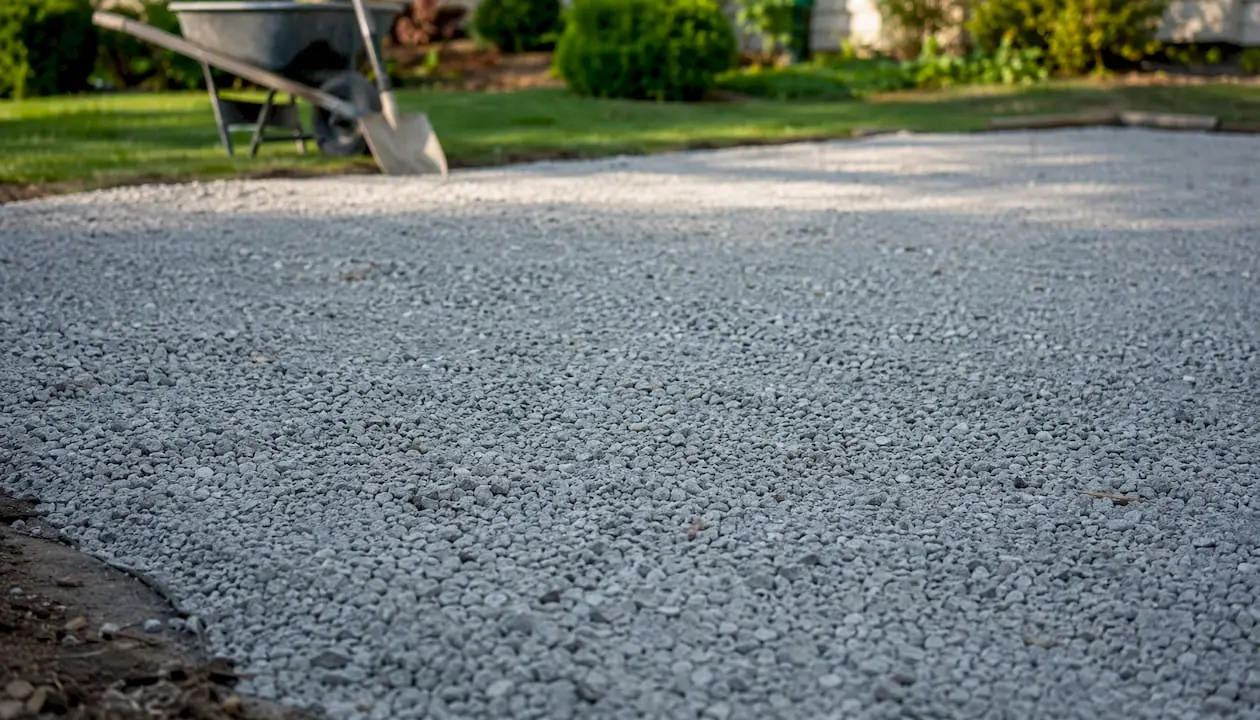
Base depth and quality: This is the biggest long-term cost driver on any NJ patio job. New Jersey’s freeze-thaw cycles demand a properly compacted granular base, typically 6–8 inches for a ground-level patio. Inadequate base depth is the most common cause of early paver failure and costly repairs. Cutting corners here saves a few hundred dollars upfront and costs thousands later.
-
Drainage and grading: Flat or low-lying yards often need engineered grading, channel drains, or linear drains integrated into the patio design. A simple surface-slope correction might add $300–$800; a full channel drain system with outlet piping can add $1,500–$3,500 depending on run length.
-
Access and logistics: A backyard accessible only through a narrow gate or side yard requires wheelbarrow runs for every load of base material and pavers. That adds hours of labor. Homeowners in HOA communities may also face restrictions on staging materials or equipment on driveways.
-
Pattern complexity and edge restraints: As noted above, herringbone and custom inlays add labor. Steel or aluminum edge restraints hold better than plastic over time and cost slightly more, but they are worth specifying.
-
Added features: Outdoor living additions like seat walls, low retaining walls, fire pits, steps, and outdoor kitchens each carry their own cost and, in many cases, their own permit requirements. A single step typically runs $300–$600; a seat wall adds $50–$100 per linear foot; a fire pit pad and surround can add $2,000–$6,000 depending on materials and gas connections.
-
Seasonal and frost-protection factors: NJ’s frost depth for footings on covered structures often requires substantial depth, which raises material and labor costs compared with frost-free regions. Ground-level patios do not require frost footings, but the base must still accommodate freeze-thaw movement. Projects started in late fall may require additional measures to protect freshly set base material, which can add cost or delay completion.
NYC-adjacent towns in northern NJ push labor rates higher than inland Morris and Somerset County locations, so the same scope can cost noticeably more in Montclair than in Randolph.
Sample Line-Item Budget for a 400 Sq Ft Paver Patio
This example models a typical NJ suburban backyard project: flat ground-level patio, minimal grading, no attached structures, standard concrete pavers in a herringbone pattern, and a 6-inch compacted gravel base. Assumptions are based on mid-range pricing for Morris and Somerset Counties.
| Line Item | Estimated Cost | Notes |
|---|---|---|
| Paver materials (400 sq ft) | $1,800–$3,000 | Concrete pavers at $4–$7/sq ft material cost |
| Base material (gravel, 6-inch depth) | $600–$1,000 | Compacted crushed stone; deeper base adds cost |
| Bedding sand (1-inch layer) | $150–$220 | Coarse concrete sand, screeded level |
| Edge restraint (perimeter) | $200–$400 | Steel or aluminum preferred over plastic |
| Labor (excavation, base, setting, finishing) | $3,200–$6,000 | $8–$16/sq ft labor; herringbone adds ~$1/sq ft |
| Jointing sand (polymeric) | $150–$300 | Polymeric sand resists weeds and ants better |
| Delivery and staging | $200–$400 | Varies by access and material weight |
| Sealant (optional, first application) | $300–$600 | Recommended for travertine and lighter pavers |
| Permit and zoning review | $150–$500 | Varies by township; variance adds significantly |
| Contingency (5–10%) | $600–$1,200 | Covers unexpected drainage, roots, or soil issues |
| Estimated Total | $7,350–$14,000 | Mid-range concrete pavers, standard NJ suburban site |
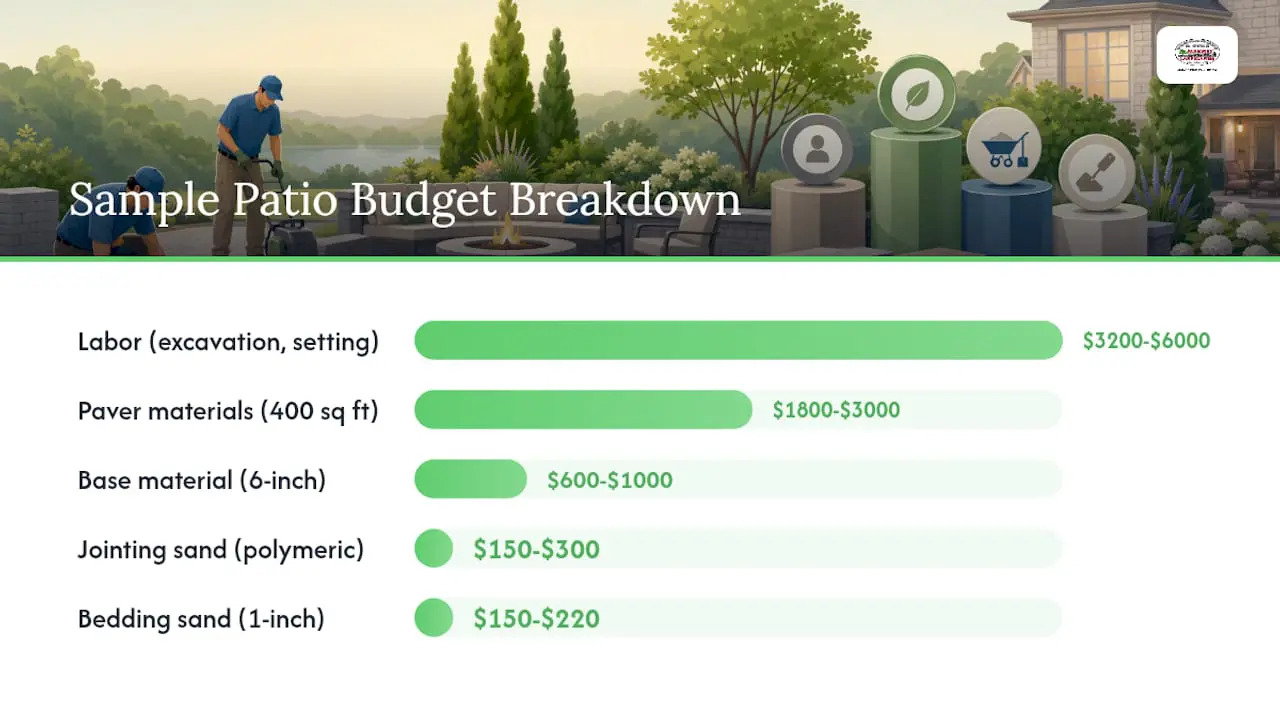
A detailed line-item breakdown like this is one of the most trust-building things a contractor can provide, because it makes tradeoffs visible. When you receive an estimate, ask for quantities (square footage of pavers, tons of base material), the specified paver product or photo, base-depth spec, compaction method, and a line for permit costs.
Trust signals to request from any contractor before signing:
-
Proof of general liability insurance and workers’ compensation coverage
-
NJ Home Improvement Contractor (HIC) registration number
-
Written scope of work with the line items above
-
Warranty or satisfaction guarantee terms in writing
-
Timeline with start date and estimated completion
Paver Patio vs. Concrete Patio: Which Makes More Sense for NJ Homeowners?
Both options are popular in New Jersey, and the right choice depends on your budget, aesthetic goals, and how long you plan to stay in the home.
-
Upfront cost: Poured concrete typically runs $8–$18 per sq ft installed in NJ, making it cheaper than most paver options at the same project size. Stamped or colored concrete narrows the gap with mid-range pavers, often landing at $15–$25 per sq ft installed.
-
Durability in NJ’s climate: Both materials handle freeze-thaw cycles when properly installed. Concrete, however, tends to crack over time as the slab shifts with ground movement. Individual pavers flex slightly with the base and rarely crack; when one does, it can be replaced without disturbing the rest of the surface.
-
Repairability: This is where pavers clearly win. Replacing a cracked or stained paver costs $50–$200 for a small area. Repairing a cracked concrete slab typically means grinding, patching, or full resurfacing, which can run $1,000–$5,000+ depending on the extent of damage.
-
Aesthetics and resale value: Pavers offer more design flexibility, a higher-end visual impression, and tend to photograph better for real estate listings. Stamped concrete can look similar initially, but color fades and surface sealers wear, requiring periodic reapplication.
-
When concrete makes sense: For a large, simple surface (a pool deck surround, for example) where budget is the primary driver and the design is straightforward, poured concrete can deliver solid results at lower cost. Pool deck cost in NJ follows similar per-square-foot logic, though pool surrounds often require specific drainage slopes and non-slip finishes that add to any material’s installed price.
For most NJ homeowners who want a gathering space that holds its value and handles the climate well, pavers justify the premium over basic concrete.
When Do You Need a Permit for a Paver Patio in New Jersey?
Permitting is the area where homeowners most often get surprised, and the rules vary more than most people expect.
-
Check zoning first, always. Most New Jersey municipalities require at least a zoning review for a ground-level patio to confirm lot coverage and setback compliance. This is separate from a building permit and is enforced by the zoning officer, not the construction code official.
-
Understand impervious surface limits. Your lot has a maximum percentage of impervious coverage (driveways, roofs, existing patios, walkways all count). If your new patio pushes you over that limit, you need either a variance or a reduction elsewhere on the property. Variances can take 2–4 months and cost $500–$2,000 in fees and escrow.
-
Building permits apply to specific conditions. A building permit is generally required for raised patios (typically over 30 inches above grade), covered structures, retaining walls above local height thresholds, and any work involving gas lines or electrical for outdoor kitchens or fire features.
-
Zoning and construction code are separate systems. A project can be exempt from the Uniform Construction Code but still require zoning approval. Jersey City’s construction code FAQ makes this explicit: even where a construction permit isn’t required for a simple ground-level paver installation, a zoning determination is often necessary before work begins.
-
Frost-depth requirements add cost for covered structures. NJ frost depth commonly runs 30–36 inches, which means any footing for a covered patio or pergola must go deep, raising material and labor costs compared with frost-free regions.
-
Unpermitted work creates real risk at resale. A buyer’s home inspector or attorney will flag unpermitted improvements. Retroactive permits, if available, often require opening up finished work for inspection.
Homeowner checklist:
-
Visit your township’s zoning office or website before finalizing your patio design.
-
Ask your contractor explicitly who will pull permits and request copies of all applications and approvals.
-
Confirm your lot’s impervious surface allowance before sizing the patio.
-
Budget $150–$500 for standard permit fees; add a variance contingency if your coverage is close to the limit.
How to Compare Paver Patio Estimates and Choose the Right NJ Contractor
Getting three bids is standard advice. Getting three comparable bids is what actually protects your budget.
-
Request line-item estimates. A complete bid should specify: paver product name or photo, square footage, base depth and material (crushed stone type and depth in inches), compaction method (plate compactor passes or machine type), edge restraint type, pattern, jointing sand type, sealant (included or optional), demolition of existing surface if applicable, permit cost responsibility, cleanup, and warranty terms.
-
Ask these questions of every contractor:
-
How many crew members will be on site, and what is the realistic timeline from start to finish?
-
Who pulls the permits, and will you provide copies of all approvals?
-
What is your change-order process if unexpected site conditions arise?
-
What is the payment schedule? (A large upfront cash-only deposit is a red flag.)
-
Can you provide references from similar NJ projects completed in the last 12 months?
-
-
Watch for red flags in bids:
- Base depth under 4 inches for a NJ ground-level patio (inadequate for freeze-thaw).
-
No edge restraint specified or listed as “optional.”
-
Vague scope language like “install pavers per homeowner’s request” with no material or depth specs.
-
Requests for more than 30–40% upfront before any work begins.
-
-
Normalize bids for a true comparison. Build a simple matrix: list each contractor across the top and each scope item down the side (same paver product, same base depth, demolition included, sealant, edging, permit). A bid that looks $1,500 cheaper may be missing the permit cost, sealant, or a proper base spec.
-
Negotiation levers that do not compromise quality:
- Simplify the pattern (running bond instead of herringbone saves labor).
-
Choose a standard paver size rather than large-format.
-
Offer scheduling flexibility — contractors who can fill a gap in their calendar sometimes sharpen pricing.
-
Ask whether homeowner-coordinated material delivery reduces the quote.
-
Considering whether to hire a contractor or attempt the work yourself? The DIY vs. contractor comparison breaks down where professional installation pays for itself in NJ conditions.
What Is the Typical Installation Timeline for a Paver Patio in NJ?
Setting realistic expectations about timing prevents frustration, especially when permitting is involved.
-
Estimate and permitting phase: Allow 1–2 weeks for an on-site estimate and proposal. Zoning review for a straightforward project typically takes 1–3 weeks; a variance adds 2–4 months. Budget this time before you expect shovels in the ground.
-
Material lead times: Standard concrete pavers are usually available within 1–2 weeks. Natural stone, large-format pavers, or custom colors can take 3–6 weeks to arrive, particularly in peak season.
-
Excavation and base work: For a 400 sq ft patio, excavation and base installation typically take 1–2 days with a standard crew. Larger projects or difficult access extends this.
-
Setting pavers and finishing: Paver installation on a 400 sq ft project usually takes 1–2 days for an experienced crew. Jointing, cleanup, and sealant application (if included) add another half to full day.
-
Total onsite time: Most small-to-medium NJ patio projects (200–600 sq ft) are completed in 3–5 working days once materials are on site and permits are in hand.
-
Seasonal scheduling tips for New Jersey:
-
Best months: April through October offer the most reliable installation windows. Spring and early fall are peak booking periods; expect longer lead times from April through June.
-
Late fall installations (October–November): Possible, but base material must be protected from freezing before it sets. Some contractors add a weather contingency clause.
-
Winter installations: Generally not recommended for new base work in NJ. Frozen ground prevents proper compaction, which leads to settling and paver movement once the ground thaws.
-
Off-season scheduling: Booking in February or March for a spring start sometimes allows more scheduling flexibility and occasionally better pricing, since contractors are filling their calendars before the busy season.
-
Permitting is the most common schedule risk on NJ patio projects. A simple zoning approval moves quickly; a variance or engineered stormwater plan can push your project start by months.
What Fernandez & Sons Routinely Sees on NJ Patio Jobs
After more than a decade working in Morris and Somerset Counties, a few patterns show up on nearly every project that homeowners did not anticipate.
The most common is base depth. Homeowners often receive a low bid that looks attractive on paper, only to discover after the fact that the contractor specified a 3–4 inch base rather than the 6–8 inches that NJ’s freeze-thaw conditions demand. The patio looks fine in year one. By year three, sections are rocking and joints are opening. The repair cost frequently exceeds what was “saved” on the original install.
Drainage surprises come second. A yard that drains fine without a patio often develops pooling once an impervious surface redirects runoff. Fernandez & Sons includes a site drainage assessment in every estimate, because catching this before excavation begins is far less expensive than adding a channel drain after the patio is set.
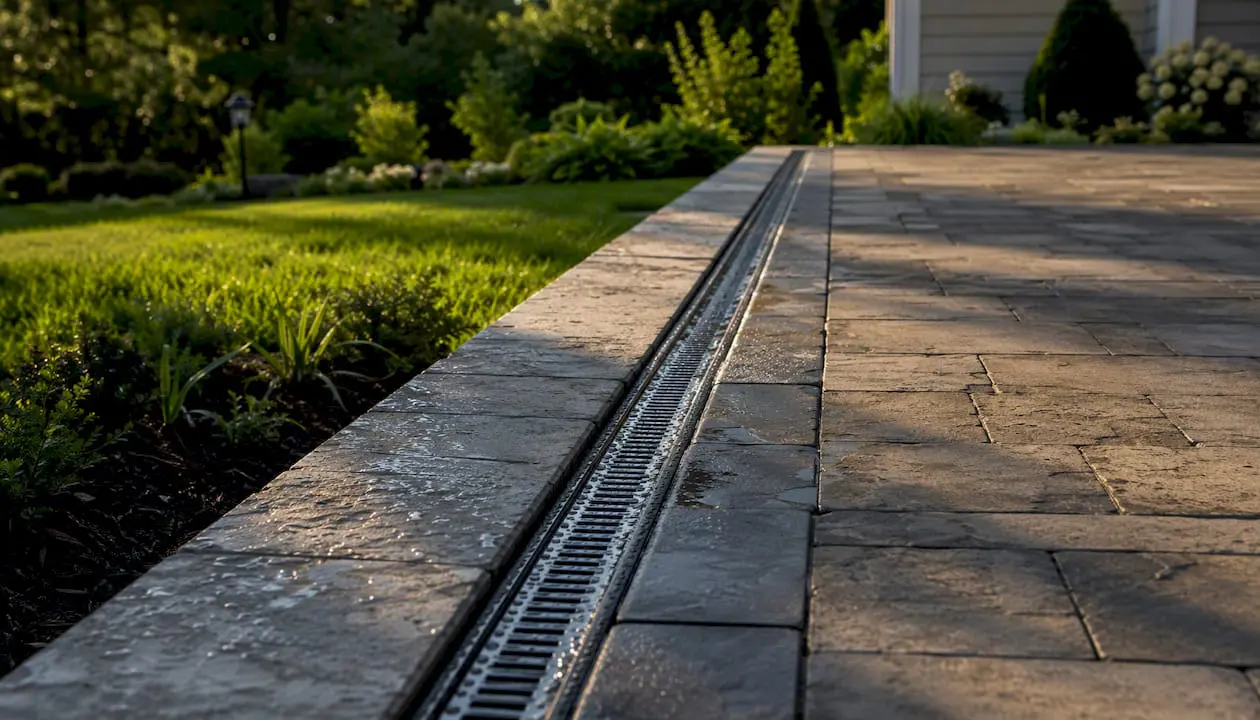
Permit surprises come third. Homeowners in townships with tight impervious surface limits sometimes discover mid-project that their planned patio size triggers a variance. Checking zoning before finalizing the design is a step Fernandez & Sons walks every client through during the free estimate visit.
Fernandez & Sons provides free, on-site estimates that include a written line-item scope, permit responsibility clarification, timeline, proof of insurance, and warranty terms. Every project comes with a satisfaction guarantee.
Fernandez & Sons Brings Local Expertise to Your Patio Project
For NJ homeowners who want a patio done right the first time, Fernandez & Sons Masonry & Landscaping has spent over a decade building outdoor living spaces across Morris and Somerset Counties. The difference between a patio that holds up through ten NJ winters and one that needs repairs in year two comes down to base depth, drainage planning, and material quality — exactly the details that get cut in a low-ball bid.
Fernandez & Sons’ free estimate includes a line-item scope covering paver product, base depth specification, edge restraint type, pattern, jointing sand, sealant options, permit responsibility, and a written timeline. Services extend beyond the patio itself: retaining walls, outdoor kitchens, fire pits, seat walls, lighting, and seasonal landscape maintenance are all available, so you can build the full outdoor living space in one coordinated project.
Ready to see what your backyard can become? Request a free on-site estimate and get a written, line-item scope from a licensed, insured contractor who has been serving Morris and Somerset Counties for over a decade. You can also explore the full range of masonry and landscaping services to plan your project from the ground up.
Additional References
Use these resources to verify permit requirements, run your own cost estimates, and confirm township-specific zoning rules before you finalize a design.
-
Paver Patio Cost in Newark, NJ (2026) — Free Calculator | HomeCostCalc
-
How Much Does It Cost to Install a Patio in New Jersey? – NJ Home Renovations and Improvements
-
Do I need a permit to install pavers or cement in my backyard? — Jersey City construction code FAQ