
Under Parsippany-Troy Hills Chapter 346, property owners and occupants must clear sidewalks, fire hydrants, and designated private areas after snow events, while the township handles public roads. To avoid liability, property managers should put a written seasonal contract in place that spells out storm triggers, response windows, insurance terms, and documentation requirements, with a local provider like Fernandez & Sons as one option for that coverage.
What to Know
Private property owners must clear sidewalks, hydrants, and designated areas within specified timeframes, as township plowing only covers public streets.
Snow pushed into streets or stored in unapproved areas violates local code, and the township can clear snow on private property with costs billed to owners.
Storm response triggers should be clearly defined in contracts using measurable accumulation levels and response windows to prevent billing surprises.
Liability rules require contracts to specify possession and control details, with documentation and service logs crucial for protecting against slip-and-fall claims.
Good pre-season planning includes site mapping, lease review, and clear communication to avoid common winter management mistakes and ensure legal compliance.
Parsippany-Troy Hills Chapter 346: who clears what, and by when
Chapter 346 places the clearing duty squarely on the people who own or occupy property abutting public streets, not on the township. The ordinance covers sidewalks, fire hydrants, and specific obligations for garden-apartment complexes, and it sets timeframes for action rather than leaving removal open-ended.
Practically, that means:
-
Owners, tenants, or occupants along public streets must remove snow and ice from abutting sidewalks within the window set by the code.
-
Fire hydrants on or near the property must stay clear so emergency crews can reach them promptly.
-
Garden-apartment complexes carry their own specific removal duties under the ordinance, separate from single-family and business properties.
-
The township can step in and remove snow itself when an owner fails to act, then bill the cost back along with penalties.
-
Depositing or pushing snow into a public street is prohibited under the code.
A single-family home, a garden-apartment complex, and a retail strip along Route 46 all fall under the same chapter, but the specific duties differ enough that a one-size-fits-all contract rarely works. Keep a copy of the ordinance link in the property’s winter operations file, since township notices sometimes phrase requirements a little differently than the code itself, and having the original language on hand settles any ambiguity fast.
Township versus private responsibility: where plowing coverage ends
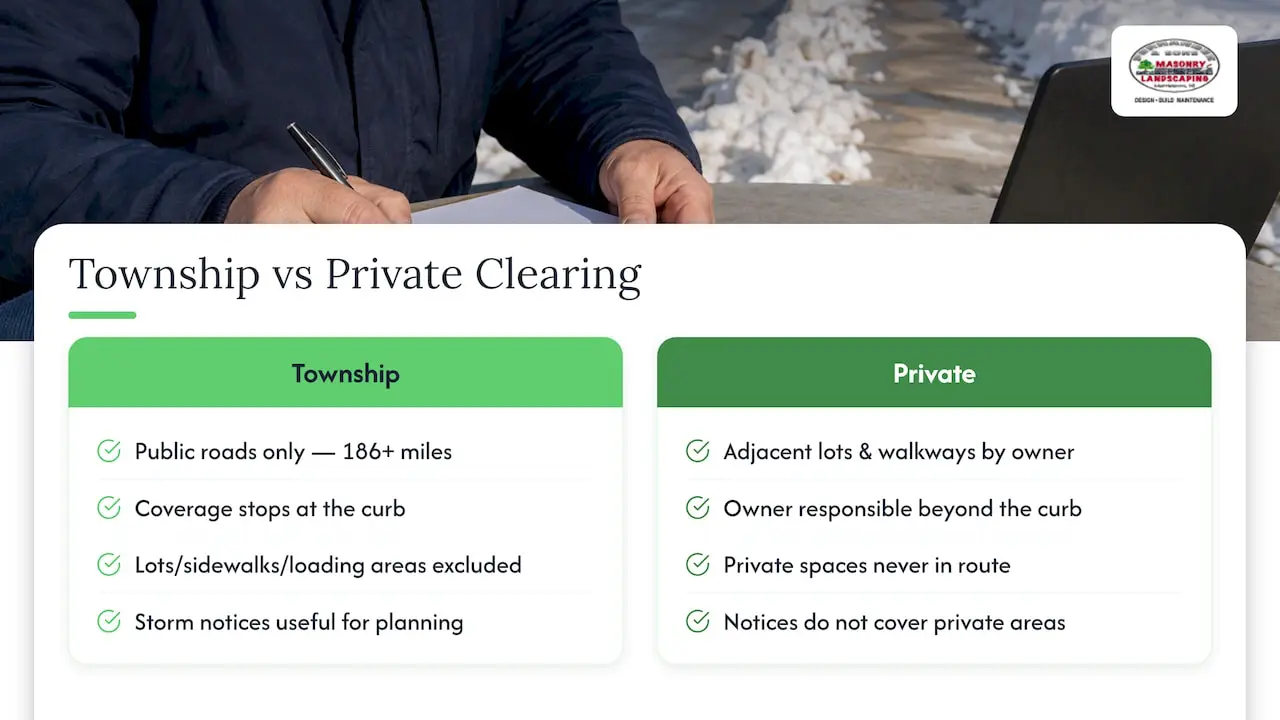
The Streets & Roads Division maintains, plows, and salts more than 186 miles of township roadway, publishing its own thresholds and priorities for when crews mobilize. That coverage stops at the curb. Private parking lots, sidewalks, loading areas, and fire lanes are never part of the township’s plowing route, no matter how promptly the public roads get cleared.
Many property managers assume that because a street looks plowed, the adjacent lot or walkway has been handled too. It has not, and that gap is exactly where a seasonal contract needs to start working. Township storm notices are useful for planning, since they often flag salting strategy and fleet status ahead of a storm, but they describe public operations only. Build your contract’s response triggers around the storm itself, not around when you notice township plows on your street.
What NJ case law means for your snow contract
Two New Jersey Supreme Court decisions shape how liability actually gets assigned when someone slips on a commercial or rental property, and both should inform how a contract reads.
Pareja v. Princeton International Properties adopted the “ongoing storm” rule in 2021: commercial landowners generally are not required to clear snow or ice while precipitation is still falling. The duty to act typically begins within a reasonable time after the storm ends, with two exceptions, when the owner’s own conduct increased the risk, or when a hazard already existed before the storm began. A contract that only promises “reasonable time after the storm” leaves that phrase open to interpretation during a dispute, so translate it into hours tied to accumulation bands instead.
Baldwin Shields v. Ramslee Motors addressed a different question: who holds the duty when a tenant has exclusive possession and control of a leased area. The 2020 decision found that lease language assigning maintenance to a tenant can shift responsibility away from the landlord for that specific space. That makes it worth checking that your lease and your snow contract agree with each other, because a mismatch between the two documents is where gaps in coverage tend to hide.
Practical takeaways: write possession and control clauses clearly in every lease, keep the right to inspect contractor work, and require proof of insurance and indemnity language in every snow agreement regardless of who signs it.
Building a snow removal contract that actually holds up
A contract built from a checklist is far easier to enforce, and far easier to bid out fairly, than one drafted from memory of last winter.
Before requesting bids, assemble:
-
A site map showing sidewalks, stairs, fire hydrants, ADA-designated spaces, drainage points, and approved snow-storage areas.
-
Paved-square-footage estimates for lots, drive aisles, and walkways.
-
A count of hydrants and accessible parking spaces that must stay clear at all times.
-
Any lease or association rules that already assign responsibility for specific areas.
-
Access restrictions, such as gated entries or tenant vehicles that need to be moved before plowing.
Once that data is in hand, the contract itself should define scope precisely: pretreatment before a storm, plowing thresholds, hand shoveling for stairs and entries, salting, hauling snow off-site when storage space runs out, and re-service triggers if a second wave of snow falls after the first pass. Spell out crew and equipment minimums, and state whether subcontracting is allowed.
Storm triggers belong in writing, not in verbal understanding. Define the accumulation depth that activates service, set a maximum response window after the storm ends, and designate where plowed snow can be piled, with a clear no-push-into-streets clause tied back to the township prohibition under Chapter 346.
Risk allocation closes the loop: require minimum insurance coverage, indemnity language, and a right to inspect work and request remediation if a pass misses an area. Some managers also negotiate a performance holdback tied to documented service quality.
Pro Tip: Ask every bidder for itemized pricing, including the unit cost of an extra push beyond the contracted number, so a mid-winter string of storms does not turn into a billing surprise.
When comparing bids, weigh itemized pricing against references, proof of insurance, the equipment list, and the length and renewal terms of the contract, not just the bottom-line seasonal rate. A property manager’s playbook for parking lot snow management walks through many of these same operational decisions in more depth.
Keeping records that hold up if something goes wrong
Good documentation does two things at once: it proves the work got done, and it protects the property if a claim ever gets filed. A simple inspection log covers most of what you need, logged timestamp by timestamp.
Each entry should capture:
-
The date and time of service, along with the crew or vehicle on site.
-
Which areas were cleared, including sidewalks, hydrants, and designated parking.
-
Materials applied, such as salt or brine, and the approximate quantity.
-
Weather conditions at the time of service and any re-service requests that followed.
-
Photos tied to the timestamp, showing cleared walkways, hydrants, and entry points.
Store logs and photos in a cloud folder organized by storm date, so a specific event can be pulled up quickly if a dispute arises. Appellate rulings in New Jersey have treated service contracts and subcontractor agreements as relevant evidence when courts apportion liability after a slip-and-fall claim, which makes a complete paper trail worth the small effort it takes to maintain.
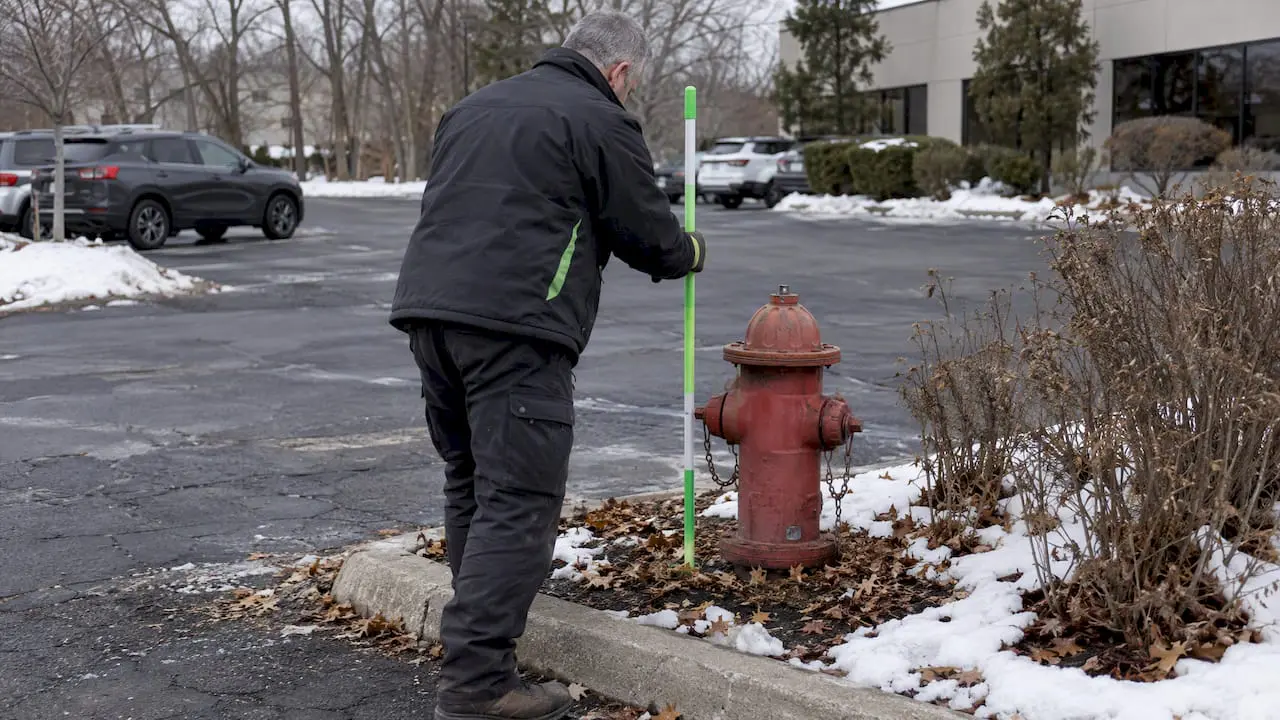
Beyond paperwork, a few operational habits reduce risk directly: mark hydrant locations clearly before the season starts, protect storm drains from being buried under plowed snow, coordinate with tenants on moving vehicles ahead of a storm, and confirm your approved snow-storage area before the first flakes fall rather than during the storm itself.
A local contractor’s view on getting ahead of winter
Every winter in Parsippany, the same few mistakes show up on properties that end up with complaints or claims: managers who assume the township’s plows will somehow cover a private lot, snow-storage areas that were never actually agreed on, and no inspection log to show what was done and when.
Before the season starts, walk the property and confirm hydrant access, pull together a site map, check that lease language matches what the snow contract actually covers, and collect emergency contact numbers for every unit or tenant. A short pre-season checklist like that catches most of the gaps before the first storm ever hits.
— BG
How Fernandez & Sons supports Parsippany property managers through winter
We provide commercial snow plowing and seasonal contracts built around the realities of Chapter 346 and New Jersey case law, not generic templates borrowed from another state’s rules. Property managers across Morris County, including Parsippany, work with us because the scope of work gets written down before the first storm, not figured out during one.

What that looks like in practice:
-
A written scope that matches both the ordinance and your property’s lease language, so there is no gap between what a tenant is responsible for and service coverage.
-
Documented service logs with timestamps and photos for every storm, stored and ready if a question ever comes up.
-
Proof of insurance provided, along with clear emergency callout terms for storms that exceed the original forecast.
-
Defined snow-storage locations and hydrant-clearing commitments built into the contract itself, not left to chance.
Onboarding starts with a free estimate and a walk-through of the property, where we map hydrants, ADA spaces, and snow-storage areas together before anything gets signed. If your property sits in Parsippany or elsewhere in Morris County and your current contract leaves gaps around storm triggers or documentation, request a free estimate for snow plowing services and we will put a scope in writing before the next storm arrives.
FAQ
How much is the average snow removal contract?
Pricing depends heavily on lot size, number of pushes included, and whether the contract is seasonal or billed per storm event. A guide to evaluating snow plowing bids breaks down the main cost drivers so you can compare proposals on equal terms, and a comparison of seasonal versus per-push pricing explains the tradeoffs between the two billing models.
Is Parsippany, NJ a rich area?
Parsippany-Troy Hills is a mixed residential and commercial township in Morris County with a range of property types, from single-family homes to garden-apartment complexes and office parks along major corridors. Property values and business density vary by neighborhood, which is part of why Chapter 346 sets separate rules for residential, garden-apartment, and commercial sites.
What happened in Parsippany, NJ today?
Winter storm activity and local updates are posted directly by the township through its storm notices and preparedness updates, which cover plow thresholds, salting strategy, and resident reminders ahead of a storm. Checking that page directly gives you the most current information rather than relying on secondhand reports.
Are landlords responsible for removing snow?
It depends on possession and control under the lease: the Baldwin Shields decision found that lease language assigning maintenance to a tenant can shift that duty away from the landlord for the specific area in question. Even so, landlords should keep inspection rights and require proof of insurance from whoever handles snow removal, since sidewalks abutting public streets can still carry separate obligations under Chapter 346.
Does a property manager need a written snow removal contract?
A written contract is the clearest way to define storm triggers, response windows, and documentation requirements before a dispute happens rather than during one. It also gives both parties, owner and contractor, a shared reference for what counts as compliant service under local rules like Chapter 346 and relevant New Jersey case law.