
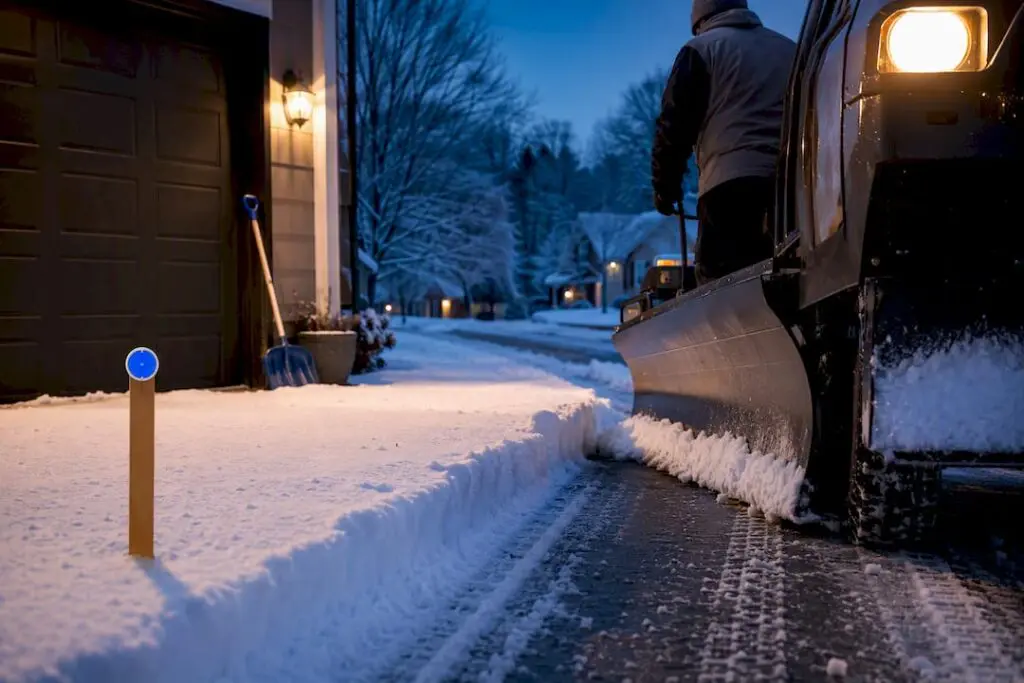
Book your seasonal snow plowing contract in early fall, ideally before the winter season starts, to lock in priority routing before the first storm hits Morris and Somerset Counties. Choose a seasonal flat-rate plan if your property sees frequent snowfall each winter, or a per-event agreement if storms are rare. Most residential contracts trigger service at 1 to 3 inches of accumulation, while commercial properties typically need lower thresholds and faster response times written into the agreement.
TL;DR:
Contract timing matters, and booking early in fall ensures priority routing and better pricing, especially for larger properties.
The trigger depth for plowing commonly ranges from 1 to 3 inches for residences and can be lower for commercial properties to meet safety standards.
Written service level agreements should specify trigger measurement methods, a clear completion window, and authority to call for service to avoid disputes.
Contractors must provide proof of insurance, recent equipment maintenance, and documented site plans; vague commitments or no SLA are red flags.
Storm response involves pre-treatment, timely plowing, de-icing, and post-storm cleanup, with documentation like photos crucial for liability and damage claims.
Table of Contents
When to Plow Snow: Comparing Service Options and Timing
The way you pay for snow removal changes when the plow shows up almost as much as the weather does. Four contract structures dominate the Morris and Somerset County market, and each one sets a different relationship between snowfall and service timing.
-
Seasonal flat-rate: One price covers the whole winter, regardless of how many storms hit. Contractors prioritize seasonal clients on their route because the revenue is locked in either way.
-
Per-event: You pay each time a qualifying storm triggers a visit. This works well in years with fewer than roughly 10 qualifying events, since seasonal plans favor predictable budgeting while per-event billing rewards a light winter.
-
Per-push: Similar to per-event, but billed by each individual plowing pass rather than the full storm cycle. Useful for properties with unpredictable traffic needs, like a retail lot that needs midday clearing on top of morning service.
-
Per-inch: Cost scales directly with accumulation, which rewards you in a light dusting but can get expensive fast in a heavy nor’easter.
Timing hinges on more than the contract type. Measurement method matters just as much. A contractor relying on a nearby weather station reading might dispatch crews later than one who sends a driver to physically check your lot, and that gap can mean the difference between a clear driveway at 6 a.m. and one still under two inches when you leave for work. Ask your contractor which measurement method triggers their dispatch before you sign anything.
What Snow Depth Triggers a Plowing Visit?
Trigger depth is the single most important number in any snow contract, and it belongs in writing, not in a verbal understanding from last October. Residential contracts commonly set the trigger between 1 and 3 inches. Commercial properties, especially those with public foot traffic or ADA-mandated accessible routes, often set it lower, sometimes calling for service at the first accumulation, because commercial SLAs commonly specify initiation at 1 to 3 inches with completion tied to business hours.
A workable SLA (service level agreement) spells out three things clearly:
-
The trigger depth in inches, measured by a named method (on-site gauge, contractor patrol, or a specified weather station).
-
The completion window, stated in hours after the storm ends. For example: “Service completed within 12 hours of snowfall cessation, or by 7 a.m. for residential driveways.”
-
The service initiator, meaning who has the authority to call for a plow. Options include the client requesting service directly, the contractor running scheduled patrols, forecast-triggered automatic dispatch, or a hybrid where the contractor monitors and the client can escalate.
The SIMA and ANSI procurement standard recommends naming this service initiator explicitly, because ambiguity here is exactly what causes 2 a.m. phone tag during a storm.
Pro Tip: Put the completion window in hours, not vague language like “promptly” or “as soon as possible.” A contractor who agrees to “within 12 hours of snowfall cessation” has something you can hold them to. One who agrees to “prompt service” has agreed to nothing.
How Do You Vet a Snow Removal Contractor?
A good plowing crew is easy to spot in March and nearly impossible to identify by a phone call alone. Run every candidate through the same checklist:
-
Confirmed general liability and auto insurance, with proof, not a verbal assurance.
-
Documented route capacity, meaning they can tell you approximately when your property falls in their storm sequence.
-
Recent equipment servicing records, since plow failures mid-storm are one of the most common reasons a “reliable” contractor leaves a lot half-cleared.
-
Local references from properties similar to yours, ideally within Morris or Somerset County.
-
A written site plan or map showing designated push zones and snow stacking locations before the season starts.
Nearly one in four New Jersey slip-and-fall claims tied to snow and ice hinge on whether the property owner or manager can show a documented, timely response. That documentation starts with the contract itself.
Your contract should spell out, at minimum: the scope of work and site map, trigger depth, SLA hours, designated push zones, whether snow hauling is included or billed separately, what de-icing material is used, when extra fees apply (a second storm within 24 hours, for instance), the procedure for reporting property damage, and how disputes get resolved. Explicit contract definitions for terms like “push zone” and “trigger depth” prevent billing arguments later.
Red flags include contractors who won’t commit to a written trigger depth, who can’t name their measurement method, or who ask you to “just call when it snows” with no defined SLA at all.
When Should You Start the Contract Process?
Snow contracts get finalized on a calendar that starts long before the leaves change color. For commercial portfolios and larger properties, procurement best practices call for starting RFPs by May and finalizing contracts by September 1, which allows time for site assessments and route allocation across a contractor’s full client list.
Homeowners can work on a shorter timeline, but early fall, before Halloween if possible, is the practical deadline.
-
May through July: Larger properties issue RFPs and begin comparing contractor proposals.
-
August through early September: Contracts get signed, site walkthroughs happen, and push zones get mapped before frost sets in.
-
Late September through October: Homeowners and smaller properties finalize agreements. This is also the last realistic window to flag drainage concerns or delicate landscape features.
Booking early does more than guarantee a spot on the route. It typically means better pricing and priority sequencing once the storms actually start.
What Happens During and After a Storm?
A well-run contractor treats a storm like a schedule, not an emergency. Expect a notice before the snow starts, a status update partway through if the storm runs long, and a rough arrival window rather than silence until the plow shows up in your driveway.
The typical operational sequence looks like this:
-
Pre-treatment application, if the contract includes it, applied before snowfall begins to prevent bonding to pavement.
-
One or more plowing passes, timed to the accumulation trigger written into your SLA.
-
De-icing material applied after the final pass.
-
A follow-up re-treatment if temperatures swing and refreeze becomes likely overnight.
New Jersey’s ongoing storm rule generally means property owners aren’t liable for icy conditions until the storm itself ends, but many local ordinances still require sidewalk clearing within 12 to 24 hours after snowfall stops. That window is worth confirming with your municipality, since Morris and Somerset County towns don’t all set identical deadlines.
Pro Tip: Ask your contractor whether they provide time-stamped completion reports or photos after each visit. That documentation is your best evidence if a damage claim or liability question comes up later.
Protecting Your Property Is as Important as Clearing It
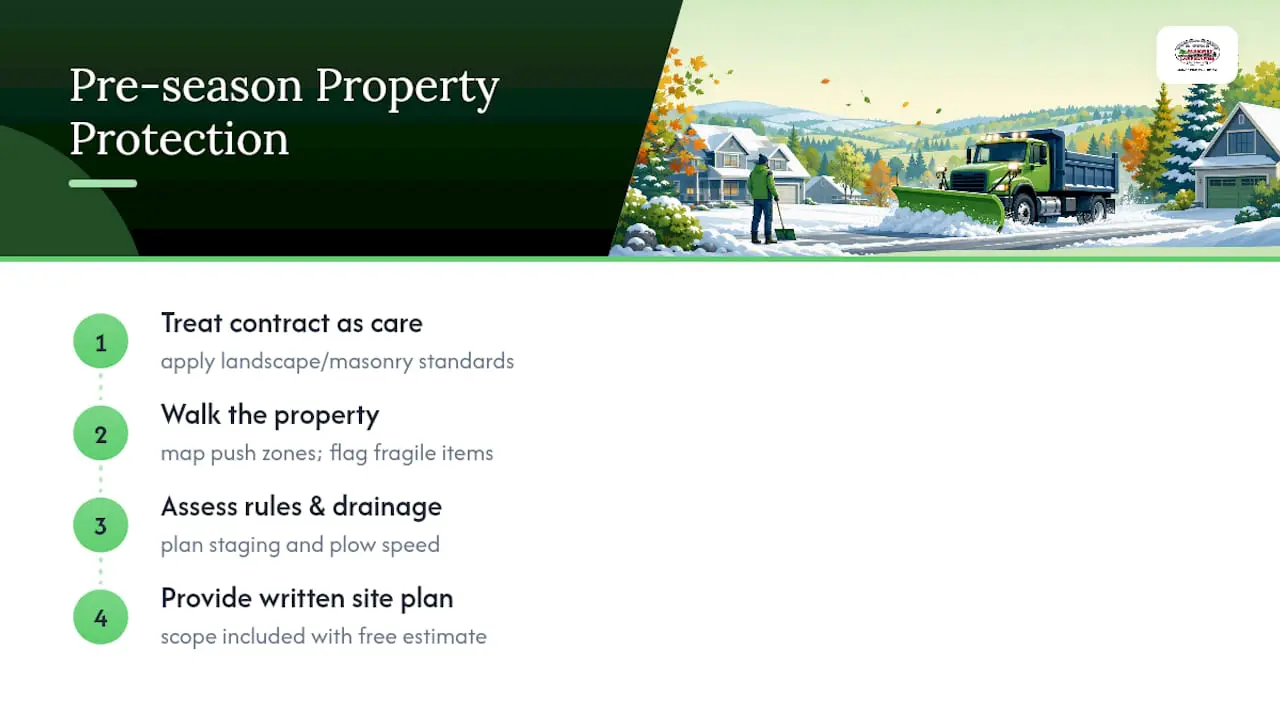
We treat every snow contract as an extension of professional landscape and masonry work built over many years in Morris and Somerset Counties. A plow blade that doesn’t know where your paver walkway ends and the lawn begins can do real damage, which is why we walk every property before the season starts to map push zones and flag anything fragile, from stamped concrete to a new retaining wall.
Local drainage patterns and municipal sidewalk rules vary block by block, and that affects where we stage snow and how fast we move. A written scope of work and site plan, typically part of a free estimate, keeps those decisions out of guesswork once the snow starts falling.
— BG
Get a Snow Removal Plan Built Around Your Property
A planned snow removal contract offers advantages over ad hoc service: a documented site plan that protects masonry, patios, and landscaping while keeping your property clear on a schedule agreed to in writing. Whether you need a seasonal contract for predictable winter budgeting or a per-event plan for a lighter snow year, crews with verified insurance working under defined SLAs provide more reliable service than vague promises.
We serve homeowners, businesses, and property managers across Morris County and handle everything from residential driveways to commercial lots that need faster response windows. If a recent storm damaged a walkway or patio edge, our masonry repair services can restore it before spring. Request a site estimate and obtain a written scope of work before the first flakes fall this season.
Sources
Review SIMA’s procurement standard, NJ premises-liability guidance, and for post-storm cleanup needs, see storm debris removal guidance.