
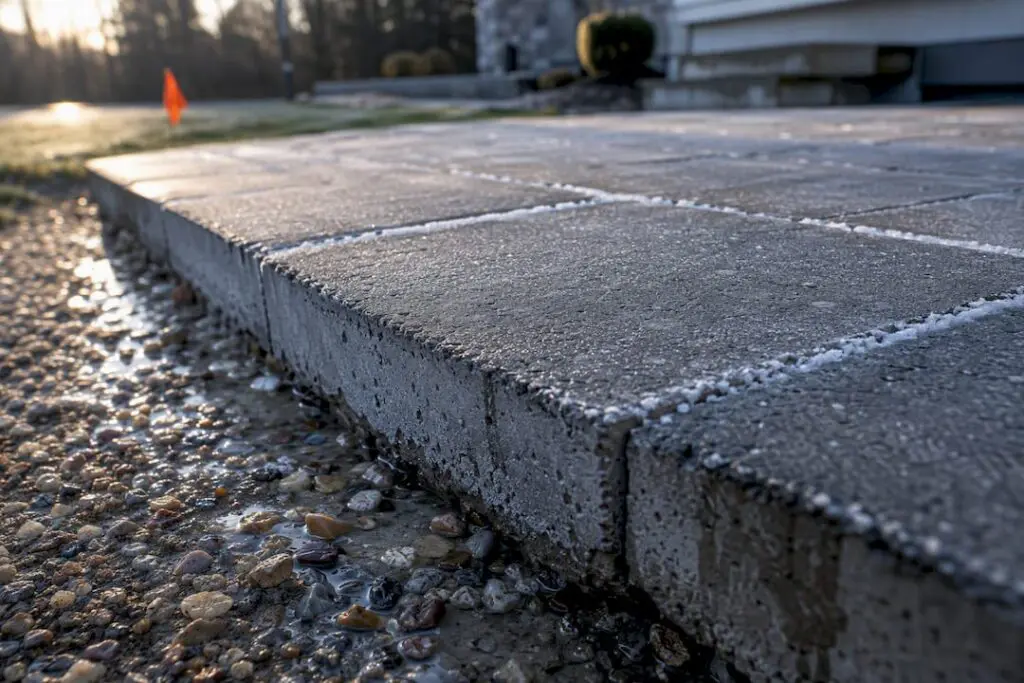
Yes, pavers hold up well in freeze thaw climates, but only when you choose frost rated, low absorption units and pair them with a base and drainage system built for the job. Material matters less than most homeowners assume. What actually determines whether your patio survives twenty New Jersey winters or starts heaving by year three comes down to what’s underneath it. If you inspect one thing before hiring anyone, inspect the base plan.
Proper base depth, drainage, and soil conditions are the most critical factors for long-term paver performance in cold climates, not the material alone.
Interlocking pavers excel at handling freeze-thaw cycles because their system distributes ground movement, and modular repairs are easier compared to concrete slabs.
Materials like porcelain and dense natural stones perform best when installed on well-prepared, frost-resistant bases; water absorption is a key factor for durability.
Installation quality, especially base compaction and drainage, largely determines success; shortcuts like shallow bases or improper grading cause early winter failures.
Regular maintenance, proper de-icer use, and inspections of joints and surface condition can prolong the life of paver systems in freeze-thaw conditions.
Table of Contents
How Freeze-Thaw Cycles Damage Paving Materials
Water does something strange when it turns to ice: it grows. Water expands by roughly 9% when it freezes, and that expansion inside a porous material has nowhere to go but outward, against the pores and microscopic channels holding it. The result is pressure. Enough pressure, repeated enough times, and you get the fine cracks and surface flaking that eventually show up as full-blown spalling.
One freeze event rarely breaks anything. Fifty of them will.*
This is why saturation level matters as much as the freezing itself. A paver that’s merely damp when temperatures drop tolerates the cycle fine. One sitting in standing water, or wicking moisture up from a soggy base, reaches critical saturation, and that’s when internal pressure exceeds what the material can absorb without cracking.
Deicing salts complicate the picture further. Chemical deicers don’t just melt ice. They can pull additional moisture into the material and trigger scaling and chemical attack on the surface, especially on concrete that wasn’t mixed with freeze thaw exposure in mind. FHWA’s technical guidance on pavement degradation points to air entrainment and controlled water to cementitious material ratios as the standard countermeasures, typically capping that ratio around 0.45 for concrete exposed to repeated freezing.
Three things drive the damage:
-
Pore pressure from ice expansion, concentrated wherever water has already soaked in
-
Cumulative microcracking that widens with every freeze and thaw, not just the first one
-
Deicer chemistry that increases saturation and accelerates surface scaling on unprotected concrete
Why Interlocking Pavers Usually Outperform Poured Slabs
A poured concrete slab is one continuous piece. When frost heave lifts part of it unevenly, the whole slab has to absorb that stress, and it usually cracks somewhere. Interlocking pavers spread that same stress across hundreds of small, independent units connected by sand joints, so ground movement gets distributed rather than concentrated.
That system-level design is the real advantage, not the material itself. A paver system built on a well-drained base flexes slightly with seasonal ground movement instead of fighting it. Poured concrete and asphalt, by contrast, rely entirely on the strength of one rigid sheet, and once that sheet cracks, your only real fix is replacing the section.
Interlocking systems also make repair proportional to the problem:
-
A handful of heaved or cracked units can be pulled, releveled, and reset without touching the rest of the patio
-
Joint sand and open assemblies give water more paths to escape rather than pool under the surface
-
Modular repair means a bad section doesn’t force a full rebuild the way a cracked slab does
None of that protects a paver installed on a shallow, poorly compacted base. Base and subgrade drainage quality is the single most critical factor in long-term paver performance, and even a premium frost rated unit will heave and shift if it’s sitting over saturated, frost-susceptible soil. The unit is the visible part. The base is what actually decides the outcome.
Choosing Materials That Handle Cold Climates
Material selection still matters. It’s just secondary to what’s happening below the surface. Here’s what to look for and avoid in each major category.
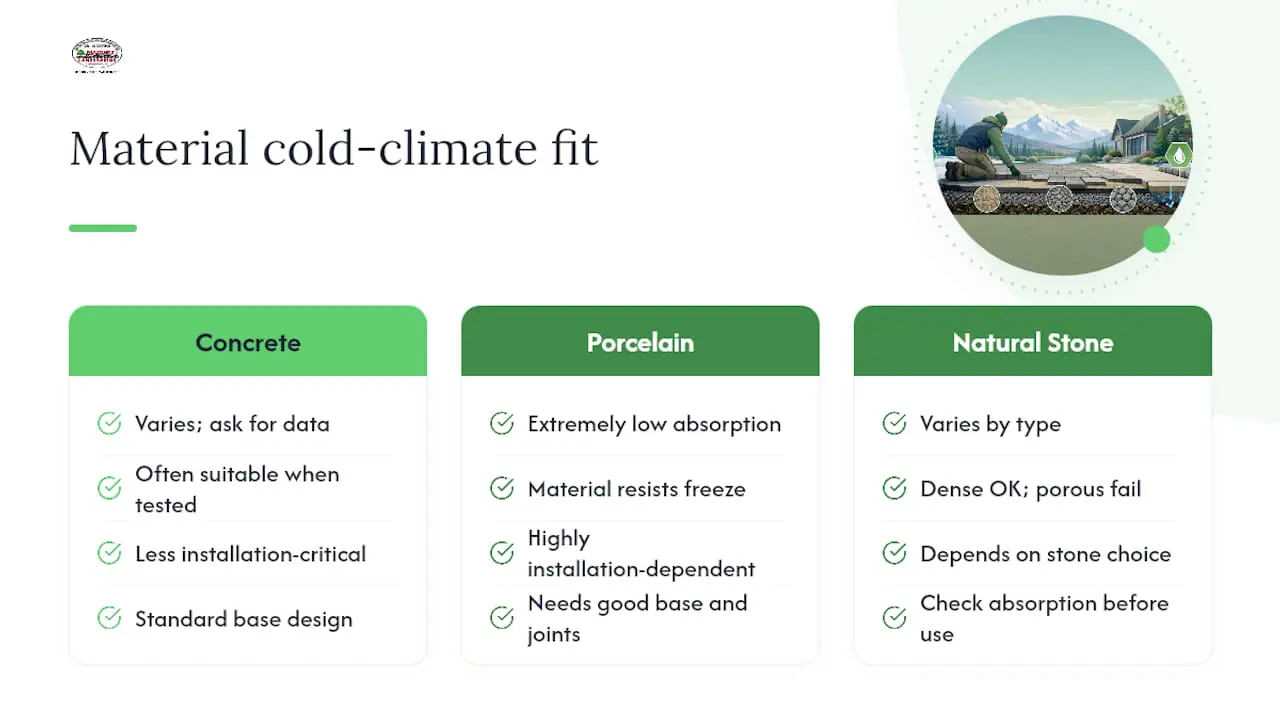
Concrete pavers remain the most common choice for cold climate driveways and patios, largely because manufacturing consistency has improved enough that quality units now specify their freeze thaw performance directly. Ask any manufacturer for water absorption data and confirmation that the product meets applicable specifications; ASTM C1782 governs segmental concrete slabs while ASTM C1645 and ASTM C936 cover broader concrete paver testing and properties. Skip anything the manufacturer can’t back up with test data.
Porcelain pavers bring a genuine edge here: extremely low water absorption, often a fraction of what standard concrete units allow, which limits how much moisture ever gets inside the material to freeze. But porcelain’s performance depends heavily on installation. Edge details, joint materials, and the supporting assembly still determine whether a porcelain installation survives its first decade, so a beautifully rated tile on a poorly built base offers no real advantage.
Natural stone varies enormously by type. Dense stones like granite and certain bluestones handle freeze thaw cycling well. Softer, more porous stones, some sandstones and certain limestones especially, absorb water readily and are poor candidates for exposed cold climate use. Always ask for water absorption figures before committing to a stone you haven’t seen perform through a New Jersey winter.
Permeable paver systems deserve a mention for stormwater management. They reduce runoff and surface ponding by letting water drain through the joints into an engineered stone base. The tradeoff is that they demand even more precise base design than standard pavers, since the entire system depends on that base draining correctly rather than holding water where it can freeze.
Getting Base Depth and Drainage Right
If there’s one lesson worth repeating from every failed patio callout, it’s this: the base does the work, and most winter failures trace back to a base that was too shallow, poorly compacted, or draining nowhere.
-
Match depth to use. Pedestrian walkways and patios typically need a moderate depth of compacted gravel base. Driveways and areas with light vehicle traffic require a thicker base, with these depths increasing in regions that experience deep frost or have weak, clay-heavy soils.
-
Choose the right base type. Dense-graded base compacts tighter and offers strong load support but holds more water. Open-graded base drains faster and resists frost heave better in wet sites, though it needs a firmer subgrade to perform well. Site conditions, not personal preference, should decide which one you use.
-
Separate and stabilize. A geotextile fabric layer between subgrade and base keeps fines from migrating upward and clogging your drainage stone over time.
-
Compact in real lifts. Base material should go down and get compacted in stages, not dumped in all at once and rolled over.
-
Give water somewhere to go. Every base needs a positive outlet, whether that’s a daylight drain, a French drain tie-in, or grading that carries subsurface water away from the structure rather than trapping it underneath.
Pro Tip: Ask your contractor what your local frost depth actually is before they quote a base thickness. Frost depth in northern New Jersey can run deeper than what a generic national guide assumes, and a base sized for a milder climate is one of the quiet ways patios fail early.
Installation Shortcuts That Cause Winter Failures
Most freeze thaw failures aren’t material failures. They’re installation failures that took two or three winters to become visible.
Watch for these red flags during a bid or a walk-through:
-
Base thickness that varies noticeably across the site instead of holding a consistent depth
-
Compaction done with a hand tamper instead of plate compaction on anything beyond a small walkway
-
Fine soil or clay mixed into the gravel base rather than kept fully separated
-
Edge restraints that stop short or leave gaps where pavers can migrate outward
-
Drainage paths interrupted by grading that slopes toward the house or a low spot instead of away from it
-
Bedding sand laid over ground that’s still frozen or saturated, which never compacts correctly
Ask any installer for their compaction specification and whether they proof-roll the base before laying pavers. A contractor who can’t answer either question plainly is one to reconsider.
Protecting Your Pavers Through Winter
Good installation buys you durability. Good maintenance keeps you from undoing it.
Sealing is worth a realistic conversation, not a blanket yes or no. A quality sealer can reduce surface absorption and make cleaning easier, but it needs reapplication every few years and won’t fix a drainage problem hiding underneath. Treat it as a maintenance layer, not a cure.
De-icing chemistry deserves real caution. Ammonium-based deicers are particularly damaging to concrete and should never touch a paver surface. Sodium chloride or calcium chloride, used sparingly, are the safer standbys, but even those work best paired with sand for traction rather than relying on chemical melt alone.
Snow removal habits matter more than most people expect:
-
Use a plastic-edged shovel or snowblower with a poly skid guard rather than a metal blade that can chip edges
-
Avoid piling snow against retaining edges, where meltwater refreezes and pushes against restraints
-
Don’t chip at ice directly on the paver surface, since that’s the fastest way to dislodge joint sand
Polymeric sand in the joints should get inspected each spring. If it’s washing out or crumbling, refill it before the next freeze cycle rather than waiting until joints have widened enough to let water straight down into the base.
Pro Tip: If you’re refilling polymeric sand yourself, do it on a dry day and sweep the joints completely before activating the sand with water. Sand applied over debris never bonds correctly, and it’ll wash out again by the next thaw.
Recognizing Damage and Knowing When to Call a Pro
Spalling, surface flaking, and units that sit noticeably higher or lower than their neighbors are the classic warning signs. So is persistent ponding after rain and joints that have visibly widened since last season.
-
Minor cosmetic issues, like a few chipped edges or slightly loose joint sand, are reasonable DIY fixes.
-
Uneven or heaving units usually mean the base has shifted, and pulling those pavers to check the base underneath is the right diagnostic step before doing anything cosmetic.
-
Widespread heaving, cracking, or repeated ponding points to a base or drainage design problem that needs excavation, not a surface patch.
Before hiring anyone for a rebuild, ask for their base specification, compaction records, and warranty terms in writing.
What We’ve Learned From Winter Callbacks
Base problems, not material problems, drive nearly every freeze thaw failure we get called out to fix around Morris and Somerset Counties. The soil here runs heavy on clay in plenty of neighborhoods, which holds water right where you don’t want it sitting through a January freeze. The fix is rarely complicated: deeper base, better drainage outlet, correct compaction. Proposals typically spell out base depth, drainage plan, and a maintenance schedule in writing, because a paver system is only as good as what’s documented before the first stone goes down.
Get Your Paver Project Built to Survive New Jersey Winters
A patio that looks great in July and heaves by February isn’t a bargain, no matter what it cost. Every paver installation should be built around the base and drainage design first, because that’s the part that decides whether your patio, walkway, or driveway is still flat a decade from now.

Our paver patio installation service covers proper base preparation, frost-rated material selection, and drainage planning suited to your property’s soil, not a generic national average. Many projects start with a free estimate, and some services are backed by satisfaction guarantees. If you’re planning ahead for winter, our masonry services page covers the full range of hardscape work we handle across Morris and Somerset Counties, from new installations to repairing pavers that were built on a shortcut base by someone else. Reach out for a free estimate and get a written base and drainage plan before anyone breaks ground.
Professional Sources
FAQ
Will paver efflorescence go away?
Efflorescence, the white powdery residue that sometimes appears on new concrete pavers, typically fades on its own within a year or two as excess lime works its way out, and it can be scrubbed with water and a stiff brush in the meantime.
What ice melter is safe for pavers?
Sodium chloride or calcium chloride, used sparingly, are the safer choices; avoid ammonium-based deicers entirely, since they’re particularly damaging to concrete and accelerate surface scaling.
What does freeze-thaw do to concrete?
Freezing water inside concrete’s pores expands by about 9%, building pressure that causes microcracking, spalling, and surface flaking, and the damage compounds with every freeze and thaw cycle over the material’s life.
Does polymeric sand harden like cement?
Polymeric sand hardens into a semi-rigid, water-resistant joint once activated with water, though it stays flexible enough to allow slight paver movement, unlike true cement, and it needs periodic refilling as joints wear or wash out over time.