

New Jersey contractors bidding snow removal work should check three sources every week during procurement season: NJSTART for state solicitations, the NJDOT contractor page and NJ Turnpike Authority postings for authority-level RFQs, and individual municipal bid pages for local contracts. Before submitting anything, have your Public Works contractor registration, current certificates of insurance, and completed bid forms (experience form, non-collusion affidavit, price sheet) ready to attach. Miss one of these and your bid gets tossed before anyone reads your price.
Quick Answer
Snow removal contracts in New Jersey are posted across state, county, and municipal portals, requiring consistent weekly monitoring of NJSTART, NJDOT, NJTA, and local bid sites.
Proper bid preparation demands current registration, insurance certificates, and complete forms, with attention to addenda and scope modifications to avoid disqualification.
Common contract types include per-push, per-inch, time and materials, seasonal, and hybrid models, each suited to specific property types and snowfall patterns.
Detailed property site surveys, accurate pricing based on lot size and access complexity, and clear proposal packaging significantly improve bid success chances.
Understanding legal, scope, and response-time clauses, along with compliance with Anti-Snow Dumping laws, is critical to prevent disputes and maintain profitability.
How Do You Find Snow Removal Contracts in NJ?
Every viable snow removal contract in NJ starts life as a public posting, and the state, county, and municipal levels each publish differently. Knowing which portal to watch, and how often, separates contractors who bid consistently from those who miss deadlines by a day.
NJSTART is where state agencies post nearly everything. It’s the Division of Purchase and Property’s eProcurement system, and solicitations for plowing, spreading, and hauling services appear there with full attachments, including the state-supplied price sheet, standard terms and conditions, and bid opening dates. A typical bid detail page, like the T0777 snow plowing and hauling services listing, shows you exactly what documents you’ll need before you commit staff hours to a proposal.
NJDOT and the New Jersey Turnpike Authority run separate procurement tracks for state highway and toll-road winter operations, requiring strong attention to winterization and operational readiness to meet contract demands such as those detailed in how winterization works in commercial buildings. NJDOT posts contractor guidance directly on its winter operations page, spelling out truck classification requirements and readiness expectations. NJTA publishes its own RFQs as standalone PDFs. The 2024 to 2027 snow removal RFQ runs dozens of pages with detailed specifications and sample contract language you’ll be bound to if you win.
Municipal postings work differently, and this trips up contractors used to state-level uniformity. Towns publish legal notices in local newspapers, then list the bid on their own borough or township website, often with a fee to pick up the full specification packet in person. The Borough of Hawthorne’s snow plowing services posting is a workable example: it names a submission deadline, a pickup location, and a dollar amount for the bid packet itself.
A few habits keep you from wasting a bidding season:
-
Check NJSTART at least twice a week during September and October, when most winter contracts get posted.
-
Bookmark your target counties’ individual municipal bid pages since there’s no single statewide municipal aggregator.
-
Sign up for email notifications where the municipality offers them, since many small towns still rely on the local paper as their primary notice.
-
Track addenda and Q&A responses separately from the original posting; they change scope more often than you’d expect.
Pro Tip: Set a recurring calendar reminder for the last week of each month from August through October. Bid volume spikes right after municipalities finalize their winter budgets, and the window between posting and bid opening is often just two to three weeks.
Addenda handling deserves its own mention because it causes more disqualifications than any other single issue. A municipality might amend a bid to change the price sheet format, extend the deadline, or add a clarifying answer to a contractor’s question. If you submit against the original documents and ignore an addendum, your bid can be ruled non-responsive even if your price was competitive.
What Contract Types and Pricing Models Are Common in NJ?
NJ commercial and municipal snow contracts fall into five recognizable structures, and picking the wrong one for a given property type is a common way contractors underprice their own labor.
Per-push contracts charge a flat rate every time plows deploy, regardless of accumulation, once a trigger depth (often two inches) is reached. This model suits properties with predictable, moderate snowfall patterns where the client wants budget certainty and you want protection against low-snow seasons eating your margin.
Per-inch contracts scale price with accumulation, usually banded (0 to 3 inches, 3 to 6 inches, 6-plus with an hourly or per-inch add-on). This model rewards contractors during heavy storms but can undercompensate for the labor of multiple light passes during a marginal-snow week.
Time and materials (T&M) bills actual hours plus equipment and material costs. It’s common for state and authority contracts where scope is unpredictable across a long highway network, and it’s also the fairest structure when de-icing material costs spike mid-season.
Seasonal contracts lock in one flat fee for the entire winter regardless of storm count. Property managers like the budget predictability; contractors like it when snowfall runs below average, and dislike it when it runs high. The break-even point between seasonal and per-event pricing depends heavily on a region’s average annual snow event count, so pulling local historical data before quoting a flat season rate matters more in central and northern NJ than it might elsewhere.
Hybrid contracts combine a base seasonal retainer with per-event or per-inch overage charges past a defined threshold. Multi-site commercial portfolios increasingly favor this structure because it balances predictability against runaway costs in an outlier winter.
Cost drivers that should move your number up or down on any of these models:
-
Lot size and total square footage of paved surface requiring plowing.
-
Stacking capacity, since a small urban lot with nowhere to pile snow costs more to service than a suburban lot with wide perimeter space.
-
Access complexity, including narrow entrances, underground garage ramps, and fire lane clearance requirements.
-
Service level, where zero-tolerance contracts (common at hospitals, senior living facilities, and some retail centers) demand faster response and higher staffing than a standard-tolerance commercial lot.
Representative market pricing in New Jersey runs from roughly $175 per hour for a small pickup-truck-with-plow job up to seasonal contracts in the tens of thousands for a mid-size shopping center, scaling into far larger numbers for sprawling commercial portfolios, according to industry pricing examples for the state. Treat these as market reference points, not fixed rates. Actual pricing on any given bid depends on the specific lot geometry, service level, and season length written into that solicitation.
For property types, residential subdivisions and small commercial lots generally do best on per-push or seasonal pricing. Large retail centers and multi-building office parks lean toward hybrid structures. State highways and turnpike segments almost always run on T&M or per-event government rate schedules, because scope varies too much mile to mile for a flat number to work.
What Licensing and Insurance Do You Need to Bid?
New Jersey doesn’t require a separate state license specifically for snow removal, but public contract bidding layers several registration and compliance requirements on top of standard business registration, and skipping any one of them disqualifies your bid regardless of price.
-
Contractors’ Registration Act compliance. If your work touches home improvement contracts, you need to be registered under the act; commercial and public snow contracts have their own registration and vendor certification expectations tracked through the state’s procurement systems.
-
Public bidding certifications under the Local Public Contracts Law. Municipal and county contracts fall under this law, which requires specific bid forms, sworn statements, and adherence to the Uniform Bid Process governing how bids are published, opened, and awarded.
-
General liability and commercial auto insurance, typically at minimums specified in each solicitation, often $1 million per occurrence for liability with matching auto coverage for plow trucks.
-
Workers’ compensation insurance covering any employee operating equipment or shoveling on site, non-negotiable on any public contract and standard on nearly every commercial one.
-
Completed operations coverage, which many property managers and municipalities now require specifically because slip-and-fall claims can surface weeks after a service event.
-
Bonding, requested on larger municipal or state contracts, particularly multi-year awards where the awarding body wants financial assurance the contractor will perform for the full term.
New Jersey’s Anti-Snow Dumping Act (N.J.S.A. 39:4-77.3) prohibits depositing plowed snow onto public roads or public lands, with fines of $250 for a first offense and $500 for subsequent violations. This matters directly for how you plan stacking and hauling on any bid, since a contract that doesn’t specify a legal stacking or haul-away location is putting you at legal risk before the first storm even hits.
NJDOT contracts add an operational layer on top of standard insurance: readiness commitments. Some NJDOT winter contracts specify a 90-minute response window from notification to plow deployment, and contractors need Class A trucks (gross vehicle weight of 45,000 pounds or more) or Class B trucks (20,000 to 44,999 pounds) depending on the route classification.
Pro Tip: Keep a standing folder of current insurance certificates, your contractor registration, and a one-page equipment roster with GVW classifications for every truck you own. Half the bid packages you’ll complete this season ask for the same four documents, and having them ready cuts your proposal turnaround from days to hours.
What Documents Do Snow Removal Bids Require?
Nearly every RFP or RFQ in New Jersey, whether state, authority, or municipal, asks for the same core package, and missing a single form is the single most common reason a technically strong bid gets rejected on a technicality.
-
State-supplied or municipality-supplied price sheet, filled out exactly as formatted; altering the layout is a common disqualification trigger.
-
Experience or qualification form, documenting prior contracts of similar size and scope, usually with references and dollar values.
-
Non-collusion affidavit, a sworn statement that your bid was prepared independently, standard across Local Public Contracts Law submissions.
-
Certificates of insurance (COIs), matching the exact coverage minimums and additional-insured language specified in the solicitation.
-
Equipment list, itemizing plow trucks, spreaders, loaders, and hand crews, often with GVW classifications called out separately.
-
Maintenance yard address, since some contracts require equipment staged within a certain drive-time radius of the service area.
Documenting prior experience well means more than listing past clients. Photos of completed work, signed contract references with dollar amounts, and a clear equipment inventory with truck classifications carry more weight than a generic capabilities paragraph. Reviewers on public bids are checking boxes against a checklist; give them exactly what the checklist asks for, in the order it’s requested.
A few packaging notes that save bids from administrative rejection:
-
Confirm whether the solicitation wants an electronic submission through NJSTART or a sealed paper copy delivered to a physical address; municipal bids still frequently require sealed hard copies.
-
Label every attachment exactly as named in the solicitation instructions, since evaluators cross-check submissions against a document list.
-
Submit early. Late bids, even by minutes past a sealed bid opening time, are routinely rejected without exception on public contracts.
How Do You Submit a Bid Through NJSTART and Municipal Portals?
Registering on NJSTART is the first step for any contractor pursuing state-level snow contracts, and the process takes longer than most contractors expect the first time through.
Create a vendor account, complete your business profile, and register under the correct commodity codes for snow removal and winter maintenance services. Once registered, you can search open solicitations, view bid detail pages, download every attachment (including the price sheet and terms and conditions), and submit your quote electronically before the posted bid opening date and time.
Municipal bidding runs on a different track entirely. Many towns still require you to physically pick up a bid packet at the municipal building, sometimes for a small fee, rather than downloading it online. Submission is frequently a sealed paper bid delivered to a specific municipal clerk’s office by a set deadline, with public bid openings where clerks read submitted prices aloud. The Hawthorne posting mentioned earlier follows this exact format.
Addenda and clarifying questions deserve close attention regardless of which portal you’re using:
-
NJSTART posts amendments directly on the bid detail page; check it again within 48 hours of the opening date.
-
Municipal addenda sometimes only appear in a follow-up newspaper notice, so a phone call to the purchasing office in the final week is worth the ten minutes it takes.
-
Questions submitted during a formal Q&A period become binding once answered; don’t rely on informal phone conversations with agency staff for scope clarifications.
Pro Tip: Call the purchasing or procurement office directly two or three business days before a bid opening. Clerks will often confirm whether any addenda have been issued even if the online posting hasn’t updated yet, which has saved contractors from submitting against outdated specs more than once.
After award, contract execution typically requires your insurance certificates on file with the awarding body before the first invoice is even issued, and payment terms on public contracts commonly run net 30 to net 60 from invoice submission. Build that lag into your cash flow planning before the season starts, not after your first big storm.
What Contract Clauses and Red Flags Should You Watch For?
Reading a solicitation for scope is one thing; reading it for the clauses that determine whether you make money is another skill entirely, and it’s the one that separates profitable winters from ones that quietly bleed cash.
Trigger depth and tolerance level set the baseline for how often you’re deploying. A zero-tolerance contract, common at hospitals and senior facilities, means plowing starts at the first accumulation and stacking gets managed continuously through a storm rather than after it ends. Price zero-tolerance work meaningfully higher than standard-tolerance lots; the labor and standby costs are not comparable.
Response-time commitments appear more often than contractors expect outside of state highway work. NJDOT’s 90-minute readiness standard is a useful benchmark: any contract requiring fast deployment means your crews and equipment need to be staged nearby and effectively on standby during storm windows, and that standby time has a real cost even when trucks aren’t moving.
Payment and adjustment clauses matter more in a volatile fuel and material market. Look for language covering invoice timelines, fuel surcharge adjustments, and overtime rates during extended or overnight storm events. A contract silent on overtime compensation for a 30-hour storm cycle is a contract that assumes you’ll absorb that cost.
Red flags worth walking away from, or at minimum pricing a hefty premium into:
-
Vague scope language that doesn’t define trigger depth, stacking location, or hauling responsibility.
-
Unlimited liability clauses with no cap tied to contract value or insurance limits.
-
No defined stacking or snow storage plan, which risks an Anti-Snow Dumping Act violation if you’re forced to improvise.
-
Unrealistic response-time expectations paired with a service radius too large for the equipment count specified.
-
Missing or ambiguous insurance requirement language, which usually signals a poorly drafted solicitation likely to generate disputes mid-season.
Pro Tip: When a solicitation’s scope section runs shorter than its insurance section, read it twice. Thin operational language is often where change orders and disputes come from once the snow actually falls.
What Do Winning Bids in Morris and Somerset Counties Look Like?
Successful contractors consistently walk a property before quoting it rather than pricing from satellite images.
A proper pre-season site survey documents stacking zones (and where they run out of capacity in a heavy winter), drainage patterns that affect refreeze risk, fire lane clearance requirements, handicapped access points that need priority treatment, and utility covers or landscaping features that plows need to avoid. Skipping this step is how contractors underbid a lot that turns out to have no realistic place to pile three feet of snow by February.
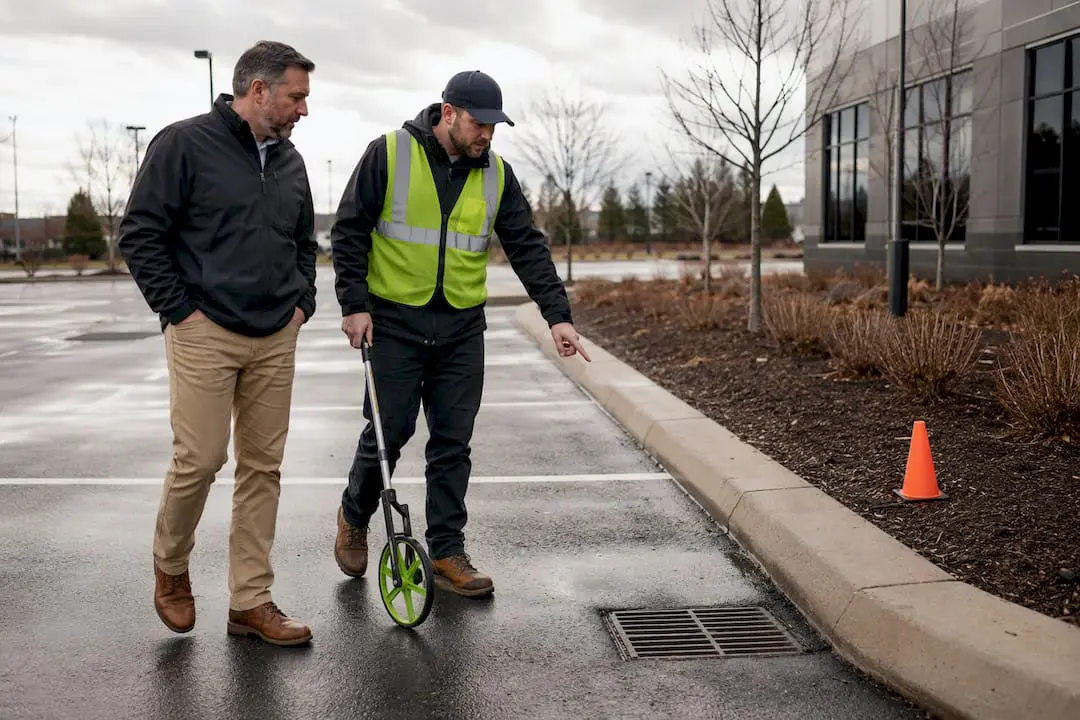
Proposal packaging matters just as much as the number on the page. A clear scope section, the required insurance language matched word for word to what the solicitation asks for, and complete attachments filed in the requested order all reduce the chance of a technical rejection before price even gets compared. For property managers overseeing several sites, proposing a hybrid pricing model with a seasonal base and clearly defined overage triggers tends to land better than a single flat number covering a diverse portfolio, since it shows the bidder understands that a strip mall and a corporate campus don’t service the same way.
What Should Contractors Prioritize Before the Season Starts?
Three things separate contractors who bid well from those scrambling in November. First, get your NJSTART account registered and your vendor profile current well before the September posting wave; a registration backlog at the state level during peak season can cost you weeks. Second, update your certificates of insurance and confirm they match current coverage minimums, since an expired COI attached to a bid package is an automatic red flag for evaluators. Third, walk your target properties and build accurate price sheets before you’re quoting under deadline pressure.
Keep the Anti-Snow Dumping Act in mind when you’re finalizing stacking plans. A contract without a defined snow storage location isn’t just a pricing risk, it’s a compliance risk once trucks start hauling.
If you want a second set of eyes on your bid documents or a site walk before you finalize a quote for a Morris or Somerset County property, Fernandez & Sons can walk that ground with you.
— BG
How Fernandez & Sons Supports Your Bidding Season
Local property managers and general contractors benefit from crews that have experience walking lots and understanding stacking and drainage challenges. That local knowledge shows up in more accurate quotes and fewer surprises once winter actually arrives.
Some companies handle site surveys, certificate of insurance preparation, and full seasonal service delivery for property managers and contractors. A typical site visit covers stacking zone mapping, drainage assessment, and a written scope for use in bid packages or seasonal planning.
Request a free estimate or schedule a site walk through the commercial services page to get a documented, accurate picture of what your property needs before the first storm of the season hits.
FAQ
How Much Does a Typical Snow Removal Contract Cost in NJ?
Pricing varies widely by property size and service level, with small commercial jobs running around $175 per hour and seasonal contracts for larger properties reaching into the tens of thousands of dollars depending on lot size, tolerance level, and contract length.
Do You Need a License to Perform Snow Removal in NJ?
New Jersey doesn’t require a dedicated snow removal license, but public contract bidding requires business registration, compliance with the Local Public Contracts Law, and, for state highway work, proper truck classification under NJDOT guidance.
How Do You Create a Snow Removal Contract?
A complete snow removal contract in NJ should define trigger depth, service tolerance level, response time, pricing model, stacking and hauling responsibility, insurance requirements, and payment terms. Reviewing an actual state RFQ document is one of the fastest ways to see what a well-structured version looks like.
What’s the Difference Between Per-Push and Seasonal Pricing?
Per-push pricing charges a flat fee each time crews deploy once a trigger depth is reached, while seasonal pricing locks in one fee for the entire winter regardless of storm count; the better choice depends on local snowfall averages and how much budget certainty the client wants.
Where Can Contractors Find Snow Removal Bids in NJ?
State and authority contracts post on NJSTART and agency sites like NJDOT and the NJ Turnpike Authority, while municipal contracts are posted individually on each town’s own bid page, often alongside a required legal notice in a local newspaper.