
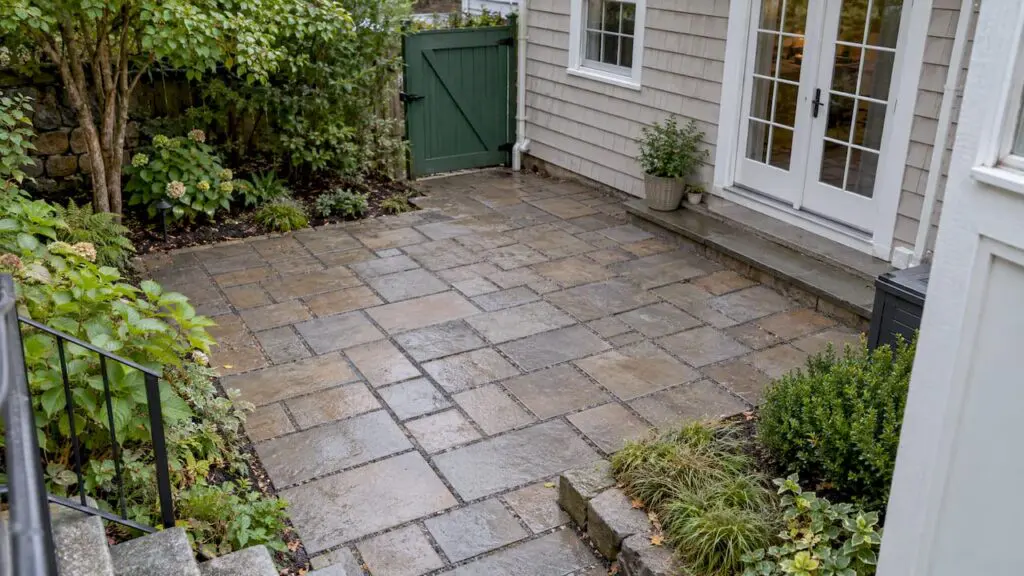
A permeable paver patio is a paver surface built over layers of open-graded stone, so rain moves through the joints, collects in a stone reservoir and soaks into the soil instead of running off. For Morris and Somerset County homeowners, that means fewer puddles, less runoff toward the neighbor’s yard or the street, and a patio that behaves well in freeze-thaw winters, as long as the base is built correctly and the joints get simple yearly care. Below, we cover how these patios work, what they cost you in upkeep, where they make sense, and what to ask a contractor before you sign.
Quick Answer
-
A permeable paver patio drains through its joints into a stone reservoir below, rather than shedding water across the surface.
-
The New Jersey DEP stormwater manual credits these systems with removing up to 80% of total suspended solids when designed for the water quality storm.
-
They are low maintenance, not no maintenance: plan on clearing the surface once or twice a year and keeping sediment and sand-based de-icers off.
-
Most of the performance lives underground, so the excavation, base and compaction matter more than the paver you pick.
-
Most single-family patios in Morris County fall below the state’s major development thresholds, but check with your town before you build.
How a Permeable Paver Patio Works
A standard paver patio sheds water. The pavers sit on compacted dense-graded stone and tight sand-filled joints, and the surface is pitched so rain runs off to a lawn, a drain or a driveway. A permeable patio does the opposite. According to the Rutgers guide, permeable pavement is a system that lets rainwater move through the surface to a storage layer below, where it slowly seeps into the ground.
The federal highway agency describes permeable interlocking concrete pavement as solid concrete units whose joints create openings in the surface once the pattern is assembled. Those joints are filled with small, clean stone rather than fine sand, which is what lets water pass.
From top to bottom, a typical residential build includes:
-
Pavers with widened joints. Many are cast with spacer bars to create a consistent gap.
-
Joint stone. Small, angular, washed aggregate, not play sand or polymeric sand.
-
Bedding layer. A thin layer of the same type of clean stone.
-
Open-graded base and reservoir. Larger, clean stone with voids between pieces, where water is stored and released.
-
Geotextile and uncompacted-friendly subgrade. Fabric separates the stone from native soil, and the soil beneath is protected from over-compaction so it can still absorb water.
-
Edge restraint. A firm border, often concrete or heavy-duty edging, that keeps the pavers locked in.
The depth of the reservoir depends on how much water the patio must hold and how quickly your soil drains. The Rutgers guide notes that storage can be increased if more is needed or if soils drain poorly.
Permeable vs. Regular Pavers: The Real Differences
People often search for permeable versus non-permeable pavers as if the pavers themselves were the difference. The surface units can look nearly identical. The system underneath is what changes.
| Feature | Conventional Paver Patio | Permeable Paver Patio |
|---|---|---|
| Joint material | Fine sand or polymeric sand | Clean, open-graded stone |
| Base | Compacted dense-graded aggregate | Open-graded stone reservoir with voids |
| Water behavior | Sheds water to the edges | Passes water through to the base |
| Surface slope | Needed for drainage | Can be flatter, depending on design |
| Sensitivity to sediment | Low | High, joints can clog |
| Excavation depth | Moderate | Usually deeper |
| Best fit | Well-drained yards with good grading | Wet spots, tight lots, runoff concerns |
Neither is better in every situation. A conventional patio on a well-graded, free-draining lot with a properly built base can perform for decades. A permeable system earns its extra excavation where water is the problem: flat sites, compacted clay soils with controlled drainage design, patios near a foundation or a downhill neighbor, and lots where you want to keep rain on your own property.
Benefits of Permeable Pavers for Patios
Here is what homeowners in northern New Jersey actually gain.
Less Runoff and Cleaner Water
The New Jersey DEP’s January 2026 manual chapter on pervious paving systems describes them as stormwater facilities that filter runoff, and it reports up to 80% removal of total suspended solids when the system is designed to treat the water quality design storm. The filtering happens as water passes through the stone layers, where a thin biological film helps break down pollutants.
That matters locally. Morris County sits in a watershed region where runoff from driveways and patios ends up in streams and reservoirs. A patio that absorbs its own rain keeps that water on your lot.
Fewer Puddles and Better Surface Drainage
Standing water on a patio means slippery algae, sunken pavers and a surface nobody wants to sit on. When the base drains, water leaves the surface within minutes rather than pooling in low spots.
Better Winter Behavior
The same DEP chapter notes that the stored moisture and sub-layer heat in these systems make the surface more resistant to frost and ice buildup, which can reduce the amount of de-icing product you need compared with conventional concrete or asphalt. We would still treat that as a benefit, not a guarantee: a heavy ice storm will glaze any surface. For the structural side of winter, see our guide on freeze-thaw rules for pavers in New Jersey, because a permeable base also has to be built to resist frost heave.
A Familiar Look
You are not limited to a rough, industrial appearance. Permeable pavers come in square, rectangular and multi-size patterns, in a range of colors and textures. Wider joints are visible, and the pattern reads as a deliberate design detail, especially with a darker joint stone against a lighter paver.
Support for Local Stormwater Goals
If your property sits near a drainage issue or you simply want to manage rain responsibly, this is a practical way to do it without adding a rain garden or a dry well. In some cases it can replace one.
Pros and Cons of Permeable Pavers
A fair look at both sides saves you from surprises.
Pros
-
Water drains through the surface instead of pooling.
-
Reduced runoff and filtered stormwater.
-
Less reliance on slopes, drains and downspout extensions.
-
More resistance to ice buildup in winter.
-
A finished look similar to a standard paver patio.
Cons
-
Higher upfront installation effort. The excavation is deeper and the stone is more specialized.
-
Joints can clog with sediment, leaves and grass clippings.
-
Sand-based de-icers and fine sand sweeping can damage performance.
-
Repairs need the right joint material, not whatever is in the truck.
-
Fewer contractors are experienced with the system, so installer choice matters more.
On cost, we do not publish a flat number because it varies with size, soil, access and design. For the general range of what a paver patio costs in the state, read our paver patio cost guide for New Jersey. Expect a permeable build to involve more excavation and stone than a conventional one, and ask your contractor to show that difference as a line item.
Is a Permeable Paver Patio Right for Your Property?
These questions help narrow it down.
-
Does water collect on or near your current patio? Permeable systems are strongest where the problem is surface water.
-
What are your soils? Sandy and loamy soils drain easily. Heavy clay needs a deeper reservoir and sometimes an outlet pipe. Soil needs to be tested, not assumed.
-
Where does the rest of your yard drain? Bare soil upslope will wash sediment onto the patio and clog it.
-
Will you use the patio for vehicles? Patios, walkways and light foot traffic are the easiest case. Driveways need a heavier design, which we cover on our driveways page.
-
Is the patio near a pool? A pool deck brings chlorinated water and splash-out into the mix, so it takes its own planning. See our pool decking projects.
The City of Portland notes that permeable pavement works for driveways, parking lots and patios, particularly where properties have large paved areas and runoff is a concern. The principle carries over to New Jersey lots, though our soils and freeze-thaw cycle require local design.
Permits and Stormwater Rules in New Jersey
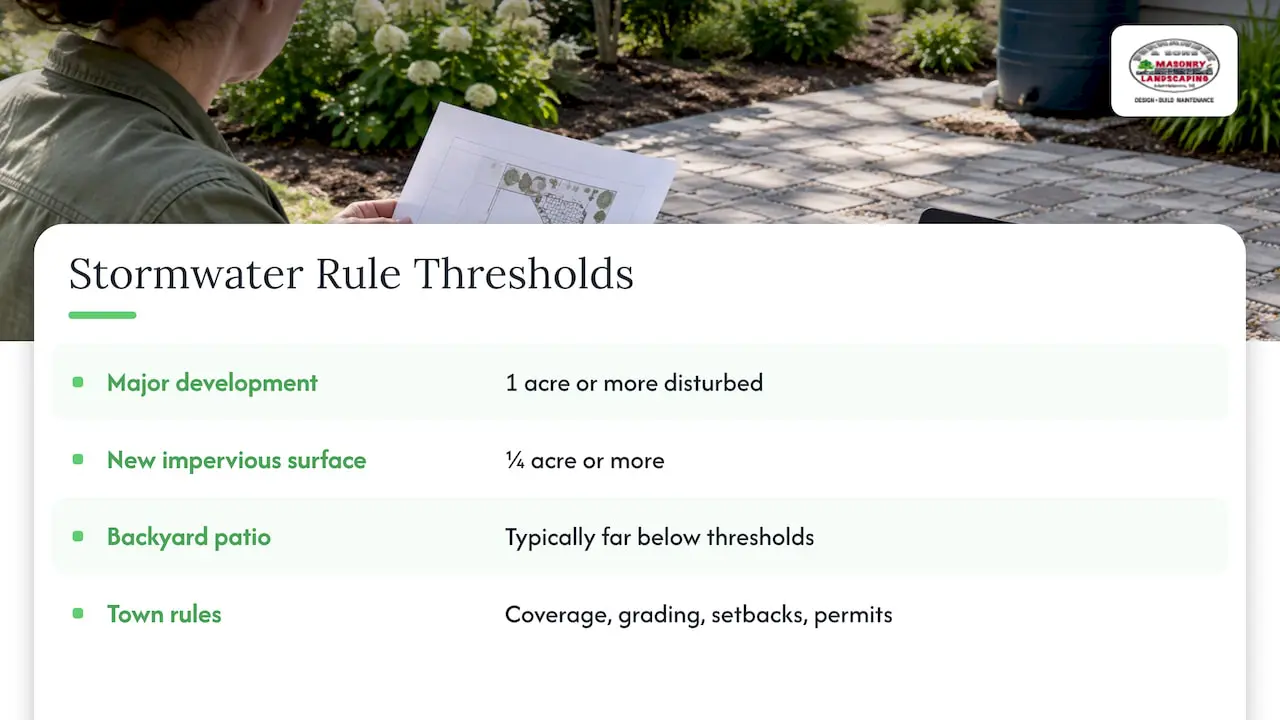
The New Jersey DEP’s stormwater rule FAQ states that porous pavement is counted as an impervious surface toward the jurisdiction threshold for the state’s stormwater management rules. In plain terms, a permeable patio does not get a free pass on paper. Major development is generally a project that disturbs one acre or more, or adds a quarter acre of new impervious surface. A typical backyard patio in Parsippany-Troy Hills, Morris Plains or East Hanover is far below that.
That said, your town may still have its own rules about lot coverage, grading and setbacks, and a permit may apply depending on size and location. We explain how this works in our New Jersey patio permit guide. Check with your building or zoning office before work begins.
How to Maintain a Permeable Paver Patio
The most common misconception is that these patios are maintenance-free. The DEP manual makes clear that longevity depends on a planned routine that keeps sediment from sealing the surface, and sealing is the leading cause of early failure.
A Simple Yearly Routine
The North Carolina DOT’s permeable interlocking concrete pavement guidelines recommend clearing leaves, debris and sediment once or twice a year with a leaf blower or a vacuum sweeper. For a home patio:
-
Spring: Blow off winter debris and check joints for settled stone or bare gaps.
-
Fall: Clear leaves before they decay into the joints, particularly under maples and oaks.
-
After storms: Look for mud or silt washed in from beds and slopes.
-
Top up joint stone: If stone has migrated, refill with the same size and type the installer used.
The Ponding Test
The same guidelines treat water that remains on the surface more than 30 minutes after a storm as a sign of localized clogging. If you see that, do not power wash at high pressure, which can push fines deeper. Call a contractor who can vacuum the joints and replace the aggregate.
Protect the Edges
EPA’s permeable pavement fact sheet identifies clogging as the main failure mode, and the transition between solid and permeable surfaces is where sediment tends to collect. Practical steps:
-
Stabilize bare soil next to the patio with mulch, groundcover or sod.
-
Direct downspouts and runoff from lawns and beds away from the joints.
-
Bag or blow off grass clippings after mowing.
-
Avoid stockpiling mulch, topsoil or sand on the surface during landscape projects.
Winter Care
Snow management needs some technique. The DEP chapter advises against sand-based de-icers, because sand permanently clogs the pores and joints. Use sparing amounts of non-toxic de-icer instead, and keep plow blades from scraping the paver edges. If you hire a plowing crew, tell them the patio or walkway is permeable. We handle residential snow work too, as described on our snow plowing services page, and lifting or protecting the blade near hardscape is part of working carefully around it.
What Goes Under Permeable Pavers
The stone beneath the pavers decides whether the patio drains. The Rutgers guide stresses that the sub-surface structure matters as much as the visible pavers, and that the design should match local soil conditions. Here is what a sound installation includes.
-
Soil evaluation. Infiltration is checked after the reservoir is excavated, before fabric goes in, to confirm the design can handle expected runoff.
-
Uncompacted subgrade where required. The DEP manual flags improper compaction of subgrade soils as a common error that ruins permeability before the job ends. Equipment traffic on the open excavation is a frequent culprit.
-
Clean, open-graded stone. No fines. If the stone arrives dusty, it should be washed.
-
Geotextile fabric. It keeps native soil from migrating up into the reservoir.
-
Proper edge restraint. Pavers must stay locked in without the dense base that conventional patios rely on.
-
Frost considerations. In our climate, base depth and drainage are linked, so water that drains quickly gives less to freeze under the pavers.
Because these steps differ from standard masonry, the NJDEP guidance encourages homeowners to confirm that a contractor follows industry-recognized installation practices for permeable systems.
Our Perspective on Permeable Patios
We build paver patios, walkways, driveways, pool decks and outdoor living spaces across Morris and Somerset Counties, and the first thing we look at on any patio is water. Where it comes from, where it goes and what the soil will let it do. Plenty of failed patios we are asked to repair are not failed pavers at all. They are failed bases, and almost every one traces back to drainage.
That is why we think of a permeable patio as a good fit for specific situations, not a trend to apply everywhere. On a sloped, well-drained lot, a conventional paver patio with a properly compacted base and good grading is often the right call. On a flat yard in Dover Township, a tight lot in Parsippany-Troy Hills or a low corner that holds water after every storm, a permeable design can solve a problem that grading alone cannot.
Our advice to homeowners is straightforward:
-
Decide what you want the patio to do before you pick the paver: seating, dining, an outdoor kitchen, a fire pit area.
-
Ask how the installer will test the soil and what happens if infiltration is slower than expected.
-
Plan the upkeep before the patio goes in, and put it on the calendar.
-
Treat the surrounding landscape as part of the patio, because bare soil and clippings are what clog joints.
We offer free estimates, and we will tell you plainly whether permeable or conventional paving suits your yard.
— Fernandez & Sons Masonry & Landscaping
Design Ideas for a Permeable Patio
Wider joints are not a limitation. They can become part of the look.
-
Dining patio with a contrasting joint. Light gray pavers with dark stone in the joints create a clean grid.
-
Mixed-size patterns. Multi-size layouts hide the joints visually and feel more organic beside a garden.
-
Fire pit gathering area. A circular permeable zone with a stone fire feature works well for evening use. Browse our fire pit projects for layouts.
-
Patio plus walkway. Use the same permeable system for a path from the driveway to the back door. Our walkway projects show how paths connect to a patio.
-
Planting pockets. Beds at the edge help the transition, as long as they are mulched and stable so soil does not wash onto the surface.
-
Steps and level changes. Where the yard drops, solid, conventionally built steps pair well with a permeable landing. See our steps projects.
For a wider range of materials, shapes and layouts, our patio installation guide for New Jersey walks through the options, and you can see finished work in our paver patio gallery.
What to Ask Before You Hire a Contractor
Because the work is more technical than a standard patio, use this checklist when comparing proposals.
-
How will you evaluate my soil and drainage before you design the base?
-
What depth and type of stone will you use, and why?
-
How will you keep the subgrade from being compacted during excavation?
-
What joint material will be used, and what should I use for repairs?
-
How will you manage my downspouts and surrounding grading so the joints stay clean?
-
What is your recommendation for winter snow and ice care?
-
What does your workmanship guarantee cover?
A contractor who can answer these specifically has done the work before. One who answers with generalities has probably not.
Plan a Permeable Patio With Fernandez & Sons
If you are weighing a permeable paver patio, we can look at your yard, talk through drainage and soils, and tell you honestly whether a permeable or conventional design fits. We provide free estimates and a satisfaction guarantee on our masonry and hardscaping work. Learn more about our masonry and landscaping services or see how our landscape design team can fold a patio into a full yard plan.
Permeable Paver Patio FAQs
Are Permeable Pavers Expensive?
They usually cost more to install than a conventional paver patio because the excavation is deeper and the stone is more specialized. The final price depends on the patio size, soil, access and design. Our paver patio cost guide covers what New Jersey homeowners typically budget, and we give a written estimate for free.
What Are the Disadvantages of Permeable Pavers?
The main drawback is clogging. Sediment, leaves, grass clippings and sand can fill the joints and slow drainage, so the patio needs regular clearing. Installation also depends heavily on the base, which means contractor experience matters more than with a standard patio.
How Long Do Permeable Pavers Last?
The pavers themselves are durable concrete units, but we do not promise a specific lifespan. Longevity depends on how well the base was built and how consistently the joints are kept clear. Patios with a planned maintenance routine last far longer than those left alone.
Can You Use Permeable Pavers in New Jersey Winters?
Yes, with care. The DEP manual notes these systems resist frost and ice buildup well, but sand-based de-icers will clog the joints, and metal plow blades can chip edges. Use a non-toxic de-icer sparingly and tell any plow crew about the surface.
Do I Need a Permit for a Permeable Paver Patio in Morris County?
It depends on your town and the project size. Most single-family patios fall below the state’s major development thresholds, but local zoning, lot coverage and grading rules may still apply. Check with your municipal office, and read our patio permit guide before you begin.