
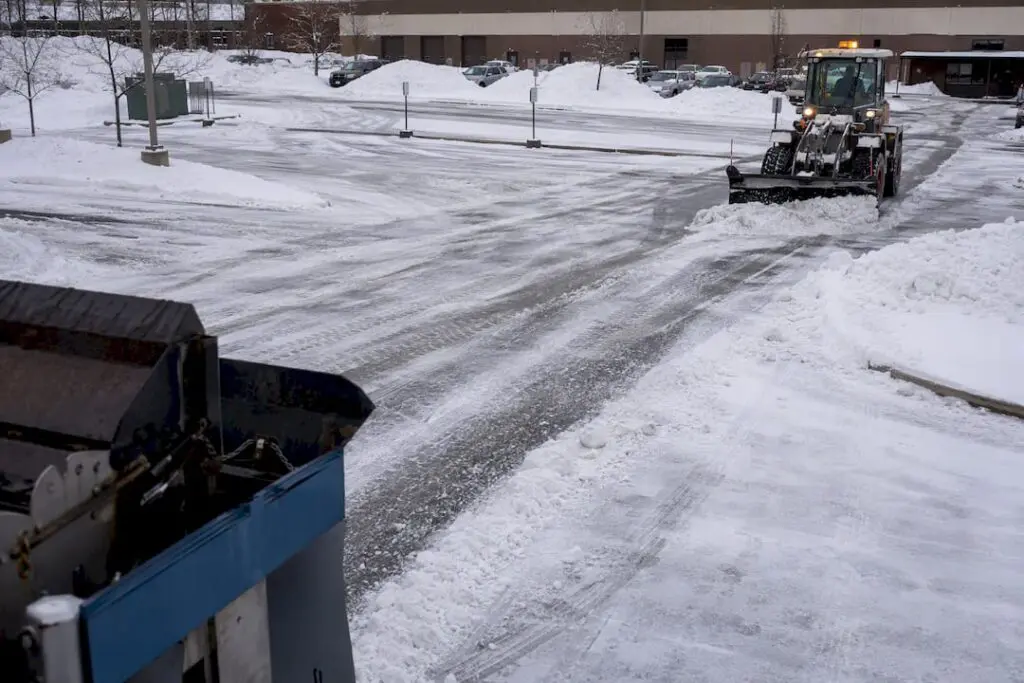
The safest, most cost-effective approach to parking lot snow management combines aggressive mechanical removal with anti-icing before a storm and calibrated de-icing after it, cutting chloride use while keeping surfaces clear. This “Smart Salting” approach, developed through Minnesota Pollution Control Agency guidance, can reduce salt use by 30 to 70 percent without sacrificing traction or safety.
Fernandez & Sons Masonry & Landscaping builds every commercial snow contract in Morris and Somerset Counties around this framework: plow early and often, pre-wet before the snow starts sticking, and apply de-icer with a calibrated spreader instead of a shovel and a guess.
Here’s the quick version that property managers need before a storm hits:
- Trigger depth: Mobilize plows at 1 to 2 inches of accumulation, not after the lot is buried.
- Anti-icing window: Apply brine 1 to 72 hours before a storm, depending on the product and forecast confidence.
- Post-storm check: Inspect the lot within a few hours of the storm’s end. New Jersey courts have found that liability can attach once a property owner has had reasonable time to address hazards after precipitation stops, per a 2025 New Jersey appellate ruling.
- Biggest risk to manage: Salt runoff into storm drains and groundwater, which is why storage and application discipline matter as much as speed.
Key Takeaways
Effective parking lot snow management pairs aggressive mechanical removal with anti-icing and calibrated de-icing to maximize safety while cutting chloride use and liability exposure.
| Point | Details |
|---|---|
| Anti-ice before the storm | Applying brine 1 to 72 hours ahead prevents bonding and can be over 50% more efficient than reactive de-icing. |
| Plow before treating | Always clear snow mechanically first; chemical applied under snow gets buried and wasted. |
| Store salt correctly | Keep salt covered on an impervious surface to prevent chloride runoff into groundwater and storm drains. |
| Document every visit | Timestamped photos and application logs are key evidence in defending slip-and-fall claims. |
| Hire a calibrated crew | Fernandez & Sons runs seasonal and per-event snow contracts in Morris and Somerset Counties with calibrated equipment and free estimates. |
Table of Contents
- What Is the Right Timeline for Snow Removal for Parking Lots?
- Anti-Icing vs. De-Icing: Which Method Actually Works Better?
- How Should You Store Salt and Manage Snow Runoff?
- What Equipment and Training Does a Winter Crew Need?
- What Drives the Cost of Commercial Snow Removal?
- Fernandez & Sons Handles the Winter Playbook So You Don’t Have To
- What Property Owners Consistently Get Wrong About Winter Prep
- Frequently Asked Questions
- Sources
What Is the Right Timeline for Snow Removal for Parking Lots?
Winter maintenance isn’t a single event. It’s a sequence, and skipping a step in that sequence is usually where lots end up with refreeze patches, wasted salt, or a slip-and-fall claim.
Before the storm, your crew should run through equipment checks: hydraulics, plow edges, spreader calibration, and fuel. Brine gets mixed and loaded in this window too, since pre-wetting accelerates melting once precipitation starts. This is also when you confirm where excess snow will get stacked and that your salt supply is under cover, not sitting exposed on pavement.
During the storm, plowing decisions follow a clear sequence:
- Clear main drive lanes and fire lanes first.
- Push snow toward designated storage zones, generally downhill and away from drains.
- Open ADA-compliant paths and accessible parking as a standing priority, not an afterthought.
- Reassess de-icing needs as temperatures and precipitation type shift.
After the storm, run a final plow pass, spot-treat high-traffic zones like entrances and crosswalks, and inspect the lot within hours rather than the next morning.
Pro Tip: Keep a simple log with timestamps and photos after every event. If a slip-and-fall claim ever surfaces, documented service records are often the deciding factor in whether a property owner is found negligent.
Roughly 0.5 to 0.75 gallons of brine per 1,000 square feet is the typical pre-wetting application rate for most commercial lots, a figure worth pinning to your equipment cab.
Anti-Icing vs. De-Icing: Which Method Actually Works Better?
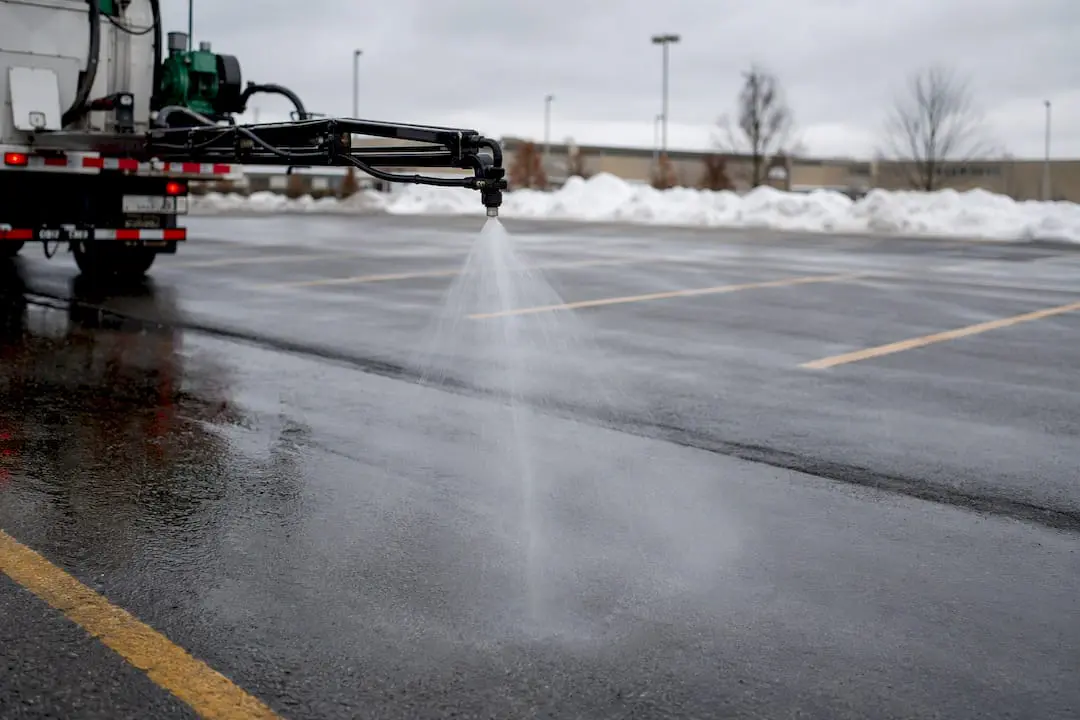
Anti-icing means applying brine before snow or ice forms, so it never gets the chance to bond to pavement. De-icing means treating snow or ice that’s already there. Both matter, but they aren’t interchangeable, and using the wrong one at the wrong moment wastes material and money.
Think of anti-icing like coating a pan before you cook. Nothing sticks, so cleanup takes a fraction of the effort. Applied 1 to 3 days ahead of a storm depending on the product, brine can make treatment more than 50 percent more efficient compared to waiting until ice has already formed and reacting with rock salt.
Plowing always comes first, regardless of which chemical strategy you’re running. Push snow off before applying any product. Spreading de-icer under snow that hasn’t been cleared just buries the material where it can’t do its job, and the next plow pass drags it off the lot entirely.
Here’s how the common de-icing materials compare on temperature range and trade-offs:
| Material | Effective Down To | Trade-Off |
|---|---|---|
| Sodium chloride (rock salt) | 15°F | Cheapest option, but corrosive to concrete and vegetation at scale |
| Calcium chloride | Well below 0°F | Works in deep cold, costs more than sodium chloride |
| Magnesium chloride | Roughly 0°F | Less corrosive than calcium chloride, higher material cost |
| Potassium acetate / CMA | Low temperatures | Lower environmental impact, significantly higher cost per pound |
Sodium chloride does most of the work on a typical New Jersey winter day, but once temperatures drop into the teens or lower, its melting power falls off fast. That’s when a blend with calcium chloride or magnesium chloride earns its higher price tag, especially on shaded lots or north-facing entrances that never see direct sun.
Pro Tip: Calibrate spreaders at the start of the season and again mid-winter. A spreader running 20 percent over its rated output doesn’t melt ice any faster. It just burns through your salt budget and dumps excess chloride into the storm drain.
How Should You Store Salt and Manage Snow Runoff?
Store bulk salt on an impervious surface, under cover, ideally inside a shed or bunker rather than tarped in a corner of the lot. Exposed piles leach chloride into soil and groundwater with every thaw cycle, and Smart Salting guidance treats covered storage as a baseline requirement, not an upgrade.
Snow storage deserves the same planning. Pick a spot downhill from the lot where possible, sized generously enough to handle a heavy season without overflowing into drive lanes. Keep it away from retention ponds, wetlands, and storm drains, since meltwater carries whatever the snow picked up off the pavement straight into those systems.
- Provide secondary containment for liquid brine tanks in case of a leak or spill.
- Route meltwater from storage piles away from catch basins, or capture it for reuse as brine stock.
- Keep salt piles at least several feet from any drainage inlet.
- Inspect catch basins each fall so they aren’t already compromised before the first storm.
If your property sits within an MS4 stormwater permit area, chloride discharge is a compliance issue, not just an environmental preference. Pushing snow into a retention pond or public waterway can violate local ordinances even when it feels like the fastest solution on a busy morning.
Pro Tip: Ask your landscaping or maintenance partner whether they treat captured brine runoff as waste or as a resource. Reusing it for the next application cuts material costs and keeps chloride out of the watershed.
What Equipment and Training Does a Winter Crew Need?
A well-equipped crew runs plow trucks, at least one skid steer or compact loader for tight corners, calibrated granular and liquid spreaders, and hand tools for curb cuts and ADA-compliant paths that machinery can’t reach cleanly.
Calibration is the step most operations skip, and it’s the one with the biggest payoff. Here’s the basic process:
- Weigh material output over a measured distance at a set spreader setting.
- Convert that figure into pounds per 1,000 square feet.
- Adjust the spreader control until output matches the target application rate for current conditions.
- Record the setting so every operator applies the same amount, not whatever “feels right.”
Training should cover Smart Salting principles or an equivalent certification, with role-based checklists for the plow operator, the site supervisor, and whoever handles documentation. In-storm communication matters just as much as the physical work. A crew that can’t reach the site supervisor when conditions shift mid-storm ends up over-applying salt out of caution.
Pro Tip: Require GPS-timestamped photos at the start and end of every service visit. It’s the single cheapest form of liability protection a contract can include, and it takes the operator about ten seconds per stop.
What Drives the Cost of Commercial Snow Removal?
Lot size, trigger frequency, hauling distance, and material choice drive most of the variation in snow removal pricing in NJ. A tight urban lot with limited stacking space costs more to service than an open suburban lot of the same square footage, because the crew spends extra time hauling snow instead of pushing it once and moving on.
Anti-icing changes the cost equation more than most managers expect. Because pre-wetted brine works more efficiently than reactive rock salt, a property investing in proactive treatment often uses noticeably less material across a season, even accounting for the extra pre-storm visit.
- Model your seasonal budget as a range tied to average local snowfall, not a fixed number.
- Build in a contingency line for storms above the typical range.
- Compare per-push pricing against a seasonal contract based on your property’s storm history.
- Require documented application rates, response-time commitments, and proof of insurance in any snow removal proposal.
Fernandez & Sons Handles the Winter Playbook So You Don’t Have To
Running this entire operation, brine timing, spreader calibration, storage compliance, documentation, takes real capacity most property management teams don’t have sitting idle in December. Fernandez & Sons Masonry & Landscaping runs commercial snow removal contracts across Morris and Somerset Counties built on exactly the Smart Salting practices covered above.

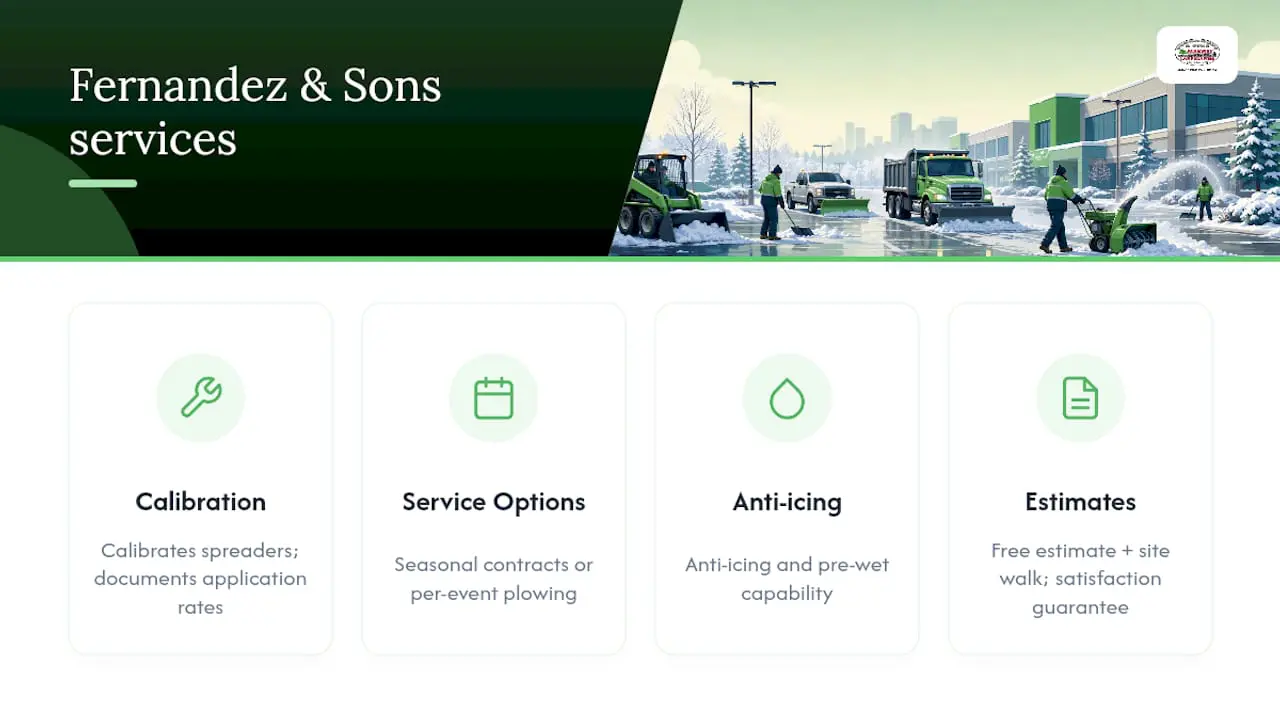
The crew calibrates spreaders before the season starts and documents application rates on every visit, so you’re never guessing what was actually applied to your lot. Seasonal contracts and per-event plowing are both available, along with anti-icing and pre-wet capability for properties that want to get ahead of a storm instead of reacting to it. Fernandez & Sons backs every job with a satisfaction guarantee and provides free estimates, including a site walk to map trigger points, drainage concerns, and snow storage zones before winter arrives.
If your current plan leaves you checking the weather app and hoping for the best, request a free estimate and get a written plan instead: site mapping, response timeline, and a documented service agreement you can hand straight to your board or ownership group.
What Property Owners Consistently Get Wrong About Winter Prep
The biggest gap I see isn’t equipment or budget. It’s timing. Owners wait for the first flakes before thinking about brine, storage locations, or where excess snow will go, and by then the decisions are already rushed.
Small design details matter more than people expect. A catch basin placed at the low point of a lot with no islands to redirect flow will refreeze every single time, no matter how good your crew is. Documenting every visit protects you when a claim comes in months later, and planning snow storage before the season, not during the first storm, saves both labor hours and parking stalls all winter long.
Frequently Asked Questions
How often should a parking lot be plowed during a storm?
Most commercial properties should mobilize plows once accumulation reaches 1 to 2 inches, then continue on a rolling schedule until the storm ends.
Is anti-icing worth the extra visit before a storm?
Yes. Pre-storm brine application can be more than 50 percent more efficient than treating ice after it forms, which usually means less material and lower seasonal costs.
What’s the biggest environmental risk in parking lot ice control?
Chloride runoff from over-application and uncovered salt storage, which can contaminate groundwater and violate MS4 stormwater permit requirements.
How quickly must a property owner respond after a storm ends?
New Jersey courts generally expect action within a reasonable time after precipitation stops, though the ongoing-storm rule can extend that window while snow or ice is still falling.
Should I sign a seasonal contract or pay per plow event?
It depends on your property’s typical snowfall pattern. High-frequency winters usually favor a seasonal contract, while lighter, unpredictable seasons can make per-event pricing more economical.
Sources
- CT GSP for Parking Lots and Sidewalks BMP (T2 Center / UConn)
- Smart Salting for Parking Lots and Sidewalks (MPCA)
- A-0262-23 – PAULA RUSSO VS. GARDEN COMMERCIAL PROPERTIES, ETC. (NJ Courts)
- Who Is Liable When You Slip on Ice in a Parking Lot (US Injury Act)