
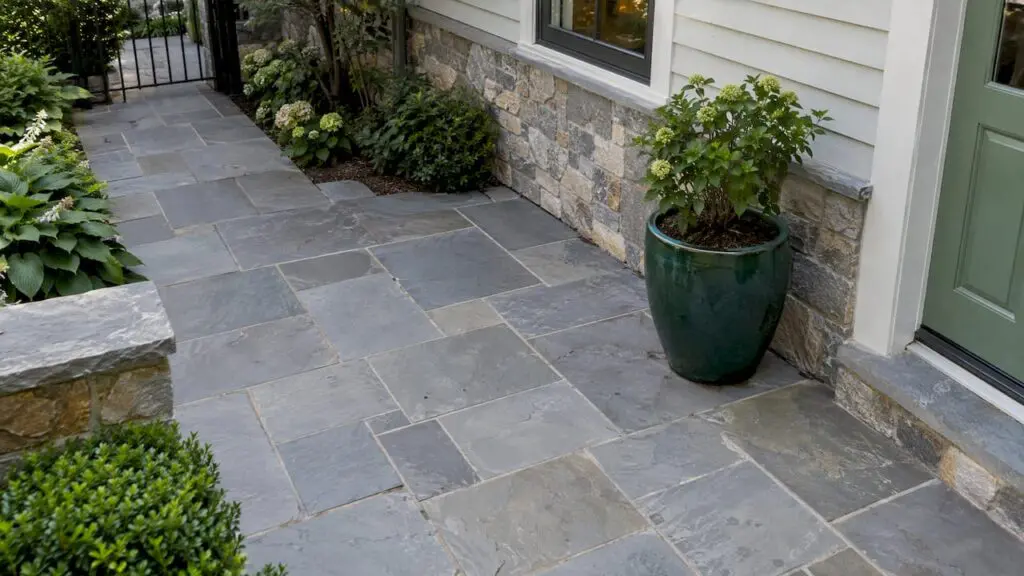
The most common bluestone pattern for a patio is random rectangular, also called ashlar, and it suits most homes. Houzz describes ashlar as a mix of square and rectangular pieces in several sizes. Formal homes often look best with running bond or a European layout, and a naturalistic garden suits irregular flagstone. This guide explains how each bluestone layout looks and behaves, how to match one to your house and patio shape, and what to settle before the first stone is set.
We build patios, walkways, steps and outdoor living spaces for homeowners across Morris and Somerset Counties, New Jersey. The advice below reflects how a pattern is planned on a real yard, with real drainage and real winters.
Things to Consider
-
Random rectangular (ashlar) is the safe, non-directional choice for most patios, walkways and pool surrounds.
-
Running bond and European patterns read as formal and linear. Diamond-set is formal too, but it needs extra perimeter cuts.
-
Irregular flagstone gives a rustic, asymmetric look and fits garden paths and informal spaces.
-
Pattern is only half the result. Base, slope, joints and edge restraints decide how the patio holds up through New Jersey freeze-thaw seasons.
-
Order stone by complete pattern sets, and round up, so the layout you chose is the layout you get.
Quick Answers: Bluestone Patterns
What is the most popular bluestone pattern? Random rectangular, or ashlar. It combines multiple square and rectangular sizes and has no obvious direction.
Which bluestone patio pattern looks most formal? Running bond, European and diamond-set layouts have a structured, linear look, according to a pattern guide from a bluestone supplier.
Which pattern fits a curved or organic patio? Irregular flagstone, because natural pieces are fitted into a broken composition without straight edges or square corners.
How much stone should you order? Divide the patio area by the square footage of one pattern set and round up to a whole set.
What Bluestone Patterns Actually Are
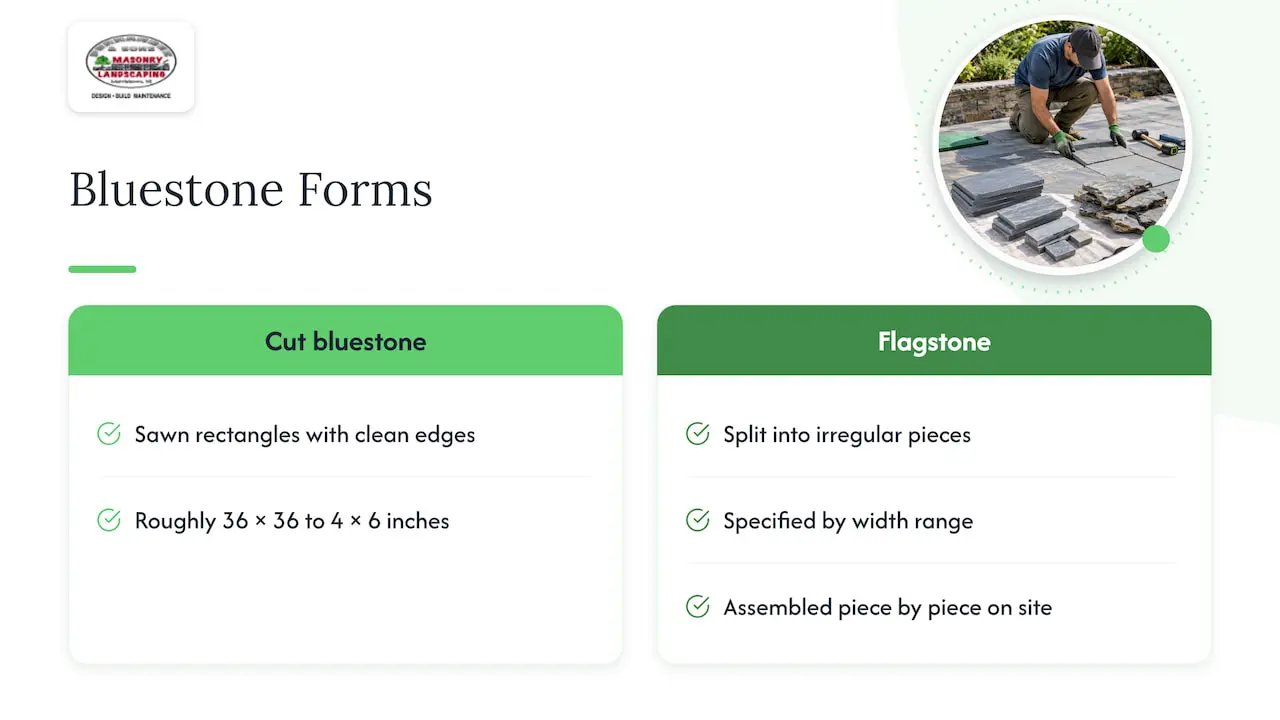
Bluestone is a dense natural stone, and it can be bought in two broad forms. Cut bluestone is sawn into rectangles with clean edges. Flagstone is split into irregular pieces and is generally specified by a width range rather than exact dimensions. Houzz reports that cut bluestone can range from roughly 36 by 36 inches down to 4 by 6 inches.
A pattern is the plan for how those pieces sit together. Some patterns repeat a fixed set of sizes, which makes ordering and installation predictable. Others, like irregular flagstone, are assembled piece by piece on site. The choice changes the look of your outdoor space, but it also changes how many cuts are needed, how much waste there is, and how long the layout takes to build.
The Main Bluestone Layouts Compared
The layouts most often described for patios and outdoor paving are random rectangular (ashlar), European, irregular, running bond, diamond-set and semi-random rectangular. Here is how the main ones differ in practice.
| Pattern | Look | Best for | Things to know |
|---|---|---|---|
| Random rectangular (ashlar) | Casual but tidy, non-directional | Most patios, walkways, pool decks | Mixes square and rectangular pieces in several sizes |
| European | Formal, linear | Contemporary or traditional homes with crisp lines | Strong visual direction |
| Running bond | Formal, brick-like rows | Narrow walkways, steps, formal entries | Long joints emphasize direction |
| Diamond-set | Formal, dramatic | Statement patios and focal areas | Requires cuts around the perimeter |
| Irregular flagstone | Rustic, asymmetric | Garden paths, naturalistic yards | No fixed pattern and no 90-degree corners |
The table summarizes descriptions from Robinson Flagstone’s pattern guide and Houzz.
Random Rectangular (Ashlar)
Ashlar is the workhorse. The supplier guide describes it as non-directional and well suited to most applications, and it combines square and rectangular pieces in a range of sizes. Because no single line dominates, the eye reads it as a calm surface, which is why it pairs easily with furniture, planters, an outdoor kitchen or a fire pit.
It also forgives odd shapes. When a patio bends around a corner or meets a foundation wall at an unusual angle, a random mix hides small adjustments better than a rigid grid.
Running Bond
Running bond lays rectangular pieces in staggered rows, like brick. It reads as formal, and it works well where the paving needs to lead the eye somewhere, such as a walkway to a front door or a set of steps. On a wide patio the long, continuous direction can feel stiff, so we usually recommend it for narrower runs.
European Pattern
European layouts also have a formal, linear character. They suit homes with symmetrical facades, clean modern lines or a traditional look where the patio should feel like an architectural extension of the house.
Diamond-Set
Setting stone on the diagonal is a classic way to make a small patio feel larger and more designed. The tradeoff is cuts: every edge where the diamond meets a straight border needs angled pieces. That adds labor and wastes some stone, so it is best chosen on purpose rather than as a casual upgrade.
Irregular Flagstone
Irregular flagstone has no fixed pattern. Natural pieces are fitted into a broken composition, generally without straight edges or right-angle corners. Houzz notes that rectangular cut bluestone creates clean lines and refined edges, while flagstone suits a woodland path or naturalistic garden. If you want a patio that feels like it grew out of the landscape, this is the one.
Standard Sizes And How Pattern Sets Work
Pattern bluestone is typically sold in standard sizes that step up in 6-inch increments, such as 12 by 12, 12 by 24, 18 by 18 and 24 by 24 inches. Because the sizes share a common module, they fit together without odd gaps.
Many patterns are sold as repeatable sets that contain a fixed number of each size. Here is a worked example using a hypothetical set (the numbers are ours, for illustration):
-
Three 12 by 12 pieces: 3 square feet
-
Two 18 by 18 pieces: 4.5 square feet
-
Two 12 by 24 pieces: 4 square feet
-
One 24 by 24 piece: 4 square feet
That set covers 15.5 square feet. For a 100-square-foot patio, 100 divided by 15.5 is about 6.45, so you would round up to seven full sets. Ordering seven sets gives you 21 pieces of 12 by 12, 14 of 18 by 18, 14 of 12 by 24 and seven of 24 by 24. Rounding up matters because it keeps the proportions of the pattern intact and leaves a small reserve for cuts at the edges.
On a real project we also account for the patio’s shape. Curves, steps and inside corners create cuts, so we plan the layout on the actual footprint instead of relying on area alone.
Matching A Pattern To Your Home And Yard
Start with the house, then the shape of the space, then how you will use it.
By Home Style
-
Colonial and traditional homes common in Morris County often pair well with ashlar or running bond, which feel settled and orderly.
-
Contemporary homes suit European or larger-format rectangular layouts with tight, consistent joints.
-
Stone cottages, wooded lots and naturalistic plantings suit irregular flagstone.
By Patio Shape
-
Rectangles and squares work with nearly any pattern.
-
Curves and freeform shapes favor ashlar or irregular stone, since fewer straight lines need to be matched.
-
Narrow paths and walkways suit running bond or a random layout with larger pieces.
By Use
If you plan to dine outdoors, choose a pattern with tight joints and a flat surface so chair legs and table feet sit steadily. Around a fire pit or outdoor kitchen, a calm, non-directional ashlar keeps attention on the gathering space rather than the paving. For pool decks, surface water must have somewhere to go, so drainage planning comes before pattern choice.
If you are still weighing the stone itself, our contractor notes on bluestone patio pros and cons cover the material in more depth. For budgeting, see our guide to bluestone patio cost.
Planning Details That Matter As Much As The Pattern
A beautiful layout fails if the surface sheds water poorly or the stones shift. These are the planning points we settle before choosing a pattern.
Slope And Drainage
Water needs to leave the patio. This Old House recommends setting finished elevation with stakes and string, pitched about 1/4 inch per foot away from the house. The U.S. Access Board recommends a maximum cross slope of 1.5 percent, about 3/16 inch per foot, for accessible pedestrian paving, which provides drainage while leaving room for construction tolerance. Both point to the same idea: a gentle, consistent pitch.
Joints And Lippage
Yale’s bluestone paving standard calls for joints of 1/4 to 3/8 inch and a maximum lip of 1/32 inch between pavers. That is a demanding institutional specification, but it shows what a well-set surface looks like: even joints and no stones standing proud of their neighbors, which is also what keeps furniture steady and prevents trips.
Edge Restraints
The same standard requires restraints such as edging, curbs, walls or steps to be installed before the pavers. Pattern layouts with many small pieces rely on a firm perimeter to stay locked together.
Stone Consistency
The Yale standard also specifies pavers from a single source and the same quarry strata, with color matched across the installation. For a homeowner, the practical lesson is to have all stone for one patio ordered together so color and thickness stay consistent from the first row to the last.
Base Preparation
This Old House recommends calling utilities before any excavation, removing topsoil down to undisturbed subsoil, and building the base in repeated lifts of 3 to 4 inches of graded base, compacted in two directions. Dry-laid patios use compacted aggregate and a sand bed, which accommodates slight seasonal movement. Mortar-set patios use a reinforced concrete slab for a more rigid installation, according to Dynamic Stone Tools. The New York State Department of Transportation’s bluestone sidewalk specification shows a sand-over-concrete method for public sidewalks, with shop drawings that show layout, dimensions, control joints and elevations. A homeowner patio does not need shop drawings, but a dimensioned plan before work begins serves the same purpose.
Why Pattern And Construction Matter In A New Jersey Winter
Morris and Somerset Counties see repeated freezing and thawing, and water trapped in or under paving is what causes most of the damage. The National Park Service reports that freeze-thaw cycles at the Statue of Liberty’s terreplein caused heaving and displacement of granite and bluestone pavers, and that deteriorated paving let rainwater pool and leak beneath the plaza. A separate 2018 park notice says replacing pavers was meant to remove deferred maintenance and the high annual repair costs tied to freeze-thaw.
Dynamic Stone Tools recommends a slope of at least 1/8 inch per foot for smooth stone and 1/4 inch per foot for rough or irregular surfaces, with a clear discharge path at the perimeter. Its natural stone patio guide also suggests a crushed-stone base at least 4 to 6 inches deep for in-ground installations and links ponding water to spalling, efflorescence, mortar deterioration and biological growth.
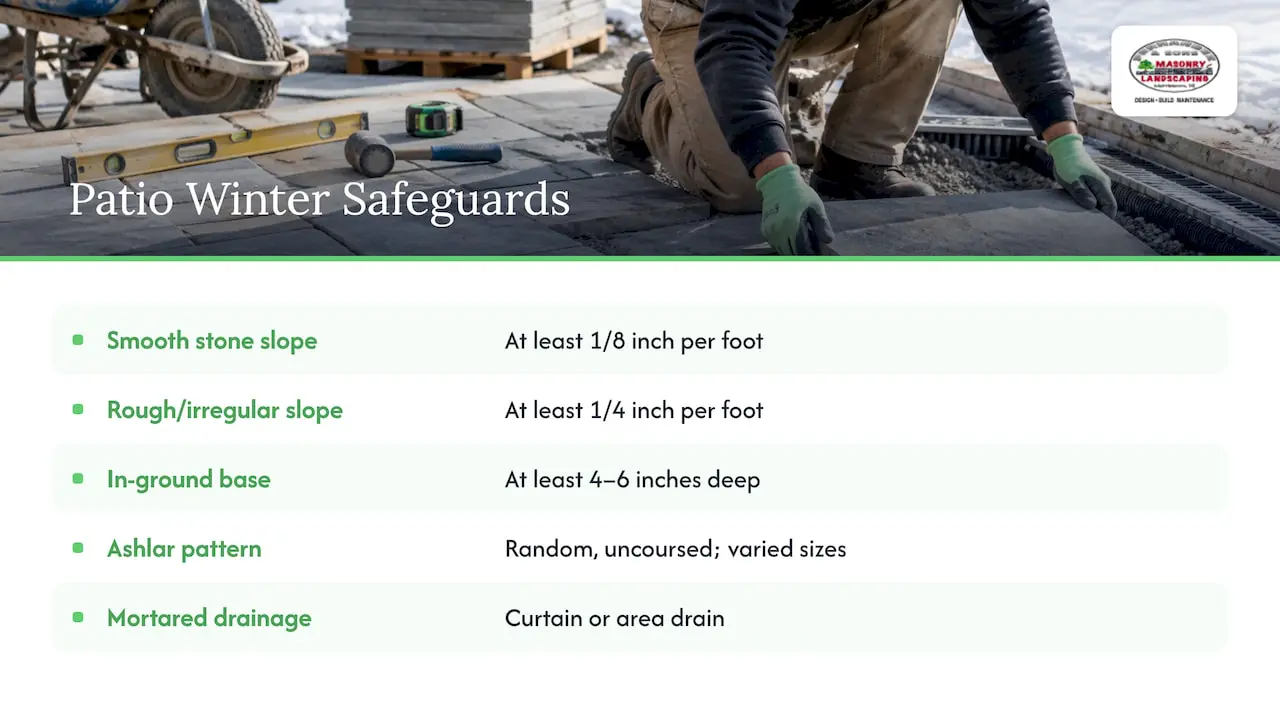
The Yale standard goes a step further for walkways, recommending a random, uncoursed ashlar pattern with varied sizes and discontinuous courses instead of long linear joints. It also requires that mortared installations drain to a curtain or area drain. For a homeowner, that supports a simple preference: where you want a pattern that stays visually calm as small movements occur, random layouts do it well.
A Simple Process For Choosing Your Layout
-
Photograph the house and yard from the main viewing spots, such as the kitchen window and the back door.
-
Note the architecture: formal and symmetrical, or relaxed and varied.
-
Mark the patio footprint and how it connects to doors, steps and walkways.
-
Decide how the space will be used: dining, lounging, a fire feature, a pool surround.
-
Pick two candidate patterns, then compare them on the footprint with the stone sizes in hand.
-
Confirm slope, drainage and edge details before ordering stone.
-
Order full pattern sets, rounded up, in one purchase.
Keeping The Pattern Looking Its Best
Bluestone keeps its character when the surface stays clean and water keeps draining. Sweep debris regularly, and keep planters and downspouts from dumping water onto the paving. Before any sealer goes on, the surface should be thoroughly clean, and this guide to cleaning pavers before sealing walks through the preparation steps. If a joint opens or a stone settles, have it reset early, since water gets under loose stone quickly in a freeze-thaw climate.
Our Perspective On Bluestone Patterns
Homeowners often arrive with a photo and ask for that exact pattern. We take the photo seriously, then walk the yard. The best bluestone patio is the one where pattern, base, slope and edges were planned together.
At Fernandez & Sons, we build patios, walkways, steps, pool decks, outdoor kitchens, fire pits and retaining walls, so we think about how a pattern will meet each of them. A random rectangular layout that flows into a set of steps, a seating wall and a fire pit has to be thought through from the first stake, not improvised at the end.
Our approach is to treat the pattern as a design decision and the construction as a promise. We offer free estimates, and our satisfaction guarantee reflects how much we care that the finished space is one your family uses for years, in every season.
Plan Your Bluestone Patio With Fernandez & Sons
If you are ready to turn a pattern idea into a finished space, our team handles design, masonry and hardscaping for homes and commercial properties in Morris and Somerset Counties. We can help you compare layouts on your actual yard and build around them.

See our patio and walkway projects for finished work, explore our outdoor living spaces for ideas that pair with a patio, or visit our residential services page to request a free estimate.
Bluestone Pattern Questions Homeowners Ask
What Is The Best Bluestone Pattern For A Backyard Patio?
For most backyards, random rectangular (ashlar) is the best starting point. It is non-directional, works with furniture and outdoor kitchens, and handles unusual patio shapes well. Choose running bond or European if you want a more formal, linear look.
Is Irregular Flagstone Or Cut Bluestone Better For A Patio?
It depends on the look you want. Cut bluestone creates clean lines and refined edges, while irregular flagstone gives a rustic, naturalistic feel. Cut stone in a pattern also tends to give a flatter surface for tables and chairs.
How Do I Know How Much Pattern Bluestone To Order?
Divide your patio area by the square footage of one pattern set and round up to a whole set. A 100-square-foot patio with a 15.5-square-foot set needs seven sets. We confirm quantities against your actual footprint, including cuts for curves and steps.
Does The Pattern Affect How Well Bluestone Handles Freezing Weather?
Pattern has a smaller effect than base, slope, joints and drainage. Random layouts avoid long straight joints, and a properly pitched, well-drained base keeps water from collecting under the stone. Good construction is what protects a patio through New Jersey winters.
Ready to see which pattern suits your yard? Call Fernandez & Sons for a free estimate on a bluestone patio anywhere in Morris or Somerset County, from Parsippany and Morris Plains to Far Hills and Mendham.