
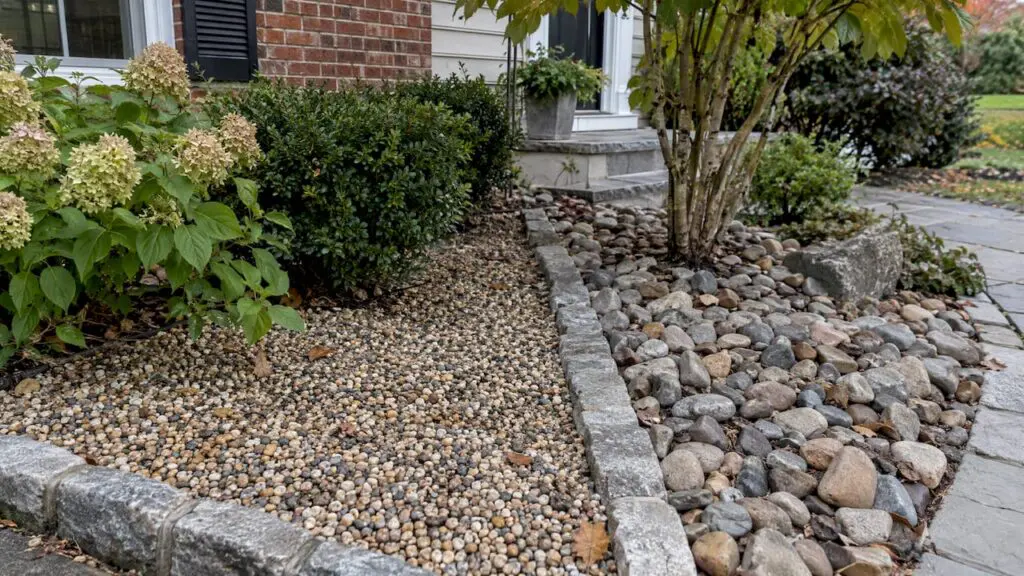
Choose pea gravel for small, comfortable-underfoot areas such as garden paths, patio surrounds and play areas. Choose river rock for planting beds, borders, dry creek beds and anywhere water needs a heavier stone that stays put. Both are smooth and rounded, so both roll, both need edging, and neither will hold up well as a driveway surface without a properly built base underneath.
That is the short version. The rest of this guide covers the details that decide whether the stone you pick still looks good in five years: size, drainage, walkability, heat, upkeep and what New Jersey winters do to a poorly built bed.
Quick answer: which stone for which job
-
Pea gravel is typically about 3/8 inch, smooth and rounded. It suits paths, borders and garden beds where a soft, polished look matters, but it does not lock together, so it is a poor fit for driveways and heavy traffic.
-
River rock starts around 3/4 inch and runs up to cobble-sized stones. Larger pieces are the better choice for dry creek beds, bed borders and spots that see heavy runoff.
-
Foot traffic: pea gravel is the more comfortable of the two to walk on. Large river rock is hard on ankles and shoes.
-
Drainage behind walls, around foundations and in French drains: neither is the standard answer. Angular crushed stone is.
-
Whatever you choose, the base and the edging matter more than the stone.
What actually separates the two stones
The names get used loosely. Some homeowners call anything small and round “river rock,” and some suppliers sell large pea gravel under that label. The useful way to tell them apart is by size and by what you plan to ask of them.
| Feature | Pea gravel | River rock |
|---|---|---|
| Typical size | About 3/8 inch | 3/4 inch to several inches |
| Shape | Small, smooth, rounded | Larger, smooth, rounded |
| Underfoot | Comfortable, shifts a little | Uneven, hard to walk on in larger sizes |
| Best uses | Paths, patio surrounds, borders, play areas | Dry creek beds, bed borders, erosion-prone slopes, ground cover |
| Stays in place in heavy rain | Poorly on slopes | Better, especially in larger sizes |
| Weed and leaf cleanup | Small stones trap debris and are harder to rake | Easier to blow and pick debris off |
The size figures come from the federal NRCS aggregate surfacing guide, which puts pea gravel near 3/8 inch and river rock from 3/4 inch up. Large river gravel and cobbles run from 1 1/4 inches to 8 inches, according to a Washington State landscaping materials guide.
One practical point about the other searches people run on this topic: “river stone” and “river rock” mean the same thing at the supply yard. If a quote lists both, ask for the actual size in inches.
Look and feel in a New Jersey yard
Pea gravel reads as fine-grained and soft. It blends into a cottage-style garden, a patio border or a walkway beside a house with traditional lines. Its earth-tone mixes of tan, gray and rust look natural against the stone, brick and shingle common in Morris County.
River rock has more presence. Larger stones create stronger visual focal points, and they define a bed edge or a dry creek bed in a way small gravel cannot. Used in a front yard, they give planting beds a clean, graphic outline. If you are planning a whole-yard refresh, our guide to front yard landscaping ideas for NJ homes shows how stone fits with plantings and hardscape.
Color matters more than most people expect. Test a handful in daylight next to your siding and roof. Wet stone looks darker and richer than dry stone, so look at it after a rinse as well.
Drainage: where homeowners get it wrong
Both stones are porous in bulk, so water moves through them. That leads people to assume either one is a drainage solution. It is not that simple.
-
Surface drainage and dry creek beds: river rock is the workhorse. Heavier stones resist being carried off. For areas with fast runoff, cobble-sized river rock in the 1 1/4 to 8 inch range is the usual guidance, because small stones get washed downslope.
-
Pea gravel on slopes: it scatters. On a grade, expect it to migrate during a hard storm.
-
French drains and foundation drainage: the common trade standard is #57 crushed stone, about 3/4 inch, whose angular edges leave stable void space for water. We recommend it over rounded stone for those jobs.
Northern New Jersey adds a wrinkle. Many Morris and Somerset County properties sit on compact glacial till, red shale or clay-rich soil that drains slowly. In that ground, the stone you pick is secondary to what sits beneath it. A graded, compacted base that sheds water away from the house does more than any decorative layer.
Walkability, traffic and the rolling problem
Rounded stones roll against each other. That is what makes pea gravel pleasant to look at and slightly unstable to walk on. On a garden path it feels soft. On a steep path, a driveway or a wheelchair route, it feels like walking on marbles.
The same NRCS guidance says rounded pea gravel does not compact and is a poor choice for driveways or heavy-traffic paths. A Washington State guide makes the contrast plain: clean crushed rock stays in place better than rounded rock. For parking areas, plan on angular stone over a compacted base, or a paved surface. If you are weighing surfaces for a parking area and want to know how each one ages and gets cleaned, this piece on matching material to traffic and pressure washing driveways is a useful read.
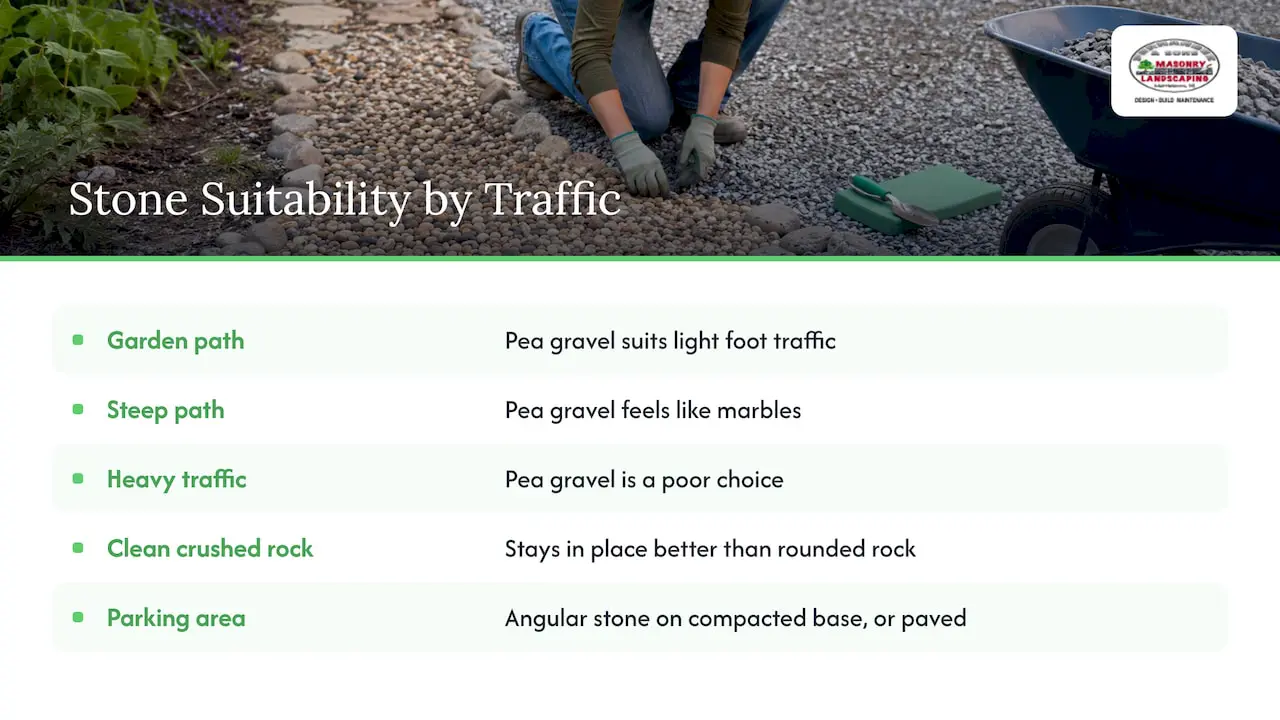
For a garden path with light foot traffic, pea gravel is a good call. For a main route from the driveway to the front door, we usually steer clients toward something firmer.
When flagstone or bluestone is the better path
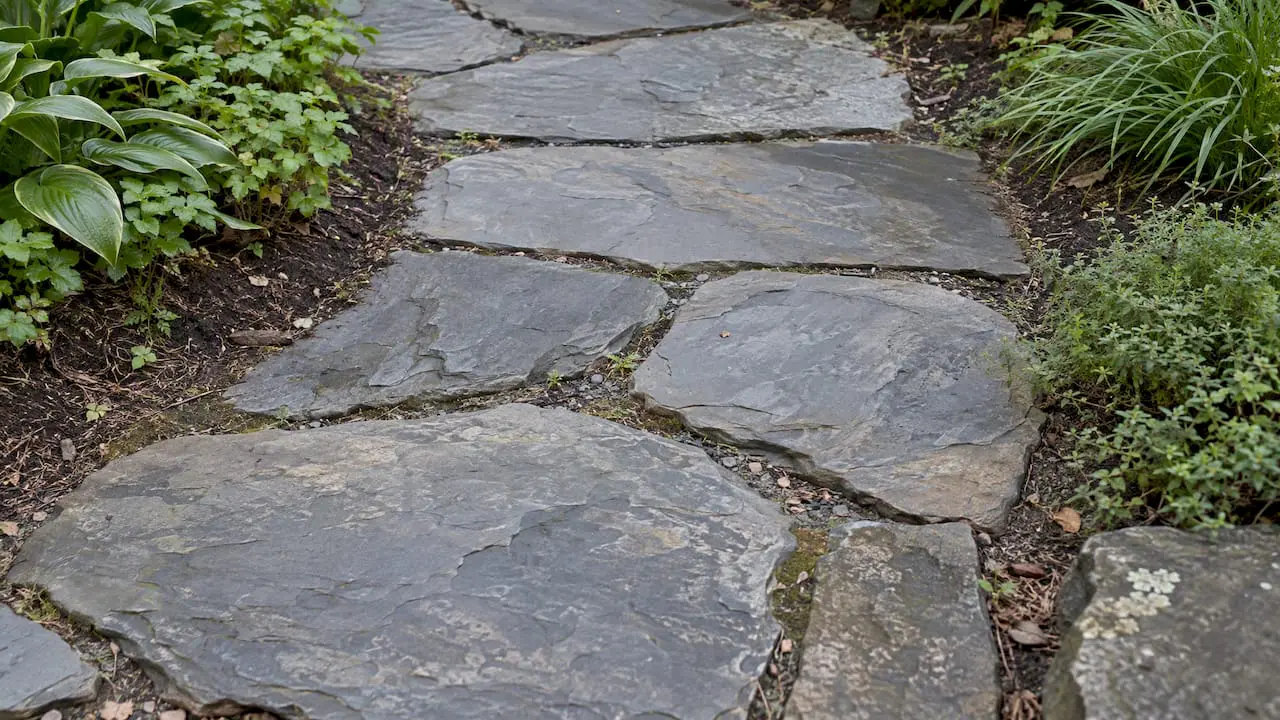
If you are comparing loose stone with a solid path surface, you will run into natural cleft and thermal bluestone. Natural cleft has a split, slightly irregular face that gives a rustic look and some texture. Thermal finishes are flatter and more uniform, which suits tighter joints and furniture that needs a level surface. Irregular flagstone suits informal paths with gaps for groundcover. Cut stone suits formal, tightly fitted layouts. None of these roll under your feet, and all of them clear snow more easily than loose gravel. Our patio installation guide for NJ goes through materials, design and cost for those solid surfaces.
Stone as mulch: what it does to plants
Many homeowners use either stone as a bed cover. It works, with trade-offs. Colorado State University Extension notes that gravel and rock are inorganic mulches, unlike wood chips or bark, and they behave differently around plants. Stone holds heat and does not feed the soil as organic mulch does.
In practice:
-
Stone suits foundation plantings, shrubs and perennials that tolerate warm roots.
-
It is a weaker choice for tender annuals and vegetable beds.
-
Leaves and seed settle between small stones and sprout, so pea gravel beds need regular cleanup.
-
Landscape fabric under stone helps, but it is not permanent. Soil and debris build up on top over the years.
If you are still deciding between stone, wood mulch and bare soil for your beds, our comparison of decorative rocks vs. mulch vs. soil lays out the pros and cons.
Cost, in plain terms
Prices for both stones vary by supplier, delivery distance and season, so we will not quote a per-ton figure here. Generally, loose stone is the budget option: gravel is usually less expensive than concrete or pavers and needs less planning, according to University of California Cooperative Extension. The real cost is in the prep. Excavation, a base, fabric and edging often cost more than the stone itself, and skipping them costs you later in refills.
When you compare quotes, check that each one lists:
-
Stone type and size in inches
-
Depth of the finished layer
-
Excavation and base material
-
Fabric and edging
-
Haul-away of excavated soil
Our 8 checks to run before choosing a landscaper in NJ explains how to read an estimate line by line.
How to build it so it lasts
The most common failure we see is stone dumped straight on soil. Within a season or two it sinks, the low spots fill with mud and the bed needs topping up. Freeze-thaw cycles move the ground in New Jersey, and a thin bed with no base moves with it.
A sound installation follows these steps:
-
Mark and excavate to the depth for base plus stone. For light-use paths, that is typically several inches. Heavier use needs more.
-
Grade for drainage, with a slight slope away from the house.
-
Install geotextile fabric between the soil and the aggregate. Penn State Extension advises fabric between native soil and the aggregate base to stop stone from sinking into the subsoil. That page covers livestock turnouts, but the principle of separating stone from soft ground applies to any loose-stone surface.
-
Add a compacted base of crushed stone or quarry process. Compaction is what gives the surface stability. Rounded stone cannot do it.
-
Set firm edging, such as steel, stone or a concrete or paver border. Loose stone migrates into lawns and beds without it.
-
Spread the decorative layer. For pea gravel, typically 2 inches is plenty. River rock usually needs enough depth to cover the fabric completely.
For garden paths where you want clean lines, we often combine a paver or stone border with a pea gravel center. Our paver and patio projects show how edges and surfaces are paired.
Our perspective: choose by the job, not the trend
We work on residential and commercial properties across Morris and Somerset Counties, and the question we hear most is which stone looks better. The better question is what the stone has to do.
When a client wants a comfortable, soft path through a garden, we lean toward pea gravel with a firm edge. When a client has a bed border, a dry creek bed or a spot where water runs hard, we lean toward river rock in a size matched to the flow. When the real issue is water at the foundation or a retaining wall, we do not treat it as a decorative choice at all. That is a drainage design problem, and it gets angular stone and a proper base.
We also think about winter. Loose stone and snow plowing do not mix well. A plow blade can scatter pea gravel across a lawn, so we advise clients who plan to plow a driveway or a lot to choose a different surface. Because we handle both construction and seasonal maintenance, we can plan a surface around how you will actually use and maintain it year-round.
If stone is meant to hold soil back, a wall is often the better answer. Our guide to retaining wall materials explains how to choose by site, code and cost.
Mistakes that shorten the life of a stone bed
-
No edging. Stone ends up in the lawn and gets hit by the mower.
-
Pea gravel on a slope. It runs downhill in the first heavy storm.
-
Choosing stone that is too small for the water load. Fast-moving water moves small stones.
-
No base. Stone sinks and the bed turns muddy.
-
Using stone against the foundation without a plan for water. Grade and drainage come first.
-
Leaf buildup ignored. Organic debris becomes soil, then weeds.
Planning a stone project with Fernandez & Sons
If you want a path, border or bed built correctly the first time, we offer free estimates and a satisfaction guarantee on landscape design, masonry and hardscaping across Morris and Somerset Counties. We can look at your grading, soil and traffic, then recommend the stone, the base and the edging. Start with our landscaping and design services or contact us through our home page.
FAQ
Is pea gravel or river rock better for drainage?
Neither is the best choice for structural drainage such as French drains. Angular #57 crushed stone is the usual standard there. For surface runoff and dry creek beds, larger river rock is better because heavier stones resist being washed away.
What size river rock should I use for landscaping?
For bed borders and ground cover, stones in the 1 to 3 inch range are common. For areas with fast water flow, larger cobbles of about 1 1/4 to 8 inches hold up better. Match the size to the water load, not just to the look.
Is pea gravel good for a walkway?
Yes, for light-use garden paths. It is comfortable underfoot and looks soft. It does not compact, so it needs firm edging and a compacted base, and it is a poor choice for steep paths or heavy traffic.
Can I use pea gravel on a driveway?
We do not recommend it. Rounded stones do not lock together, so they shift under tires and spread. Angular stone over a compacted base, or a paved surface, performs better.
Where the stone guidance in this article comes from
-
Washington State Department of Ecology Yard Program Landscaping Materials Guide
-
Colorado State University Extension: Mulches for Home Grounds
-
University of California Cooperative Extension: Gravel Pathways in the Garden
-
Penn State Extension: Options for Quick-Fix Mud-Free Turnouts
-
Matching material to traffic: driveway pressure washing for homeowners