
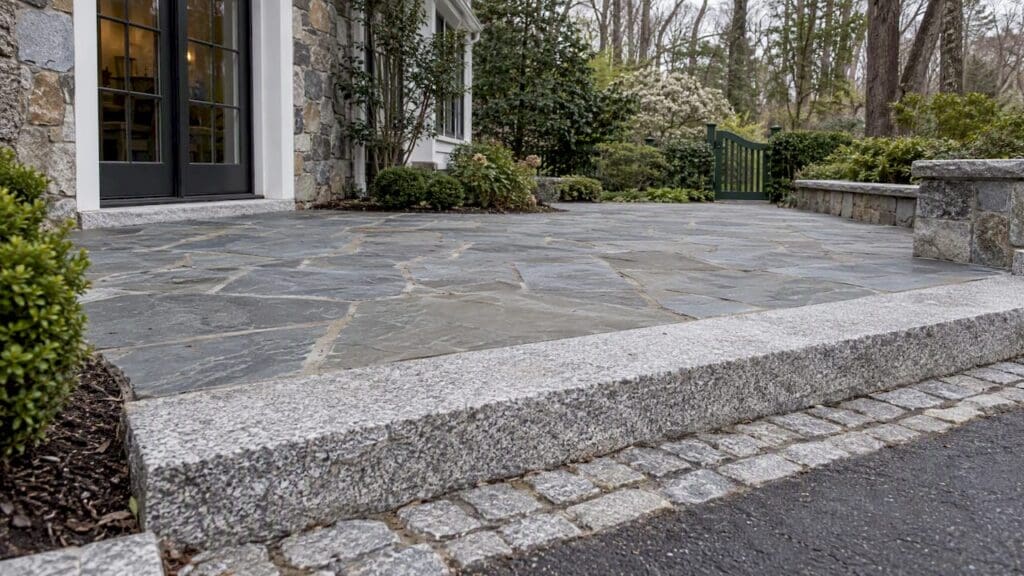
Choose bluestone for patios, walkways and fully supported steps when you want a natural blue-gray look at a moderate price. Choose granite when the surface takes heavy wear, spans open air, or needs the hardest, least porous stone you can buy. For many Morris and Somerset County homes, the best answer is both: a bluestone field with granite steps or accents. Below we compare the two stones on durability, winter performance, appearance, steps and cost, and we explain where travertine fits.
Quick Answers
-
Bluestone is a dense sandstone with a natural, varied color. Granite is harder and less porous, so it resists staining and freeze-thaw damage better.
-
For New Jersey winters, either stone performs when it is set on a compacted, well-drained base. Avoid rock salt on both.
-
Bluestone suits patios, walkways and supported steps. Granite suits heavy-use, open-span and formal steps, and driveways.
-
Installed prices overlap, and the details of the job (thickness, base, access, pattern) move the total more than the stone name.
-
Travertine looks elegant but is a limestone, so it asks for more care in a freeze-thaw climate.
What Each Stone Actually Is
Bluestone
Bluestone is the name for a dense, fine-grained sandstone quarried mainly in New York and Pennsylvania. A 2025 New York and New Jersey stone comparison describes its tones as blue-gray, green, lilac and rust, with natural variation from piece to piece. That variation is part of the appeal. A bluestone patio reads as warm and organic, and no two slabs look alike.
Bluestone is sold in two common forms. Irregular pieces (often called flagstone) create a natural, puzzle-like pattern. Cut rectangular pieces (called patterned or dimensional bluestone) create a cleaner, more formal layout. Both can have a natural-cleft surface, which has a textured, slightly uneven face, or a thermal finish, which is flame-textured for a more even, slip-resistant face.
Granite
Granite is an igneous stone, formed from cooled magma, which is why it is so hard and so tightly bound. The Natural Stone Institute says granite is well suited to exterior paving because of its strength, abrasion resistance and weathering durability, and it also reports that granite has resisted snow-melting chemicals in northern climates. It is sold in a wide range of colors, from soft gray to warm tan, pink and near-black, so you can match a house in ways bluestone cannot.
In outdoor work, granite shows up as cut pavers, cobblestones, steps, treads, curbing and coping. Many homeowners picture a polished kitchen countertop, but outdoor granite is almost never polished, for reasons we cover below.
Bluestone vs Granite Side by Side
| Factor | Bluestone | Granite |
|---|---|---|
| Stone type | Dense sandstone | Igneous stone |
| Typical look | Blue-gray with green, lilac and rust variation | Wide color range, speckled or uniform |
| Hardness and wear | Durable for residential use | Exceptionally hard, suited to heavy traffic |
| Porosity | More porous, so sealing helps | Less porous, resists staining |
| Freeze-thaw | Good when dense and well installed | Very good |
| Best uses | Patios, walkways, supported steps, pool decks | Steps, driveways, curbs, accents, open-span treads |
| Maintenance | Periodic sealing and cleaning | Lighter upkeep |
Durability and Weather Resistance in New Jersey
New Jersey’s real stone test is not summer sun. It is dozens of freeze-thaw cycles each winter, plus the de-icing products people spread to stay safe. Water that enters a stone freezes, expands and can flake the surface. The less water a stone absorbs, the better it handles this.
That is where granite has its edge. Use Natural Stone describes granite as exceptionally hard and highly resistant to heat, scratching and staining, and recommends it where permanence and low deterioration matter, including steps, terraces and driveways. The New York and New Jersey comparison mentioned above notes that bluestone is more porous than granite, so absorbed moisture can contribute to staining and freeze-thaw damage. It recommends high-density material and periodic sealing, and it warns that lower-quality bluestone can spall, meaning the surface flakes away.
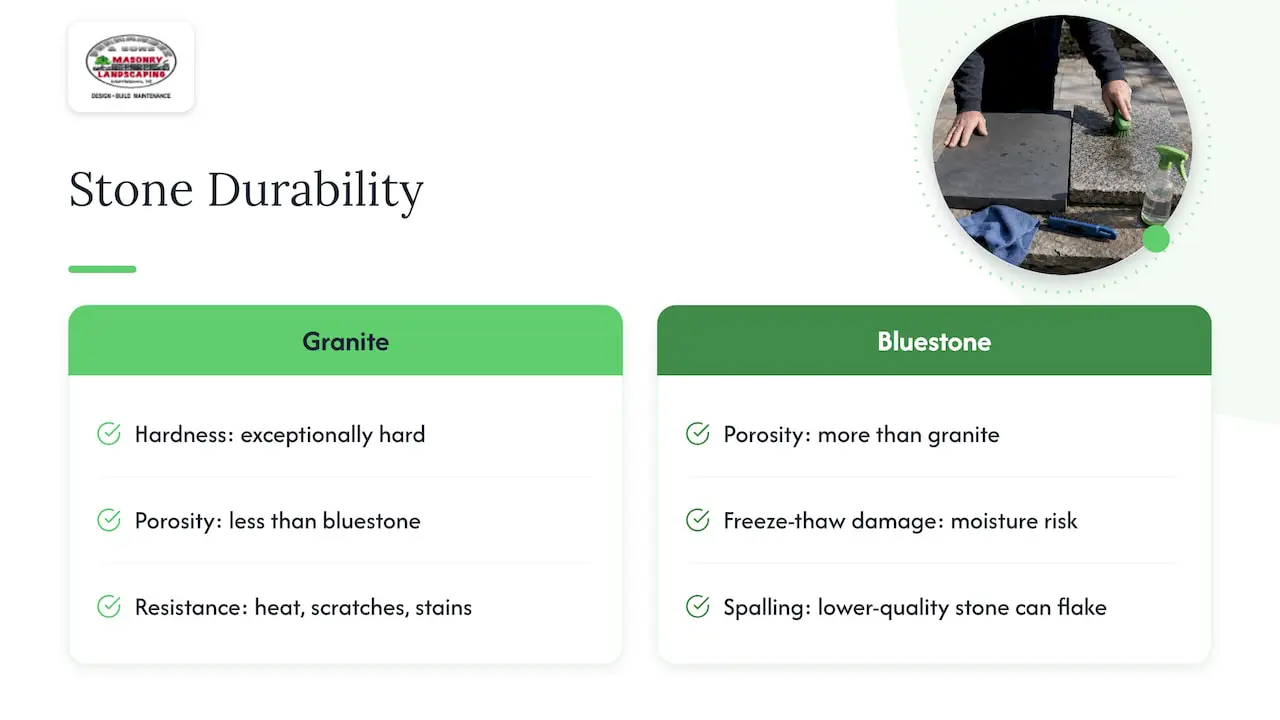
The practical takeaway: dense, quality bluestone performs well here, which is why it is so common in the region, but the quality of the stone and the installation matter more than they do with granite. Ask your contractor where the stone was quarried and how thick it is.
Why the Base Matters More Than the Stone
Most failures we see in hardscapes trace back to the base, not the surface. A stone set over poorly compacted soil or a base that holds water will heave and settle no matter how hard it is. A compacted gravel base with proper drainage is the foundation for either material. Our guide to freeze-thaw rules for pavers explains base depth and drainage in detail. If you are curious about the aggregate itself, this comparison of 304 versus 411 limestone shows how base stone types differ in a driveway context.
De-Icing and Winter Care
Whatever stone you choose, do not use standard rock salt (sodium chloride) on steps and walkways. One stone installation guide recommends calcium magnesium acetate de-icers instead if ice treatment is needed. Shoveling early reduces how much de-icer you need at all. We cover the habits that protect stone in shovel first and ice melt rules for NJ homeowners, and our seasonal exterior stone care guide covers sealing and cleaning through the year.
Appearance and Style
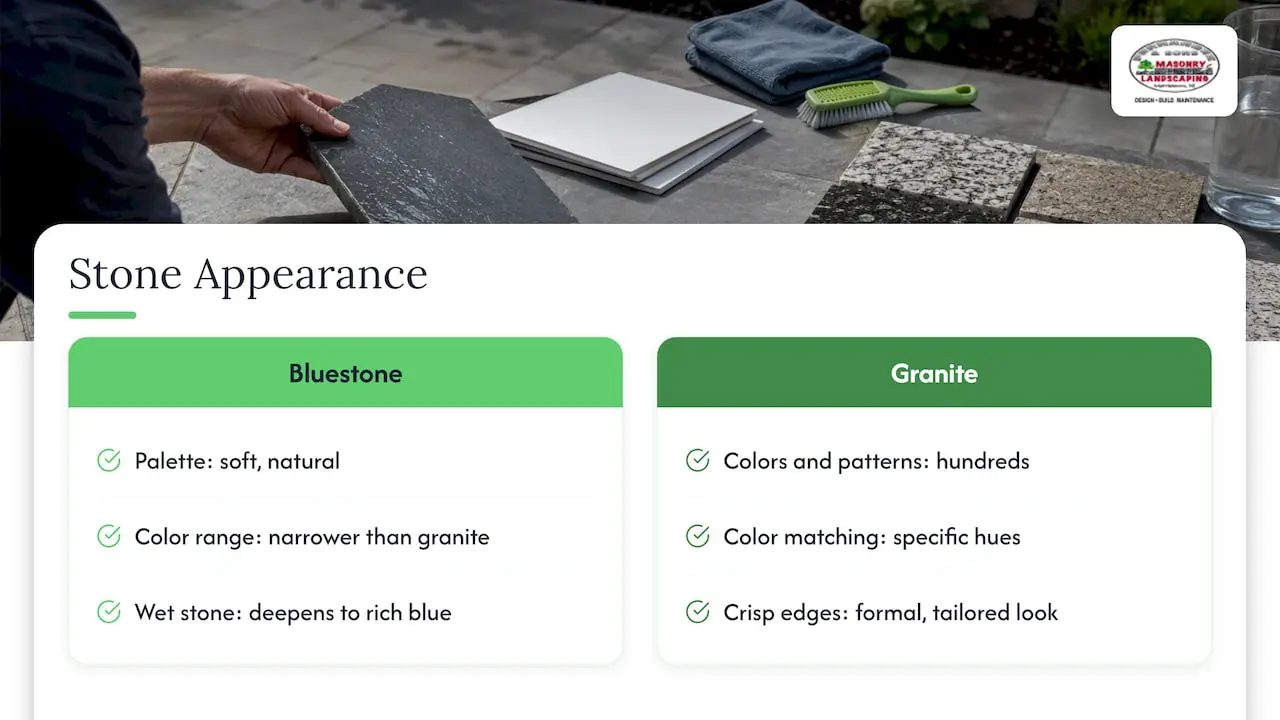
Bluestone gives you a soft, natural palette that sits comfortably beside most Northern New Jersey landscapes: wooded lots in Mendham and Mountain Lakes, stone-faced colonials in Far Hills, and newer homes in Parsippany and East Hanover. The color range is narrower than granite’s, but the variation within a single patio gives it depth. Wet bluestone deepens to a rich blue, which many homeowners love beside a pool.
Granite is the better choice when you need to coordinate with a specific color: a warm tan to match a brick facade, or a cool gray beside a modern home. It can also be cut into very crisp edges, so it reads as more formal and tailored. Its hundreds of available colors and patterns, as reported by Use Natural Stone, give designers far more room than bluestone does.
One combination works especially well: a bluestone field with granite accents, such as granite steps or a cobble apron along the edge. One regional stone supplier describes this pairing as a mature choice for higher-end properties, and it is a look we can build into outdoor living spaces, walkways and entries.
Bluestone vs Granite Steps
Steps are where the two stones differ most, because they carry the greatest safety and load demands.
Bluestone steps work best when every tread is fully supported, such as treads set over a solid masonry or concrete frame. Natural-cleft or thermal finishes provide traction. Bluestone is a good fit for porches, garden steps and landings that feel part of the patio.
Granite steps suit heavy-use entries, formal front steps and any tread that spans open space between supports, because the stone is stronger and can be cut thicker without cracking. According to a company guide to bluestone and granite steps, you should specify appropriate tread thickness and depth, textured finishes, and a compacted gravel base with proper drainage. Since that comes from a supplier, treat the exact dimensions as a starting point and confirm them with your mason and local code.
Traction and Finish
Polished granite becomes slippery when wet, and one stone supplier advises against it for outdoor floors, recommending a flamed or thermal finish for walking surfaces. In a state with icy mornings, that choice matters. Ask for a flamed or thermal finish on any outdoor granite step, and a natural-cleft or thermal finish on bluestone.
For layouts, riser heights and tread depths, see our guide to stone steps design for NJ homes and a look at our step projects.
Bluestone vs Granite Cost
Prices vary by region, thickness, pattern and site access, so treat any figure as a range and get a written estimate for your property. Published national guides give a sense of scale:
-
Bluestone patios: one 2026 estimator puts installed bluestone at $16 to $35 per square foot, about $6,400 to $14,000 for a 400-square-foot patio.
-
Granite pavers: a cost guide estimates a 10 by 20 foot granite paver patio at $3,800 to $6,400 total, which works out to roughly $19 to $32 per square foot for 200 square feet.
The ranges overlap heavily. That tells you that the stone name alone does not set the price. What does:
-
Thickness and size. Thicker, larger pieces cost more to quarry, ship and set.
-
Finish. Thermal or flamed finishes add processing.
-
Pattern. Irregular flagstone often takes more cutting and fitting labor than uniform pavers.
-
Base and drainage. A proper compacted base is where a lasting job gets its money’s worth.
-
Site conditions. Slopes, tight access, tree roots and old-patio removal all add labor.
-
Edges and details. Steps, curves, borders and walls cost more than open field.
Our bluestone patio cost guide walks through budgeting in more detail. We do not publish set prices because every yard is different, but our estimates are free.
Where Travertine Fits
Homeowners often ask us to compare travertine and bluestone, so here is the short version. Travertine is a form of limestone with a soft, creamy look that stays cooler underfoot in the sun, which is why it is popular around pools. Limestone is generally softer and more porous than bluestone and is susceptible to acids, as a recent stone comparison and the wider limestone guidance note, so harsh cleaners and de-icers can etch it.
In a freeze-thaw climate, that means travertine needs a quality base, sealing and gentler care than bluestone. It can work well in sheltered spots, but for exposed walkways and steps in Morris County we usually lean toward bluestone or granite.
On price, travertine is not automatically cheaper. One cost guide lists travertine pavers at $5 to $30 per square foot for materials and $13 to $45 installed, a range wide enough to overlap both bluestone and granite. Compare actual quotes for the same layout rather than relying on stone type.
Our Perspective on Choosing Between Them
We build with both stones, and we rarely tell a homeowner that one is simply better. We start with how the space will be used. A family patio with a grill and a dining table is a natural home for bluestone. A front entry that sees daily traffic, salt tracked in from the driveway and heavy deliveries may be better served by granite steps. A pool deck needs a textured, slip-resistant finish above all.
Then we look at the site: drainage, grade, sun exposure and where snow gets piled. Most of the problems we are called to repair began below the surface, with a base that was too thin or drained poorly. So we put as much effort into excavation, compaction and drainage as we do into stone selection. Our crews work across Morris and Somerset Counties, so we know how local soil, frost and winter plowing treat a hardscape over time.
If you are weighing a bluestone patio, our contractor notes on bluestone pros and cons cover the tradeoffs candidly.
— Fernandez & Sons Masonry & Landscaping
Which Stone for Which Project
-
Patio: Bluestone is the classic pick. Use thermal finish near a grill or pool. Granite pavers suit a more formal, uniform look.
-
Walkway: Either works. Bluestone gives an informal garden feel, and granite handles heavy use and plowing better. See our paver walkway ideas.
-
Front steps: Granite is the safer choice for open-span or heavily used steps. Bluestone fits fully supported steps.
-
Pool deck and coping: Choose a textured finish. Bluestone is popular for its look and slightly cooler surface, while granite coping resists staining and wear.
-
Fireplace hearth: Granite handles heat well, and bluestone is an option but is thick and heavy.
-
Driveway: Granite pavers or cobbles tolerate vehicle loads best, as long as the base is built for them. Our driveway projects show the range.
-
Outdoor kitchen: Granite counters resist stains from food and grease, and bluestone or stone veneer can tie the structure to the patio. See our outdoor kitchen layout guide.
Plan Your Stone Project With Fernandez & Sons
We design and build patios, walkways, steps, retaining walls, pool decks, outdoor kitchens and fire features for homeowners and commercial properties in Morris and Somerset Counties. We offer free estimates and a satisfaction guarantee. If you are deciding between bluestone and granite, we can bring samples to your property, look at drainage and traffic, and give you a written recommendation. Explore our masonry and hardscaping services or our patio projects.

We also handle winter, with snow plowing for homes and businesses, so the stone we install is cared for by a crew that knows what it needs.
Frequently Asked Questions About Bluestone and Granite
Is Granite Better Than Bluestone for Outdoor Use?
Granite is harder and less porous, so it resists staining and freeze-thaw wear better. Bluestone is still a durable, popular choice when the stone is dense and the base is built well. The better pick depends on the use: granite for heavy traffic and open-span steps, bluestone for patios and supported steps.
Is Bluestone or Granite Cheaper?
Their installed ranges overlap, so neither is reliably cheaper. Thickness, finish, pattern, base work and site access shape the price more than the stone name. Ask for itemized quotes for the same layout and compare them line by line.
Is Bluestone Slippery When Wet?
Natural-cleft and thermal-finish bluestone give good traction, but any smooth stone gets slick with ice or algae. Keep surfaces clean, shovel promptly and avoid rock salt. Ask your mason for a textured finish on steps and pool decks.
Is Travertine a Good Alternative to Bluestone in New Jersey?
Travertine can work in sheltered spaces, but it is a softer, more porous limestone that is sensitive to acidic cleaners and harsh de-icers. It needs sealing and a well-drained base. For exposed steps and walkways, bluestone or granite is usually the lower-maintenance choice.
Can I Use Bluestone and Granite Together?
Yes, and it is a common pairing. A bluestone patio with granite steps or a granite cobble border adds strength where it is needed and visual contrast where it looks best.
Get a Free Stone Estimate in Morris and Somerset Counties
If you are planning a patio, walkway or set of steps in Parsippany, Morris Plains, Dover, East Hanover or anywhere nearby, call Fernandez & Sons for a free estimate. We will walk the property, show you bluestone and granite samples in your own light, and build a plan around your budget and your winters. Start at fernandeznsons.com and tell us about your project.