Thin stone veneer is real quarried stone cut to roughly 1 inch thick. It is adhered to a wall and needs no extra support. Full stone, also called full-bed or full-dimensional stone, is 3 to 5 inches deep and rests on a ledge or foundation. For most house walls, fireplace surrounds, chimneys and outdoor kitchen bases in Morris and Somerset Counties, thin veneer gives you the look of solid stone with far less structure underneath. Full-bed stone earns its place where mass is part of the design, such as retaining walls, freestanding columns and outdoor fireplaces.
Below is how the two compare on thickness, weight, installation, cost, appearance and upkeep, plus how to match each to the project you have in mind.
Things to Consider
-
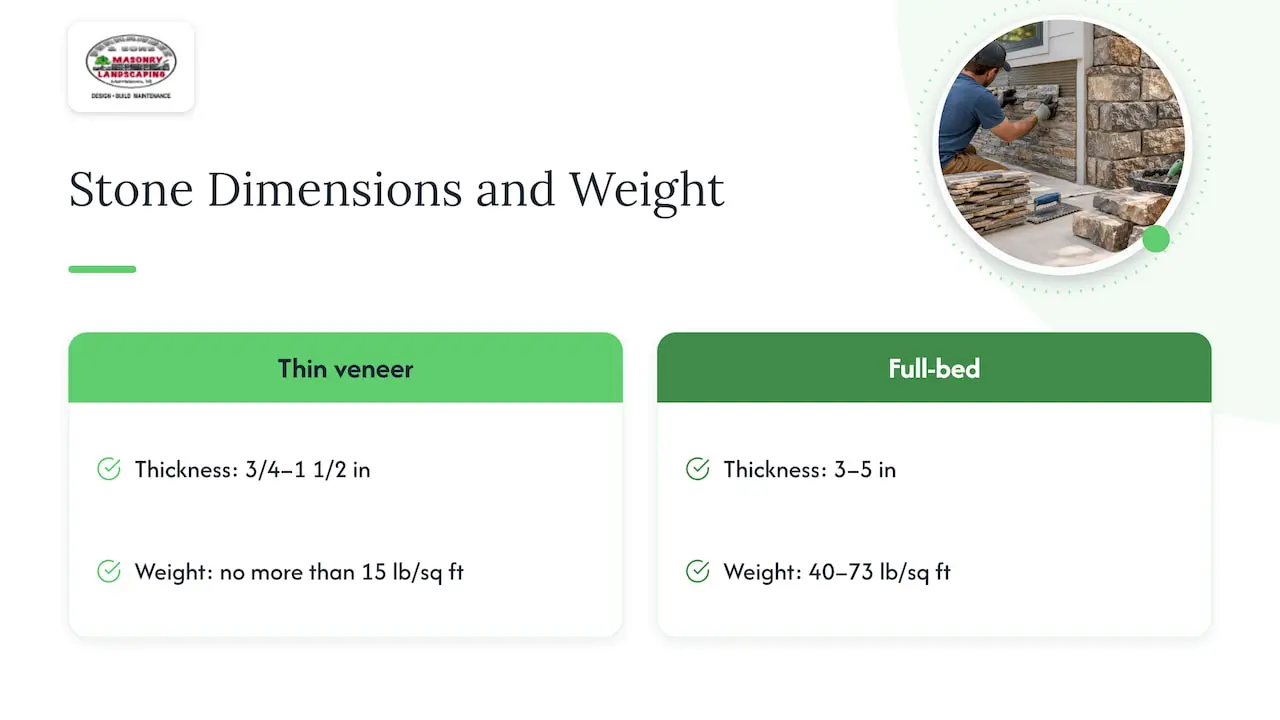
Thin natural veneer is normally 3/4 to 1-1/2 inches thick and no more than 15 lb per sq ft. Full-bed stone is typically 3 to 5 inches deep and 40 to 73 lb per sq ft, depending on the stone.
-
Thin veneer is adhered to the wall. Full-bed stone sits on a ledge incorporated with the foundation and is tied back to the wall.
-
Both are real stone with a very long service life when installed properly, so the choice is mostly about structure, site and budget.
-
Use thin veneer for walls, chimneys, fireplace faces and kitchen bases. Use full-bed stone for retaining walls, columns, gate piers and fireplaces designed as freestanding masses.
-
A free on-site estimate from a Morris County mason settles the question faster than any chart.
What Stone Veneer and Full Stone Actually Mean
The terms cause confusion because every stone product used on a wall face is a veneer in the broad sense. The difference is thickness and how the stone is carried.
Thin stone veneer is genuine quarried stone, sliced or split thin. The Building Stone Institute’s technical guide describes it as normally 3/4 to 1-1/2 inches thick and no more than 15 lb per sq ft, designed for lightweight, non-structural installation. One stone supplier explains that it is the same stone as the full-thickness version cut to about 1 inch, at roughly 13 lb per sq ft.
Full-bed stone is the traditional thickness. The same institute guide gives typical full-dimensional stone as 3 to 5 inches deep and 40 to 73 lb per sq ft, with weight varying by stone density. Masonry Magazine’s primer on natural stone also places full veneer at a nominal 3 to 5 inches.
One point worth clearing up: thin veneer is not the same as manufactured (faux) stone. Natural thin veneer is the real rock. Manufactured stone is a cast product. Everything in this article about thin veneer refers to natural stone.
Side-by-Side Comparison
| Factor | Natural Thin Veneer | Full-Bed Stone |
|---|---|---|
| Typical thickness | 3/4 to 1-1/2 in. | 3 to 5 in. |
| Typical weight | Up to 15 lb per sq ft | 40 to 73 lb per sq ft (varies by stone) |
| Support | Adhered to the wall, no ledge needed | Ledge incorporated with the foundation, plus wall ties |
| Installed cost (national) | $18 to $45 per sq ft | $25 to $50+ per sq ft |
| Best uses | House walls, chimneys, fireplace faces, kitchen bases, retrofits | Retaining walls, columns, gate piers, freestanding fireplaces |
| Color | Real mineral color | Real mineral color |
The cost row comes from a published buyer’s guide, which also lists $22 to $60 per sq ft for natural thin veneer in the Northeast. Treat those as ranges, not quotes. Stone type, wall shape, access and prep all move the final number, and we do not publish fixed prices because each site is different.
How Each Type Is Installed and Supported
Thin Veneer: Bonded to the Wall
Thin veneer hangs on the wall surface and does not need its own ledge. According to Masonry Magazine, it is adhered directly to the wall, while full veneer rests on a stone ledge incorporated with the foundation wall and is anchored with wall ties or a similar system.
The wall behind the stone still matters a great deal. For framed exterior walls, the Building Stone Institute guide calls for:
-
A weather-resistant barrier or paper-backed, corrosion-resistant lath
-
A scratch coat
-
Mortar with full coverage on the back of each stone
The same guide says thin veneer can go directly onto sound existing concrete block or brick. Wood surfaces need non-corrosive wire lath and a 1/2 to 1 inch setting mix before the stone is placed. That is why a veneer over an existing brick chimney can be a straightforward job, as we explain in our guide to stone veneer on a chimney over brick.
Lighter weight does not remove moisture management. Current guidance stresses that thin veneer depends on substrate preparation, flashing, drainage and weather barriers, including at transitions and penetrations. The same layered thinking applies to other exterior claddings, and this overview of weather barrier and siding preparation shows why the layers behind a finished wall deserve as much attention as the face.
Full-Bed Stone: Built Up From the Foundation
Full-bed stone is heavy, so it needs a structural path to the ground. One comparison notes it typically needs a foundation ledge or another structural support system. That can mean added footing and reinforcement before a single stone is set, which is where much of its extra cost comes from. For a new addition or a freestanding feature, that planning happens at the design stage, and it is the kind of work a masonry contractor coordinates with the rest of the build.
Cost, Durability, and Appearance
Cost
Thin veneer generally costs less in material and labor. Full-bed work costs more because it can require footing, structural reinforcement and more labor. Handling is easier too: thin pieces are lighter to lift and need less cutting and trimming. The gap narrows on a small project, and it can flip when the structure to carry thin veneer is not already there.
Durability
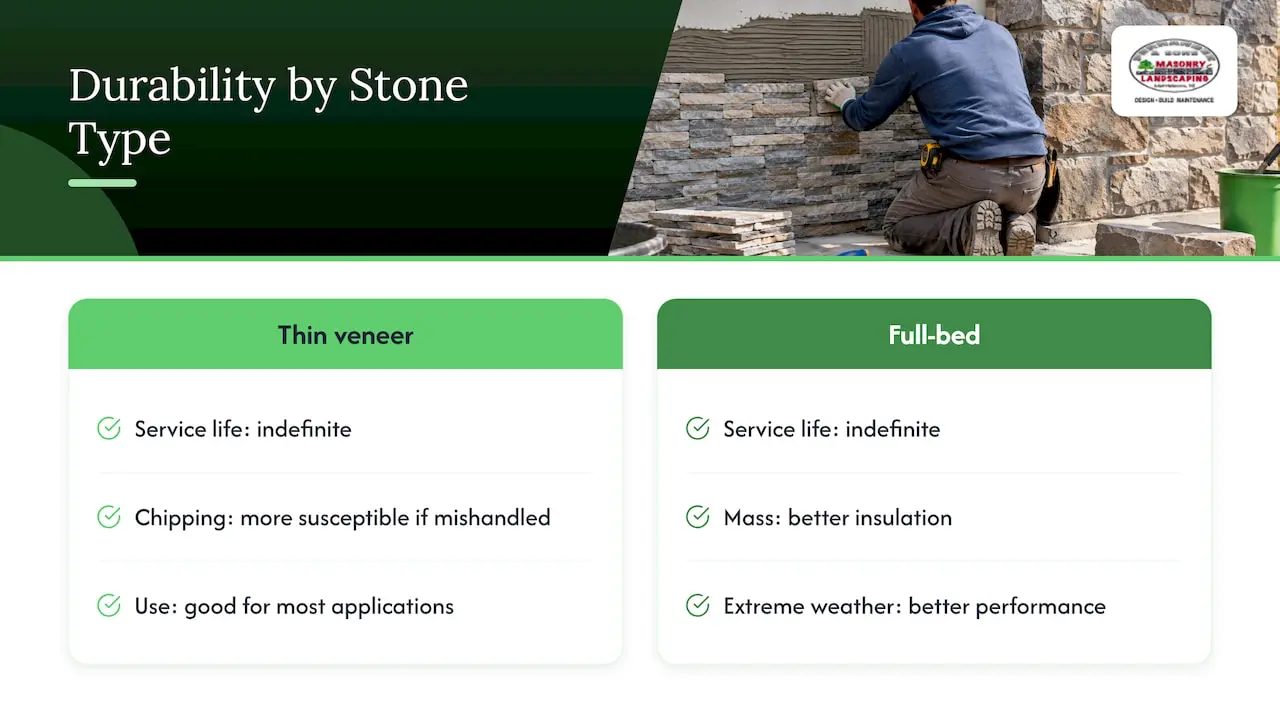
Both are real stone. When properly installed, the buyer’s guide cited above describes an indefinite service life for both thin and full-bed stone. Full-bed pieces have more mass, which one supplier says gives better insulation and performance in extreme weather. Thin pieces are described as good for most applications, though they are more susceptible to chipping if mishandled. With New Jersey’s freeze-thaw winters, the installation details (drainage, flashing, full mortar coverage) matter more than thickness alone.
Appearance
Natural thin veneer keeps the mineral color and natural variation of the quarry stone, and that color does not fade the way some manufactured pigments can. Full-bed stone offers the same color with a deeper profile. On a corner, a thick stone shows its depth, while thin veneer is usually finished with corner pieces made to wrap the edge. Either way, the finished wall reads as stone, and the choice comes down to the structure you want.
Maintenance
Upkeep is similar for both:
-
Clean with a pH-neutral cleaner
-
Inspect mortar joints once a year in freeze-thaw climates
-
If you seal, use a breathable sealer rather than a film-forming one
Our seasonal exterior stone care guide walks through what to check each season on New Jersey homes.
Which Projects Suit Thin Veneer and Which Suit Full-Bed Stone
A useful rule is to ask whether the stone is a skin or a structure. If it is a skin over a wall that already stands, thin veneer fits. If the stone itself is the wall, full-bed fits.
Good Fits for Thin Veneer
-
Home exteriors and accent walls: entry facades, foundation skirts and gable accents
-
Chimneys and fireplace faces: a lighter wrap over existing brick or block
-
Outdoor kitchen bases: stone over a framed or block base, covered in our post on outdoor kitchen cladding materials
-
Retrofits: adding stone to a house without building new footings
-
Interior features: accent walls and hearths
A published comparison lists non-load-bearing surfaces, light commercial façades, interior accents and retrofits as typical thin veneer uses. For ideas on styles and materials, see our stone veneer fireplace ideas.
Good Fits for Full-Bed Stone
-
Retaining walls: the stone’s weight and depth do structural and visual work
-
Freestanding columns and entry piers: mass is part of the look
-
Outdoor fireplaces: a built form rather than a cladding
-
Garden walls: low walls where the stone is the material
The same source lists structural masonry, retaining walls, columns and gates for full-bed stone. A Maryland project write-up shows the split in practice: thin veneer for exterior and interior cladding, and full-thickness stone for an outdoor fireplace and garden walls.
If a retaining wall is on your list, soil, drainage and local code come into play. Our guides to retaining wall materials by site, code and cost and types of retaining walls explain the decisions before you hire.
How to Decide for Your Property
Work through these questions in order:
-
Is there already a wall? If sound brick, block or concrete is in place, thin veneer can go on it. If you are building a new feature from scratch, full-bed becomes an option.
-
Does the stone carry soil or load? Retaining walls and columns point to full-bed. Walls that only need a face point to thin veneer.
-
Is there a ledge or footing? Without one, thin veneer avoids the structural work full-bed needs.
-
What look do you want at corners and edges? Deep, chunky profiles favor full-bed. Clean wraps favor thin veneer.
-
What is your budget range? Start with the national and Northeast ranges above and ask for a site-specific estimate.
A mixed approach is common. A patio might have a thin-veneer kitchen base, a full-bed seat wall and a bluestone surface. Our post on bluestone patio pros and cons is helpful if the surface is still undecided.
Stone Veneer and Masonry Work From Fernandez & Sons
We provide stone veneer installation, chimneys and fireplaces, outdoor kitchens, patios, walkways, retaining walls and pool decks for homeowners and businesses in Morris and Somerset Counties. Our work includes projects in areas such as Parsippany-Troy Hills, Dover, Morris Plains and East Hanover. Free estimates and a satisfaction guarantee come with the work.

You can see finished examples on our stone veneer projects page, learn more about our masonry services, or start from our main site to request an estimate.
Quick Answers: Stone Veneer vs Full Stone
-
Thickness: Thin veneer is about 3/4 to 1-1/2 inches. Full-bed stone is about 3 to 5 inches.
-
Weight: Thin veneer is up to 15 lb per sq ft. Full-bed stone ranges from 40 to 73 lb per sq ft.
-
Support: Thin veneer is adhered to a prepared wall. Full-bed stone needs a ledge or foundation support and wall ties.
-
Cost: Thin veneer typically costs less installed. Full-bed costs more when footings and reinforcement are required.
-
Best for: Thin veneer suits walls, chimneys, fireplace faces and kitchen bases. Full-bed suits retaining walls, columns and freestanding fireplaces.
Frequently Asked Questions About Stone Veneer and Full Stone
Is Thin Stone Veneer Real Stone?
Yes, natural thin veneer is genuine quarried stone cut thinner. It is different from manufactured stone, which is a cast product. Real thin veneer keeps the mineral color and variation of the original rock.
Is Full-Bed Stone Better Than Thin Veneer?
Neither is better in every case. Full-bed stone suits structural uses such as retaining walls and columns, where its mass is part of the design. Thin veneer suits house walls, chimneys and kitchen bases, where the wall behind it already provides support.
Does Thin Veneer Need a Foundation Ledge?
No. Thin veneer is adhered directly to a properly prepared wall and does not need its own ledge. Full-bed stone rests on a ledge incorporated with the foundation and is tied to the wall. The wall behind thin veneer still needs the right barrier, lath and mortar coverage.
Can Stone Veneer Go Over an Existing Brick Chimney?
Often yes. Technical guidance says thin veneer may be applied directly to sound existing brick or concrete block. A mason should check the condition of the brick and mortar first. See our guide on stone veneer over a chimney for the process.
How Do I Get a Stone Veneer Estimate in Morris County?
Contact Fernandez & Sons for a free estimate, and we will look at your wall, chimney or outdoor space in person. We serve homeowners and businesses across Morris and Somerset Counties, including Parsippany-Troy Hills, Dover, Morris Plains and East Hanover. Call us from our website to schedule a visit and plan your stone project before the next building season.