
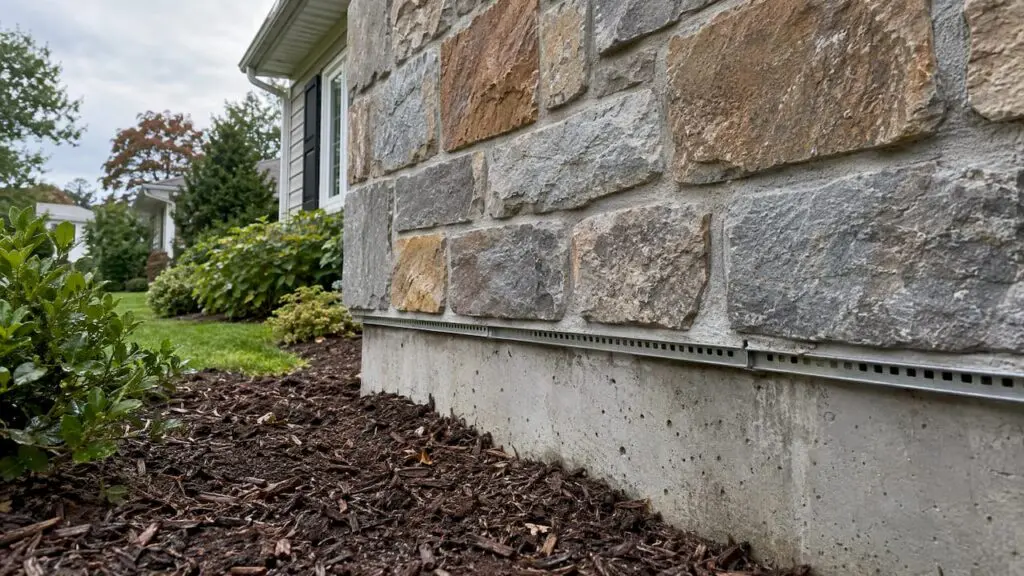
Stone veneer handles New Jersey weather well when the wall behind it is built to drain. Moisture trouble almost never starts with the stone. It starts with missing flashing, a single thin barrier, or no gap for water to escape. For Morris and Somerset County homeowners, the practical answer is a properly layered wall, and that is the standard we build stone veneer to at Fernandez & Sons.
This guide explains where water goes, what a protected wall contains, how stone veneer water damage shows up, and what sealing can and cannot do.
Quick Answer
-
Stone veneer sheds most rain, but some water always reaches the layer behind it, so the wall needs a drainage path.
-
A well-built wall has flashing at the base and over openings, two layers of weather-resistive barrier, and a way for water to exit at the bottom.
-
Wet, freeze-thaw climates like northern New Jersey make joint style, gutters and flashing details matter more.
-
Sealing is optional on most natural stone, and only a breathable penetrating product suits the wall.
-
Stains, white haze, cracks and loose stones are early signs worth having a mason look at.
Where Moisture Comes From in a Stone Veneer Wall
Water reaches the back of a veneer wall three main ways: rain driving through joints and the stone itself, water running down from roofs, windows and ledges, and vapor moving inward after the sun heats a wet wall.
The stone and mortar are porous enough to hold water. Researchers at the USDA Forest Service found that inward moisture from absorptive claddings such as brick, stucco or adhered stone can be significant in wood-frame walls. After rain, sun heats the cladding and pushes stored moisture toward the sheathing.
A 2021 paper from IIBEC, the building enclosure professionals’ institute, notes that manufactured stone veneer allows water to reach the water-resistive barrier behind it. So the design question is not how to keep every drop out. It is how to collect that water and send it back outside.
Why Freeze-Thaw Raises the Stakes
Morris County winters cycle above and below freezing many times. The Concrete Masonry & Hardscapes Association explains that masonry can be damaged during freeze/thaw cycles as moisture inside it expands and contracts. Water that sits in a joint, ledge or cap has far more time to cause harm than water that drains away within minutes.
What Moisture Damage Looks Like
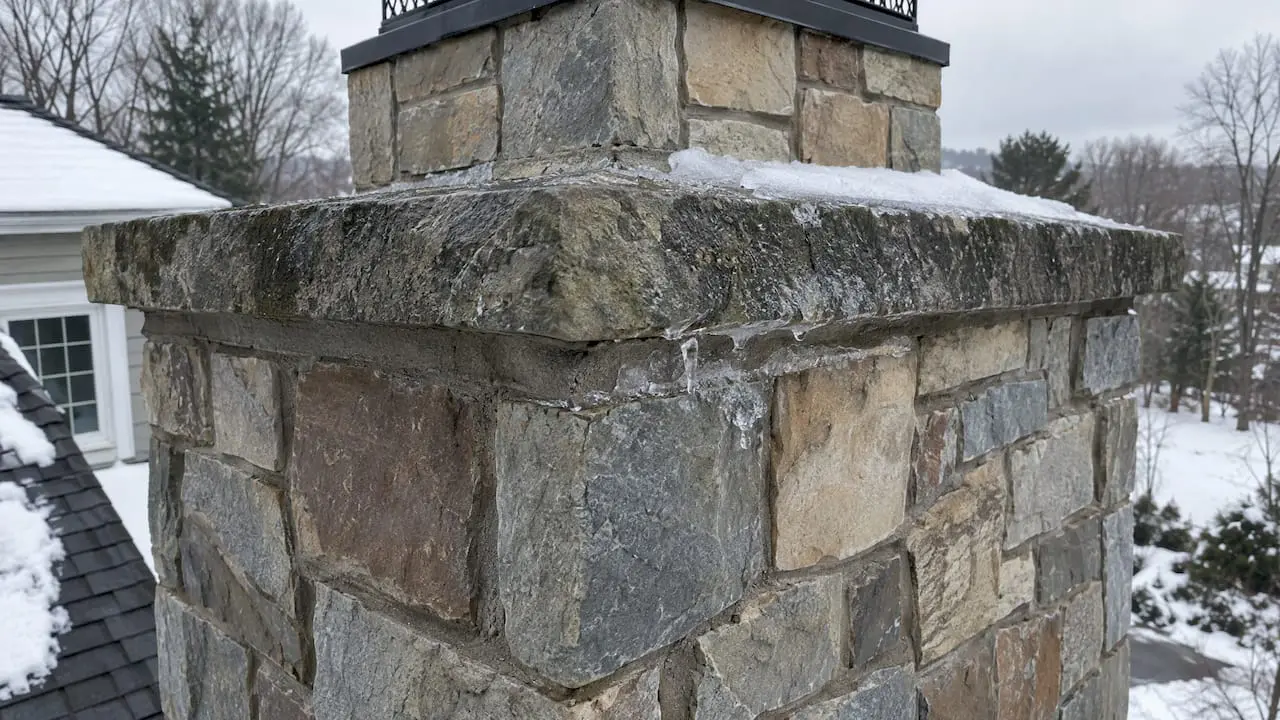
When water gets trapped, the damage tends to show up in the layers behind the stone first, and on the surface later. According to the same CMHA guidance, moisture intrusion can rot wood sheathing and framing, reduce insulation performance, rust metal fasteners and cause efflorescence.
Homeowners usually notice the surface signs:
-
White, chalky haze (efflorescence): salts carried to the surface by moving water. Our guide to removing efflorescence from pavers explains the same mechanism on patios.
-
Staining below windows, ledges or roof lines: a sign water is being diverted onto the stone. Centurion Stone’s instructions warn that missing or incorrect flashing, gutters or downspouts can stain masonry and, with severe freeze-thaw, lead to surface damage.
-
Cracks, spalls or stones that pop off: IIBEC authors describe how swelling wood sheathing pushes on the veneer and causes cracks, spalls and pop-offs. Where metal lath is not fully protected, its corrosion can add to the force.
-
Soft or damp interior walls near the veneer: a reason to have the exterior assessed promptly.
The Cast Stone Institute adds that water ponded under coping can deteriorate mortar through freeze-thaw, which is why caps and tops of walls deserve attention.
What Goes Behind Stone Veneer
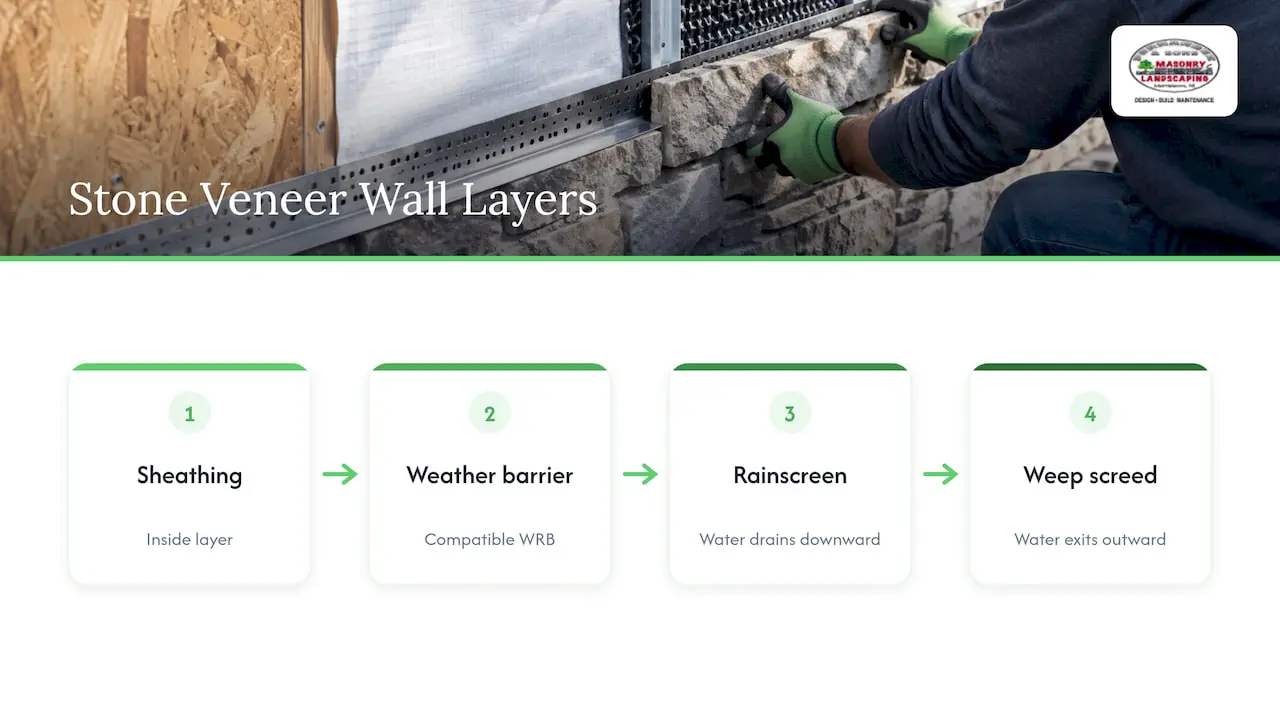
A stone veneer wall that stays dry is a system of layers, working from inside to outside. The CMHA recommends sheathing, a compatible weather-resistive barrier, a rainscreen and a weep screed to drain incidental water.
Flashing First
Flashing is the metal or plastic strip that directs water outward. Centurion’s instructions state flashing must be in place before the weather barrier, so the barrier laps over it and water runs onto it rather than behind it. The same document calls for a foundation weep screed over the flashing at the floor line so moisture can escape and drip away. Old World Stone’s guidelines specify galvanized steel or plastic flashing rather than aluminum.
Two Layers of Weather-Resistive Barrier
Over wood sheathing, the standard for manufactured stone is two separate barrier layers. The NCMA guidance on ASTM C1780 says the layers go on in shingle fashion, with the upper layer lapping the lower by at least 2 inches. Vertical joints lap at least 6 inches, and corners overlap at least 16 inches past the corner in both directions.
The inner layer and the flashing form the drainage plane. The outer layer keeps wet scratch coat from touching the inner barrier, according to the CMHA’s guidance on rainscreens behind manufactured stone veneer.
A Gap for Water to Drain
A rainscreen is a small air space between the barrier and the stone. It lets water run down and breaks the capillary pull that draws moisture sideways. It can be built from drainage mats, formed polymer sheeting, strapping or furring.
Building code is moving in this direction. Engineers at WJE note the 2021 International Building Code requires, in moist climate zones that cover the eastern seaboard, at least a 3/16-inch drainage space or a material with 90% drainage efficiency on the outside of the barrier. Local code applies to each project, and your township’s building department has the final word on what is required.
Weep Openings and Openings Over Windows
Water has to have a way out at the bottom of the wall and above windows and doors. The Cast Stone Institute recommends through-wall flashing and weep holes at the base and at window heads, with continuous, lapped flashing and end dams over openings. For full-height cavity walls it suggests 1-inch-high weep openings spaced no more than 24 inches apart, and it discourages plastic tubes because they clog.
When Concrete or Block Is the Backup
The Building Stone Institute’s installation guide notes that building paper is needed over wood or steel stud sheathing, while concrete block and poured concrete need no moisture barrier. That matters when you are veneering a chimney or foundation wall. See our article on stone veneer over a chimney for how those projects differ.
Joint Style and Design Choices That Help in Freeze-Thaw Weather
The look you pick affects how well the wall sheds water. WJE’s engineers state that a concave, compacted joint is the optimal profile and raked joints hold water on ledges. They also explain that the open joints of a dry stack look collect water and carry it to the mortar layer behind the units, and the Building Stone Institute guide recommends against dry stack in freeze-thaw climates.
For a Morris County home, that points to a few practical choices:
-
A filled, tooled, concave joint for most exterior walls.
-
Caps and sills with flashing underneath them, since these are the spots that stay wet longest.
-
Gutters and downspouts that carry roof water away from the stone, not across it.
-
Grade and drainage at the base of the wall so water does not pool against the bottom course.
The same logic applies to freestanding masonry. Our retaining wall drainage guide and our piece on freeze-thaw rules for pavers show how drainage drives durability across a property. For design inspiration, see our overview of stone veneer fireplace ideas and cladding choices for outdoor kitchens.
Indoor Stone Is a Different Situation
Stone veneer also appears indoors, as in stone ledger media walls, where rain and freeze-thaw exposure are not part of the picture. Everything in this guide concerns exterior walls, chimneys, outdoor kitchens and pool surrounds.
Should You Seal Stone Veneer?
Usually it is optional. The Building Stone Institute says most natural stone veneer is weather-resistant and needs no treatment over time, though a breathable silane or siloxane-based water repellent can help at constantly wetted areas such as wall bases, sills and caps.
The type of product matters. The same guide advises avoiding elastomeric or acrylic film-forming sealers because they can trap water in the wall. Eldorado Stone’s FAQ says that sealing is not required and that an optional penetrating, breathable sealer adds protection and eases cleaning without changing the look.
A sealer works on the surface. It does not replace flashing, barriers or drainage behind the stone, and it does not fix a moisture source that is already inside the wall.
Quick Answers: Stone Veneer Moisture
-
Does stone veneer let moisture in? Some water reaches the layer behind it, which is why the wall includes a drainage plane, flashing and weep openings.
-
What goes behind stone veneer? Flashing, two layers of weather-resistive barrier over wood sheathing, and a drainage gap or rainscreen, finished with a weep screed at the base.
-
What causes stone veneer water damage? Missing flashing, trapped water behind the stone, raked or dry stack joints in freeze-thaw weather, and runoff from gutters or roofs.
-
Should stone veneer be sealed? Optional. If used, choose a breathable silane or siloxane product, not a film-forming sealer.
-
What are the warning signs? Efflorescence, staining below ledges, cracks, loose stones and damp interior walls.
Why Hiring a Mason Beats Guessing at the Details
The layers above are hidden once the stone goes on. Lap lengths, flashing order and weep placement cannot be corrected without removing the veneer. That is why this work belongs with a masonry contractor who builds the whole wall, not only the stone face. Fernandez & Sons provides stone veneer installation and masonry repair across Morris and Somerset Counties, including Parsippany-Troy Hills, Morris Plains, East Hanover and Dover Township. We offer free estimates and a satisfaction guarantee.

If you are planning a veneer fireplace, chimney, outdoor kitchen or home exterior, see our stone veneer projects or our masonry services. If you already see staining, haze or loose stone, our masonry repair services cover that too.
Our Perspective on Keeping Veneer Walls Dry
We treat stone veneer as a wall assembly, not a surface. The stone is what you see, but the flashing, barriers and drainage path decide how the wall performs through a New Jersey winter.
Our work across Morris and Somerset Counties is masonry and hardscaping, so we think about water on every project: roof lines, grade, caps, and where a wall meets a patio or a retaining wall. A veneer finish that looks good on day one should look just as good after many freeze-thaw seasons.
That is why we encourage homeowners to plan the details early, before the stone is chosen. Joint style, cap design and drainage are easier and less costly to get right at the start, and our free estimate is a good place to talk through them.
Fernandez & Sons
Frequently Asked Questions About Stone Veneer and Water
Can Water Damage Stone Veneer?
The stone itself is durable, but water trapped behind it can damage the layers that hold it up. Rotting sheathing, rusting fasteners and freeze-thaw cracking are the usual results, according to the CMHA’s water management guidance. A drainage plane, flashing and weep openings are what prevent them.
Do You Need a Vapor Barrier Behind Stone Veneer?
What you need is a weather-resistive barrier, and over wood sheathing the standard calls for two layers. Concrete block and poured concrete backing need no moisture barrier, per the Building Stone Institute guide. Your contractor and local building department determine the exact assembly for your wall.
How Do I Know If There Is Moisture Behind My Stone Veneer?
Look for white haze, stains below windows and ledges, cracked or loose stones, and dampness on interior walls beside the veneer. Any of these is a reason to schedule an inspection. A mason can trace the water source before the damage spreads.
Is Dry Stack Veneer a Bad Idea in New Jersey?
It is more demanding in freeze-thaw climates. WJE’s engineers explain that open joints collect water and carry it to the mortar behind the stone, and recommend filled, concave joints instead. A filled joint gives you a classic look with better water shedding.
What Is the Best Sealer for Stone Veneer?
When a sealer is wanted, a breathable silane or siloxane penetrating product is the type the Building Stone Institute describes for wetted areas. Film-forming acrylic or elastomeric coatings can trap water inside the wall.
Plan Your Stone Veneer Project in Morris and Somerset Counties
If you are building or repairing stone veneer in Morris or Somerset County, contact Fernandez & Sons for a free estimate. We will walk your property, look at the water paths, and plan a wall that stays dry from Parsippany to Morris Plains and beyond.