
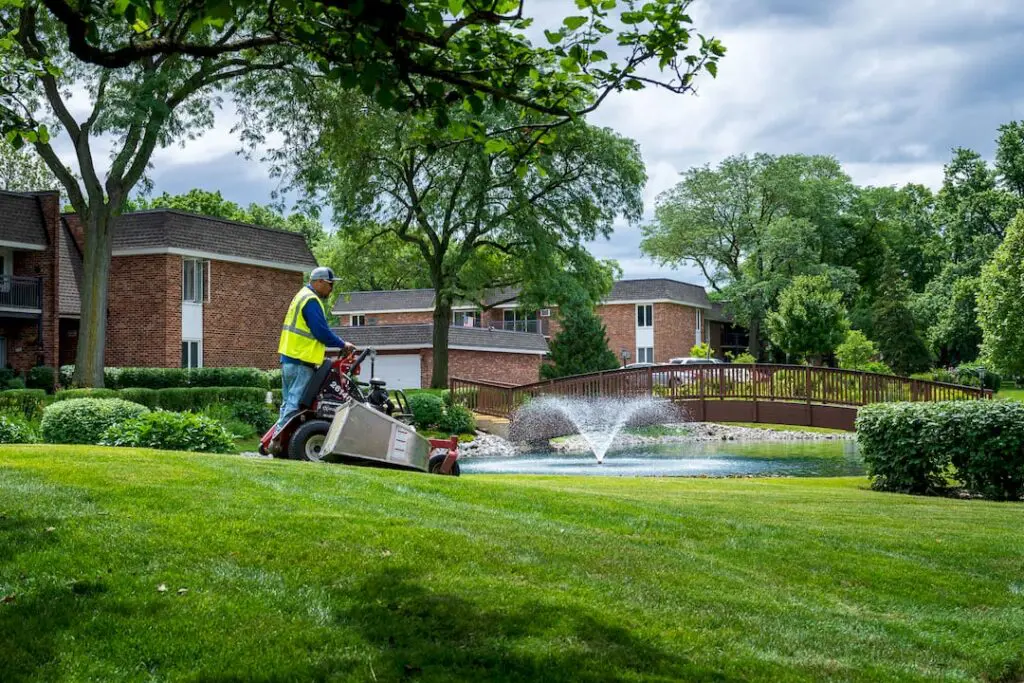
Require these four things now: weekly litter and debris policing, weekly irrigation verification, a mowing schedule locked to the season’s growth rate, and a documented seasonal activation and shutdown plan. That single sentence is the backbone of any commercial landscape maintenance checklist, and everything else in this guide builds on it.
The site supervisor or crew lead should own verification, not the property manager checking in from an office. Give that person the downloadable checklist below as an actual work order, not a reference document. Print it, clip it to a board, and have it initialed at every visit. Photograph exceptions (dead turf, a broken sprinkler head, a cracked paver) and attach the photo to the sign off. That habit alone resolves most disputes over whether a task was actually completed.
Well-kept grounds are not a cosmetic afterthought. Analysis of commercial property values found that consistent landscaping quality directly affects tenant perception and long-term asset value, which is exactly why a checklist with teeth matters more than a vague service agreement.
Pro Tip: Attach the checklist to the vendor contract as an exhibit, not a suggestion. A checklist referenced only in an email thread carries no weight when a dispute over scope comes up in month four.
-
Weekly: litter removal, irrigation spot check, mowing per growth stage, walkway safety scan
-
Monthly: controller adjustment, mulch depth check, equipment and PPE audit
-
Seasonal: irrigation activation/shutdown, pruning windows, fertilization cadence, leaf management
-
Documented: photo log of exceptions, crew lead sign off, supervisor audit trail
| Point | Details |
|---|---|
| Weekly non-negotiables | Litter policing and irrigation checks catch small problems before they become client complaints. |
| Ownership | A named site supervisor or crew lead signs off on every visit, not an office-based manager. |
| Documentation | Photo logs plus sign-off sheets settle scope disputes without a site visit. |
Key Points to Consider
A commercial landscape maintenance checklist works when weekly tasks are non-negotiable, monthly inspections catch system drift, and every visit is documented with photos and sign-offs.
| Point | Details |
|---|---|
| Weekly floor | Litter policing, irrigation spot checks, and growth-based mowing must happen on every visit. |
| Monthly system checks | Controller adjustments, mulch depth, and equipment audits prevent small issues from compounding. |
| Seasonal transitions | Spring activation and fall/winter shutdown need documented steps, not improvised routines. |
| Documentation requirement | Photo logs and crew sign-offs turn a checklist into an enforceable service record. |
| Next steps | Download the checklist, assign a site lead, and schedule an irrigation controller audit this month. |
| Professional support | Fernandez & Sons manages this full checklist, including hardscape repairs and snow removal, across Morris and Somerset Counties, NJ. |
Table of Contents
-
What Should a Commercial Landscape Maintenance Checklist Cover Weekly?
-
What Equipment Maintenance and Safety Rules Should Crews Follow?
-
What Does a Sample Checklist and Task-Frequency Matrix Look Like?
What Should a Commercial Landscape Maintenance Checklist Cover Weekly?
Weekly visits are where most contract friction starts, because weekly is the frequency clients actually notice. A parking lot full of wrappers on a Monday morning does more reputational damage than a slightly overgrown hedge nobody will spot for another two weeks.
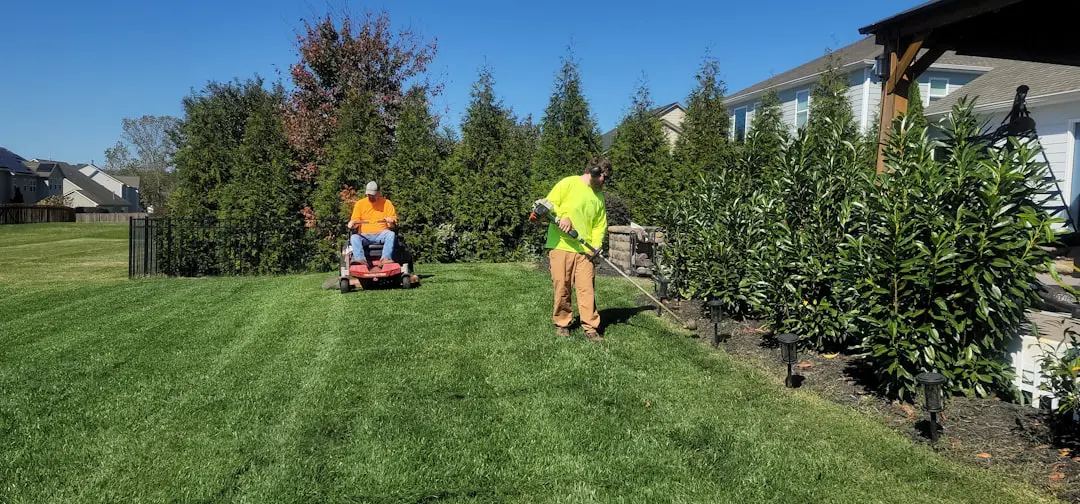
Require litter and debris pickup on every visit, including cigarette butts near entrances and cart corrals in retail settings. Mow and edge according to the growth stage of the turf, not a fixed calendar day, since spring growth spikes can demand weekly cuts while an August dry spell might stretch that to ten days. Police high-traffic beds near entrances and signage first; these are what visitors and tenants actually see. Walk the irrigation zones for obvious leaks, blown heads, or standing water, even if a full system audit is a monthly task. Check walkways and lighting fixtures for trip hazards while you’re already on foot. Confirm trash receptacles aren’t overflowing and that any dog stations or amenities are stocked.
Give each item an acceptance standard the crew lead can check against, not just a task name.
| Weekly Task | Acceptance Standard |
|---|---|
| Litter and debris removal | No visible trash in parking areas, entrances, or main walkways |
| Mowing and edging | Clippings blown off sidewalks; edges clean along curbs and beds |
| Bed policing | No weeds visible from primary sightlines; mulch undisturbed |
| Irrigation spot check | No pooling, no visibly broken heads, no dry brown patches |
| Walkway and lighting scan | No cracked pavers, no burned-out fixtures at dusk inspection |
| Amenity check | Trash cans not overflowing; benches and stations serviceable |
Extension research on landscape service specifications backs this approach: contracts that define acceptance criteria in writing, rather than relying on a verbal walkthrough, produce far more consistent results because crews aren’t guessing what “clean” means to a particular property manager.
What Monthly Inspections Should Managers Schedule?
Monthly visits are where you catch the problems weekly glances miss, mostly because they require actually opening a control panel or getting on your knees to measure something.
Irrigation controllers need a monthly look regardless of how well the system ran the week before. Seasons shift watering needs faster than most default programs account for, and a controller still running July settings in October is wasting water and stressing turf roots. Check valve function, confirm zones are firing in sequence, and adjust run times based on rainfall totals from the past 30 days.
-
Inspect the irrigation controller and adjust timers to match the current month’s rainfall and temperature trends.
-
Measure mulch depth across beds and top off any areas below two inches, spot-pruning stray growth while you’re there.
-
Walk the property specifically for weeds, since a monthly sweep catches infestations before they seed.
-
Inventory mowers, trimmers, and blowers, checking blade sharpness and general wear.
-
Confirm PPE (eye protection, hearing protection, gloves) is present and in usable condition for every crew member on site.
Skipping the equipment check because “the mower ran fine last week” is how a $40 blade-sharpening job turns into a $600 deck replacement. Dull blades tear grass instead of cutting it, which leaves ragged, brown-tipped turf that looks diseased even when it isn’t.
How Should Seasonal Landscape Tasks Be Scheduled?
Seasonal transitions cause more service failures than any other part of a commercial landscape maintenance schedule, because they require a change in routine right when everyone is busy with the last season’s leftover work.
-
Spring activation. Reactivate and pressure-test the irrigation system before turf breaks dormancy, checking every zone for winter cracks or blown fittings. Apply mulch to refresh bed appearance and suppress early weeds. Prune summer-blooming shrubs and perennials before new growth hardens. Begin a turf transition fertilization program timed to soil temperature, not the calendar date. A spring landscape checklist built around these four items prevents the scramble that happens when everything gets tackled in the same week.
-
Summer care. Tune irrigation run times upward as heat stress increases, and watch for wilting or blue-gray turf tint that signals drought stress before brown patches appear. Run IPM inspections biweekly during peak insect activity. Adjust mowing frequency upward during flush growth periods, then back off as summer heat slows growth naturally.
-
Fall cleanup. Build a leaf management schedule that ramps up as drop accelerates, rather than a single late-November blitz. Schedule aeration to relieve summer compaction and consider overseeding thin turf areas while soil temperatures still favor germination. Winterize equipment that won’t see use again until spring. NC State Extension’s guidance on fall lawn preparation is worth reviewing alongside your own property’s tree canopy density.
-
Winterization. Blow out irrigation lines in climates where freeze risk demands it, and wrap or relocate cold-sensitive container plantings. Shift to a reduced but targeted visit schedule focused on snow readiness, salt damage prevention near walkways, and structural checks after storms.
Pro Tip: The single most common seasonal transition error is treating irrigation shutdown and spring reactivation as the same five-minute task every year. Systems age, valves stick, and a five-minute walk-through in year one becomes a half-day repair job by year four if nobody’s tracking wear.
What Turf Maintenance Standards Belong in the Contract?
Turf is the single largest visible surface on most commercial properties, and it’s also the area where vague specifications cause the most disagreement between managers and contractors.
Mowing height should match the turf species, not a one-size-fits-all number. Cool-season grasses like tall fescue or Kentucky bluegrass generally hold up best around 2 to 3 inches, while warm-season varieties often run shorter. The governing principle across both is the one-third rule: never remove more than one-third of the blade height in a single cut, which means mowing frequency should track growth rate rather than a fixed day of the week.
Aeration timing depends heavily on soil composition. Clay-heavy soils compact fast under foot traffic and equipment weight, and industry maintenance guidance recommends aerating clay soils twice a year, typically spring and fall, while sandy soils usually need just one annual pass. Skip aeration during active drought stress or extreme heat, since the process itself stresses already-struggling roots.
| Turf Factor | Recommended Standard |
|---|---|
| Cool-season mow height | 2 to 3 inches, cut on the one-third rule |
| Aeration, clay soil | Twice yearly, spring and fall |
| Aeration, sandy soil | Once yearly |
| Fertilization | Six applications per year, documented with application details |
| Watering during growing season | About 1 inch of water per week, adjusted for shade and soil type |
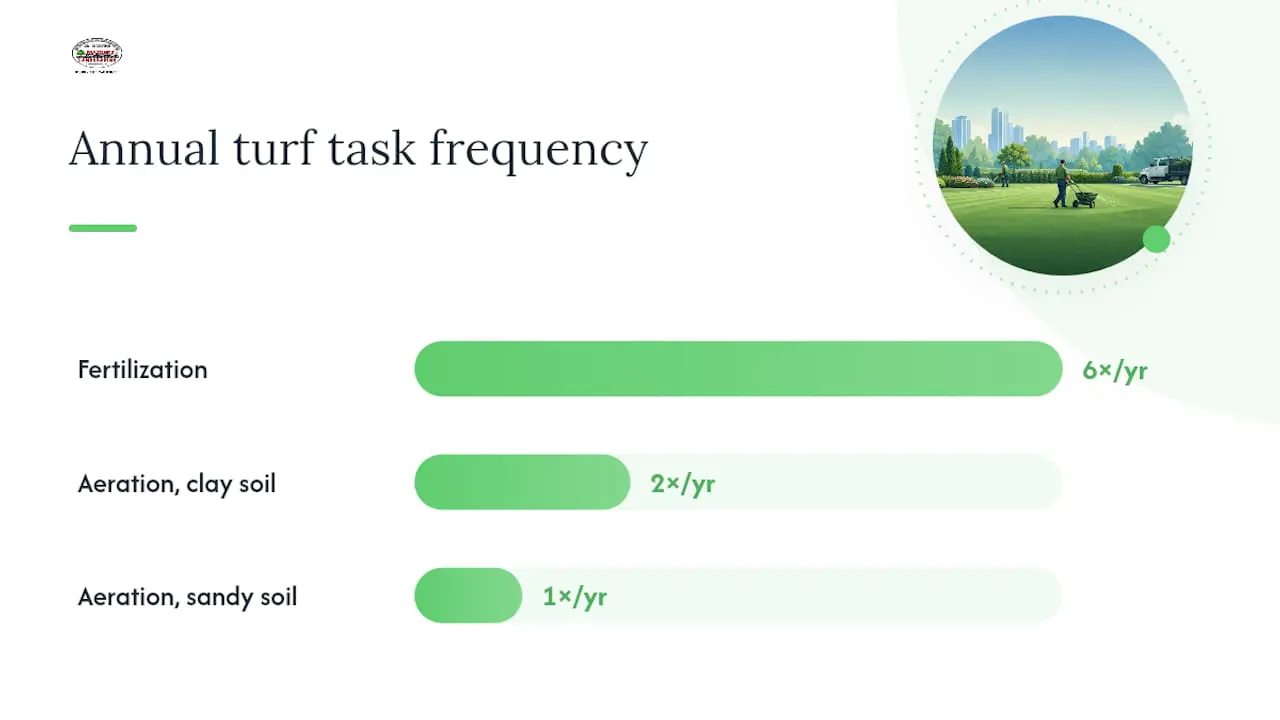
A Sustainable Landscape Management RFP template uses this six-application fertilization cadence as a baseline for commercial-grade turf programs, and it’s a reasonable default to write into any service agreement. Document every application date, product, and rate on the site log, since that record protects both the contractor and the property if a runoff complaint ever surfaces.
Pro Tip: Don’t guess on fertilizer rates. A soil test every two to three years costs less than one bad application and tells you exactly what the turf actually needs instead of what the label assumes.
How Often Should Irrigation Systems Be Checked?
Water waste on commercial properties almost always traces back to one thing: a controller nobody adjusted after the last rainstorm.
Weekly visual checks catch the obvious failures, a head stuck in the up position, a zone that never shuts off, a puddle forming where there shouldn’t be one. Monthly controller reviews are where the real savings happen. Irrigation guidance from Arizona’s water conservation office recommends about 1 inch of water per week during the growing season, adjusted for soil type, plant needs, and rainfall, and that adjustment only happens if someone is actually opening the panel monthly rather than letting a spring setting run through October.
-
Walk every zone weekly for leaks, misaligned heads, and dry or oversaturated patches.
-
Adjust the controller monthly, and immediately switch to rain mode or a manual pause after any significant storm.
-
Rotate valve, backflow preventer, and filter inspections across the season rather than doing them all at once.
-
Escalate any repair beyond basic head replacement or minor valve work as out-of-scope, documented, and quoted separately.
-
Inspect drainage swales, catch basins, and downspout discharge points after every major storm, and log corrective work with photos.
Sustainable Landscape Management specifications call for monthly controller adjustments and weekly cleaning of granite or gravel drainage areas as a baseline for commercial-grade contracts, which is a useful benchmark if your current scope of work doesn’t specify a frequency at all.
What Pruning and Shrub Care Standards Should Crews Follow?
Pruning done at the wrong time of year can cost a property an entire season of blooms, or worse, expose plants to disease they’d otherwise avoid.
Timing depends on the objective. Safety and visibility clearance around signage, entrances, and parking areas should happen whenever growth interferes, not on a fixed seasonal schedule. Flowering shrub pruning generally follows bloom time, spring bloomers get pruned right after flowering, while summer bloomers are typically cut back in late winter before new growth starts. Structural pruning on trees, especially anything requiring climbing or heavy limb removal, belongs with a certified arborist, not a mowing crew working off a general maintenance contract.
-
Prune for sightline and safety clearance as needed, year-round
-
Prune spring-flowering shrubs immediately after bloom
-
Prune summer-flowering shrubs in late winter dormancy
-
Reserve structural tree work and hazard assessment for certified arborists
-
Maintain mulch depth at 2 to 3 inches, pulled back from trunk flare to prevent rot
-
Flag declining or structurally compromised trees for a documented arborist evaluation rather than crew-level removal decisions
Mulch depth matters more than most contracts acknowledge. Two to three inches is generally the target; piling mulch higher against a trunk (the “mulch volcano” look landscapers dread) traps moisture against bark and invites rot and pest activity. When a shrub or bed is in obvious decline, decide early whether it’s a rehab candidate or a replacement, and document the reasoning, since that decision affects both budget and the client’s expectations for how the property looks next season.
Pro Tip: Keep a running photo file of any tree flagged for arborist review. If a limb fails between the flag date and the scheduled evaluation, that documentation is the difference between a maintenance record and a liability question.
How Does IPM Reduce Pesticide Use and Liability?
Blanket pesticide spraying on a fixed schedule is outdated practice, and it’s also the fastest way to invite a compliance complaint. The EPA’s Integrated Pest Management framework lays out a specific sequence: monitor first, identify the actual pest or disease correctly, establish a threshold for when action is warranted, favor non-chemical controls, and reserve targeted chemical treatment for situations that genuinely require it.
-
Monitor beds and turf on a regular schedule rather than reacting only to visible damage
-
Identify the pest or pathogen correctly before choosing any treatment
-
Set a real threshold, not every aphid warrants a spray application
-
Try non-chemical controls first: hand removal, cultural adjustments, beneficial insect habitat
-
Apply targeted chemical treatment only when the threshold is crossed, and only by a certified applicator
Every applicator on site needs current certification, and every application needs a paper trail: product, rate, target pest, date, and weather conditions. That recordkeeping isn’t optional paperwork. The pesticide label is a legal document, and applying a product in a manner inconsistent with its label is a federal violation regardless of intent.
Pollinator protection deserves specific attention in any commercial IPM program. NALP’s best management practices recommend avoiding applications during active bloom periods when practical and choosing lower-input plant species where the design allows it, both of which reduce pollinator exposure without sacrificing pest control effectiveness.
What Hardscape and Safety Items Need Regular Inspection?
Trip-and-fall liability on commercial property almost always traces back to something a weekly walkthrough would have caught: a heaved paver, a cracked slab, a light that’s been out for two weeks.
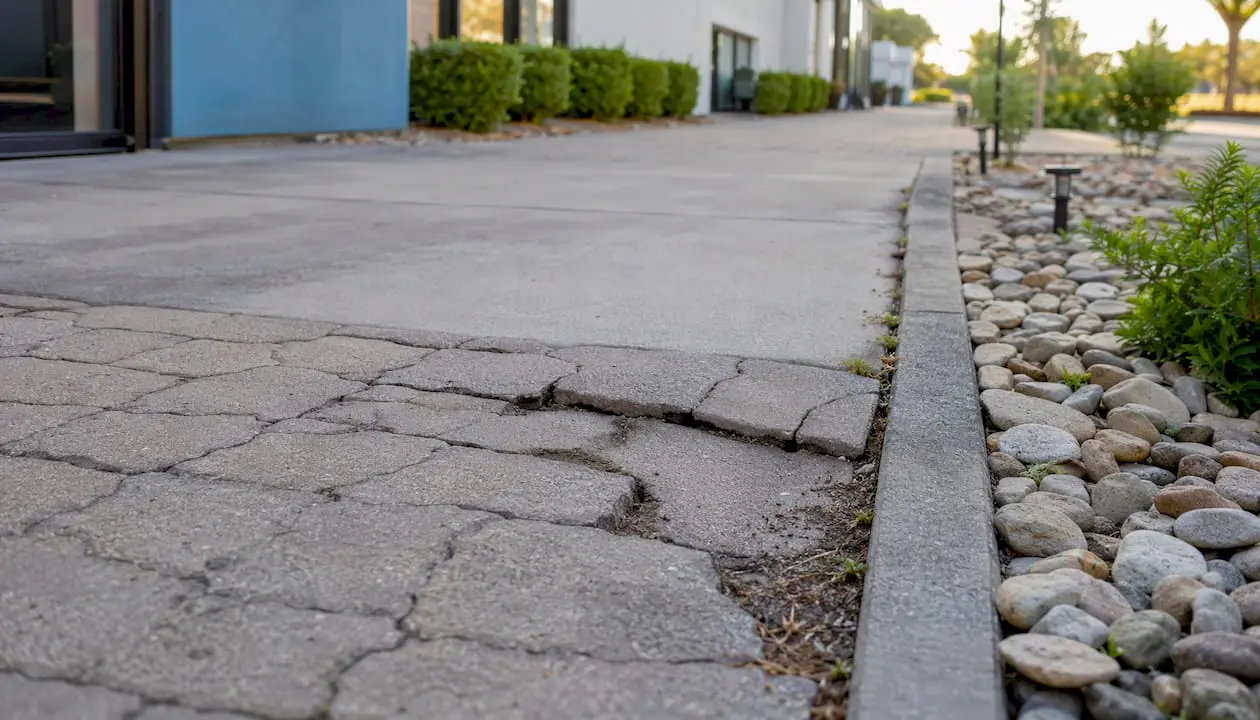
Walk every path of travel weekly, looking specifically for loose pavers, cracked concrete, uneven transitions, and anything that could catch a heel or a wheelchair caster. ADA path-of-travel compliance isn’t just a construction-phase concern; seasonal ground movement and root heave can turn a compliant walkway into a liability within a year or two. Check lighting fixtures for burned-out bulbs, cracked lenses, or fixtures knocked out of alignment, and confirm illumination actually covers the hours tenants and visitors use the space.
Amenities need the same attention hardscape gets. Benches, trash receptacles, bike racks, and dog waste stations all take wear from weather and use, and a broken bench near an entrance says more about property upkeep than most managers realize. Report any hazard, a broken paver, a downed light pole, a splintered bench, immediately rather than batching it into the next scheduled visit; the gap between “we saw it” and “we fixed it” is exactly what a liability claim looks for.
What Equipment Maintenance and Safety Rules Should Crews Follow?
Equipment failure mid-visit is one of the most preventable causes of missed service windows, and it’s almost always traceable to a skipped routine check.
Service intervals for oil changes, belt inspection, and blade sharpening should be written into the crew’s SOP, not left to individual judgment. A mower blade sharpened weekly during peak growing season produces a cleaner cut and healthier-looking turf than one sharpened monthly, since a dull blade tears grass fibers rather than slicing them cleanly. PPE, eye protection, hearing protection, gloves, and steel-toe boots where appropriate, should be checked as part of the same routine, not treated as a separate compliance exercise nobody actually verifies.
-
Sharpen mower blades on a schedule matched to mowing frequency, not a fixed monthly date
-
Service engines (oil, filters, belts) per manufacturer intervals, logged by machine
-
Store equipment under cover, fuel-drained where seasonally appropriate
-
Verify PPE availability and condition at every crew check-in
-
Recommend or require Landscape Industry Certified Technician training for equipment operators
-
Document any unexpected repair with date, cause, and downtime, and escalate repeated failures to a fleet review
Pro Tip: Track downtime by machine, not just by incident. A single mower failing three times in a season is a maintenance pattern, not three unrelated bad days, and it usually points to a service interval that’s too long.
How Should Managers Document and Verify Completed Work?
A checklist is only as good as the paper trail behind it. Crews should be able to service a property correctly from a written standard operating procedure without a supervisor standing over their shoulder, and that requires more than a task list.
Build the SOP around a property map showing bed boundaries, irrigation zones, and any “no-go” conditions, saturated turf after heavy rain, active pest treatment zones, areas under construction, so a new crew member isn’t guessing. Define acceptance criteria for every task the same way the weekly checklist table above does; “mow the lawn” is not an instruction a new hire can execute consistently, but “mow to 2.5 inches, edges clean, clippings blown off hardscape” is.
-
Require a photo log for any exception: dead turf, storm damage, a piece of equipment left broken.
-
Have the crew lead initial or digitally sign off on each visit against the checklist.
-
Schedule a supervisor audit at least monthly, separate from the crew’s own sign-off.
-
Route all client communication through one point of contact to prevent conflicting instructions from reaching the crew.
Crews should be able to service a property correctly from a written standard operating procedure without supervisor presence. The SOP needs site maps, defined “no-go” conditions like saturated turf, safety protocols, and a standard photographic exception log to actually work in the field.
That single-point communication protocol matters more than most contracts acknowledge. When three different tenant representatives can independently redirect a crew, the schedule falls apart within a month, and the resulting confusion is what shows up as a dropped task on next week’s checklist.
What Does a Sample Checklist and Task-Frequency Matrix Look Like?
A usable checklist assigns every task to a frequency and a responsible role, so nobody has to guess who owns what when a task slips.
Build your printable version around three tiers: weekly (crew-executed, checklist-verified on site), monthly (supervisor-led inspection and adjustment), and seasonal (scheduled in advance, often requiring specialized equipment or a licensed applicator). Customize the matrix by adjusting frequency up for high-visibility properties, retail frontages, corporate campuses with heavy foot traffic, and down for lower-visibility sites like back-of-building industrial lots where appearance standards can be less demanding without sacrificing safety.
| Task | Frequency | Responsible Role |
|---|---|---|
| Litter and debris removal | Weekly | Crew |
| Irrigation visual check | Weekly | Crew |
| Mowing and edging | Weekly (growth-dependent) | Crew |
| Controller/timer adjustment | Monthly | Supervisor |
| Mulch depth and bed inspection | Monthly | Supervisor |
| Equipment and PPE audit | Monthly | Supervisor |
| Fertilization application | Seasonal (about six times per year) | Licensed contractor |
| Aeration | Seasonal (1 to 2 times per year, soil dependent) | Contractor |
| Irrigation activation/winterization | Seasonal | Contractor |
| Pruning (structural/arborist-level) | As needed, flagged | Certified arborist |
-
Adjust weekly frequency upward for entrance beds and street-facing turf on high-visibility properties
-
Reserve reduced-frequency schedules for interior courtyards or low-traffic perimeter areas
-
Keep the fertilization and aeration rows tied to the turf-specific standards from the turf section above rather than restating a generic frequency
| Point | Details |
|---|---|
| Weekly ownership | Crew executes and initials the weekly tier of the matrix on every visit. |
| Monthly ownership | Supervisor handles controller adjustments and equipment audits, separate from crew tasks. |
| Seasonal ownership | Licensed contractors handle fertilization, aeration, and irrigation activation/shutdown. |
How Does This Checklist Align With Industry Best Practices?
Every standard in this guide traces back to a recognized body, not an arbitrary internal preference, which is exactly why it holds up when a client or regulator asks where a number came from.
Mowing height, the one-third rule, and aeration timing follow guidance published in industry maintenance manuals from the Landscape Industry. Irrigation water targets and seasonal scheduling reflect state water conservation guidance. The pest management sequence follows EPA IPM principles directly, and pollinator protection practices come from NALP’s published BMPs.
-
Turf standards align with Landscape Industry maintenance manual guidance
-
Irrigation targets align with state water-conservation checklist recommendations
-
Pest and disease protocols align with EPA IPM principles
-
Pollinator protection and applicator conduct align with NALP best management practices
-
Fertilization cadence aligns with RFP-level Sustainable Landscape Management specifications
Training closes the gap between a written checklist and a crew that actually executes it correctly. Landscape Industry Certified Technician programs cover irrigation, turf, safety, and equipment operation in a structured curriculum, and requiring it for lead crew members raises the floor on service quality across an entire portfolio, not just one property.
Require one documented in-field skills check per crew member per season, covering mowing technique, irrigation troubleshooting, and PPE use, and keep those records on file. When a contract renewal or audit comes up, that documentation demonstrates a trained, accountable workforce instead of just a service history.
What Separates a Good Maintenance Program From a Great One?
Most commercial landscape programs fail the same way: not from bad crews, but from undocumented decisions. A crew lead skips the irrigation check because “it looked fine last week,” a supervisor eyeballs mulch depth instead of measuring it, and six months later nobody can explain why a section of turf died or why a client is threatening to switch contractors.
The gap between adequate and excellent almost never comes down to better equipment or more experienced crews. It comes down to whether the program has a written SOP that survives a personnel change, and whether every visit leaves a paper trail that would make sense to someone who wasn’t there. Photo verification, in particular, does something a checklist alone can’t: it turns a subjective “the property looks fine” into an objective record that protects both the contractor and the client when questions come up months later. I’d argue that managers who invest in training and documentation see far less contract churn than those who invest purely in reactive fixes, because clients rarely leave over one bad mow. They leave over a pattern of small inconsistencies nobody could ever quite explain. A strong commercial landscaping program treats documentation as part of the service, not an afterthought tacked on for liability purposes.
How Fernandez & Sons Can Manage This Checklist for You
Running this checklist internally takes a trained crew, a documentation system, and someone willing to own it every single week, which is a lot to ask of a property management team already juggling leasing, maintenance requests, and tenant relations. Fernandez & Sons handles the entire program instead, from weekly litter and irrigation checks through seasonal turf, pruning, and pest management, plus the hardscape repairs and snow removal that a landscaping-only vendor typically can’t touch.
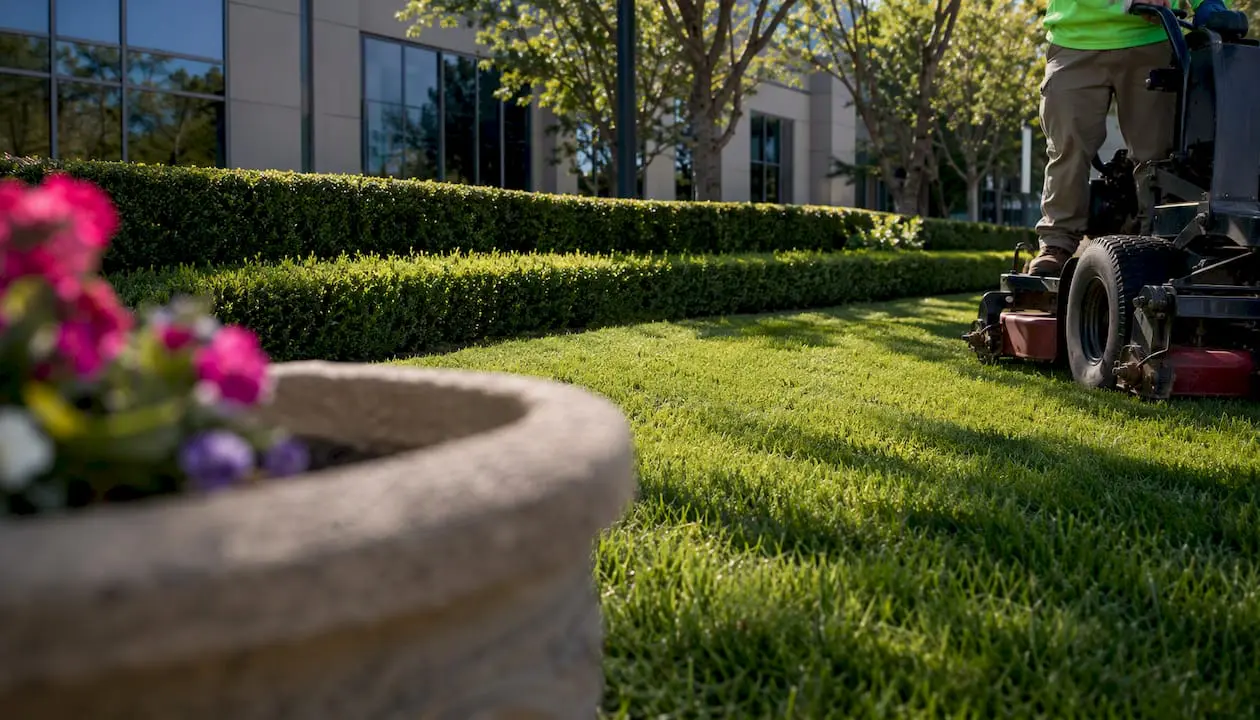
That range matters more than it might seem at first. A cracked walkway, a settling paver, or a retaining wall issue flagged during a routine inspection doesn’t require a second vendor and a second contract; it gets addressed by the same team already on site. Properties across Morris and Somerset Counties, New Jersey, rely on that combination of scheduled maintenance and hardscape capability to keep one point of contact instead of three.
The next step is simple: request a free site estimate through the Fernandez & Sons service page, and a walkthrough will identify exactly where your current program has gaps against the standards in this checklist. Every project comes backed by a satisfaction guarantee, so you’re evaluating the work against a real commitment, not just a sales pitch.
Additional Resources
A few sources back nearly every standard in this checklist, and each one supports a different piece of the program.
How often should a commercial property’s irrigation system be inspected? Check irrigation visually every week for leaks or malfunctioning heads, and adjust the controller monthly based on rainfall and seasonal water needs, following roughly 1 inch of water per week during the growing season as a baseline.
Who should be responsible for verifying that landscaping tasks were completed? A site supervisor or crew lead should own verification on every visit, using a documented checklist with photo logs for exceptions rather than relying on a property manager’s occasional walkthrough.
What is the one-third rule in mowing? The one-third rule means never removing more than a third of the grass blade’s height in a single mow, which keeps turf healthier and reduces stress-related browning.
Is pesticide label compliance actually a legal requirement? Yes. The pesticide label functions as a legally binding document, and applying a product outside its labeled instructions is a violation regardless of intent, which is why EPA’s IPM framework prioritizes non-chemical controls first.
How does a checklist reduce landscaping contract disputes? Written acceptance criteria and photo documentation remove ambiguity about whether a task was completed to standard, and SOP-based contracts tend to produce far more consistent service than verbal instructions alone.
This article provides general maintenance guidance and does not replace advice from a licensed pesticide applicator, certified arborist, or local extension office for property-specific regulatory questions.