
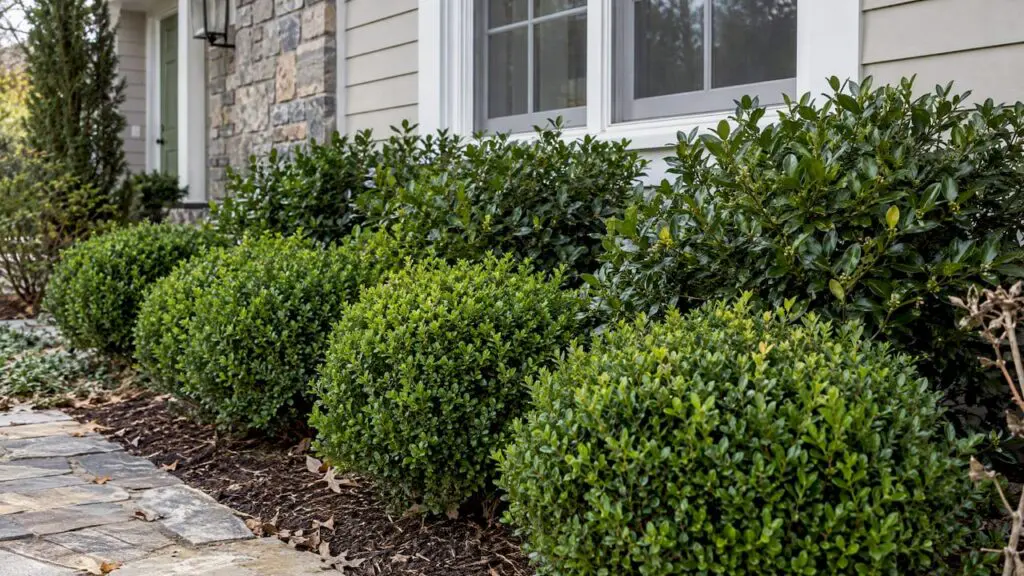
The best evergreen foundation plants for New Jersey are the ones that fit your wall’s light, your soil’s pH, and the size you want in ten years. For most Morris and Somerset County homes, that means inkberry holly, boxwood, compact Japanese holly, and American holly in sunnier beds, and pieris, rhododendron, and mountain laurel along shadier, north-facing walls where the soil runs acidic. Deer pressure and road salt narrow the list further, and we cover both below.
We design and install foundation plantings across Morris and Somerset Counties, so this guide follows the questions we hear on site visits: what will survive here, how big will it get, and what will the deer leave alone.
Quick Answers
-
Read your light first: 6 or more hours of direct sun is full sun, and 2 to 6 hours is partial shade, which decides most of your plant list.
-
Inkberry holly and American holly are strong choices where deer and road salt are concerns. Arborvitae and yew are not.
-
Test your soil. Rhododendron, pieris, and mountain laurel want acidic soil, while boxwood and yew prefer a pH above 6.0.
-
Pick plants by mature size so you prune less. Constant pruning usually means the wrong plant in the wrong spot.
-
Winter burn is the main seasonal risk for broadleaf evergreens. Mulch, skip late fertilizing, and avoid windy, sunny exposures.
Best Evergreen Foundation Plants for New Jersey at a Glance
The table below pulls together what university extension programs and horticultural organizations say about the plants we are asked about most. Use it to build a shortlist, then check your own site conditions in the sections that follow.
| Plant | Light | Soil and site notes | Deer and salt notes |
|---|---|---|---|
| Inkberry holly (Ilex glabra) | Sun to part shade | Tolerates occasional flooding and drought; grows 3 to 6 feet tall | Deer-resistant and salt-tolerant, per Penn State Extension |
| American holly (Ilex opaca) | Sun to part shade | Tree-form holly; prefers acidic soil | Rated rarely damaged by deer in northern New Jersey, per Rutgers Cooperative Extension |
| Compact Japanese holly | Full sun to partial shade | Suitable as a foundation plant, per NC State Extension | Check deer pressure on your street |
| Boxwood (Buxus) | Sun to part shade | Performs well above pH 6.0 | Choose varieties by mature size |
| Yew (Taxus) | Sun to full shade | Needs well-drained soil | Deer will readily browse it; toxic if eaten |
| Japanese pieris | Part sun to part shade | Acid-loving; can reach 6 to 12 feet | Place in shade; full sun may scorch leaves |
| Rhododendron | Sun to part shade, by variety | Acid-loving, pH below 6.0 | Protect from winter wind |
| Mountain laurel (Kalmia latifolia) | Sun or shade | Acidic, well-drained soil; native to the New Jersey Pinelands | Native option |
| Arborvitae (Thuja) | Sun to part sun | Many sizes, from compact globes to tall screens | Very salt-sensitive and often browsed by deer |
Match the Plant to the Light on Your Foundation Wall
Walk around your house at midday and again late afternoon before you buy anything. Light is the first filter, and the terms matter. According to NC State Extension, full sun means 6 or more hours of direct sunlight daily, while partial shade means 2 to 6 hours. The National Garden Bureau draws the line a little differently, calling partial shade about 3 to 6 hours, ideally morning or early afternoon, and full shade under 3 hours. Whichever definition you use, the practical point is the same: count the hours, don’t guess.
South- and West-Facing Walls
These walls take the strongest sun and reflect heat in summer. Broadleaf evergreens here face the most drying in both July and January. Good candidates include boxwood, inkberry holly, compact Japanese holly, and arborvitae cultivars in sun to part sun. The National Garden Bureau’s evergreen shrub list names boxwood ‘Winter Gem’, Japanese holly ‘Chubby Hubby’, and GEM BOX inkberry holly among its sun to part shade picks.
North- and East-Facing Walls
A north-facing bed may get only a few hours of sun, as in one New Jersey homeowner’s question about a northeast-facing spot with about 3.5 hours of direct light. That is workable. The National Garden Bureau suggests lower-growing boxwood, compact holly, cherry laurel, and dwarf variegated osmanthus for shaded foundation areas. Yews tolerate full sun through full shade, according to The Spruce, though excessive shade can reduce their vigor. Japanese pieris is a classic shade-garden foundation shrub, but Garden.org advises placing it in shade because full sun may scorch the leaves.
Dappled and Filtered Light
Dappled shade is sunlight filtered through overhead branches. Beds under mature trees often fall here, and moisture can matter as much as light. Garden.org notes that light shade is often more limited by moisture than by the amount of light. If the bed is dry under a big maple, plan for irrigation or choose tougher plants.
Check Soil pH and Drainage Before You Buy
New Jersey soils vary widely, from heavy clay in parts of Morris County to sandier, acidic soil toward the Pinelands. Both pH and drainage change which evergreens thrive.
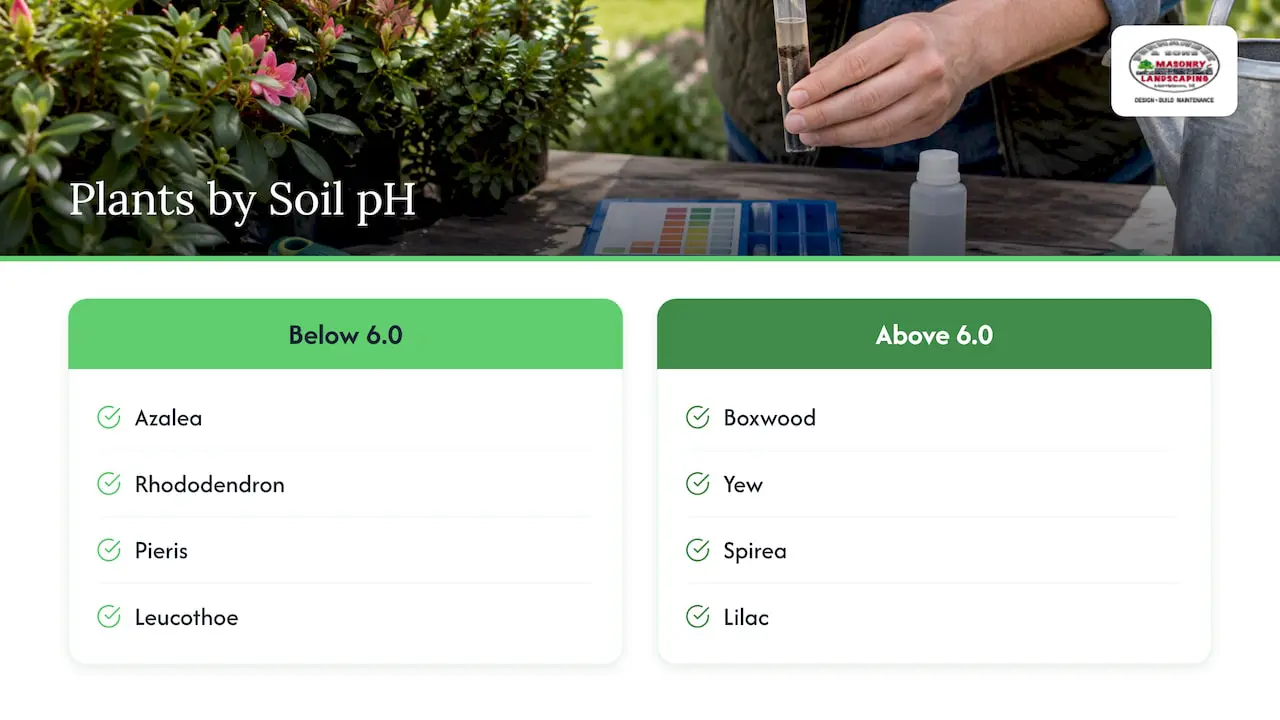
Rutgers Cooperative Extension groups azalea, rhododendron, pieris, leucothoe, mountain laurel, juniper, and tree-form holly as acid-loving plants that need a pH below 6.0. Boxwood, yew, spirea, and lilac generally do well above 6.0. That split is useful: if a soil test shows a pH of 6.8 near a concrete foundation, which can raise alkalinity over time, boxwood is a safer bet than rhododendron.
Drainage matters even more for some plants. Virginia Cooperative Extension identifies poor drainage as the primary cause of yew failure. Mountain laurel also wants acidic, well-drained soil. If water pools along your foundation after a storm, fix the grade or drainage first, and plant second. A raised bed edged in stone is often the cleanest answer, which is where our masonry and landscape teams work together.
A Rutgers soil test costs little compared with replacing a row of shrubs. Run one before a planting project, not after the first plant yellows.
Choose by Mature Size, Not Nursery Pot Size
The most common foundation mistake we see is a plant that was perfect in a 3-gallon pot and is now covering a window. Check mature height and width before you buy, so the plants never block windows, walkways, or utility equipment.
Colorado State University Extension puts it simply: choose evergreens by mature size because most need little or no pruning, and if you are pruning often to keep a plant in bounds, consider replacing it with a better-sized one. Mature size is the cheapest form of maintenance.
Some real-world size examples:
-
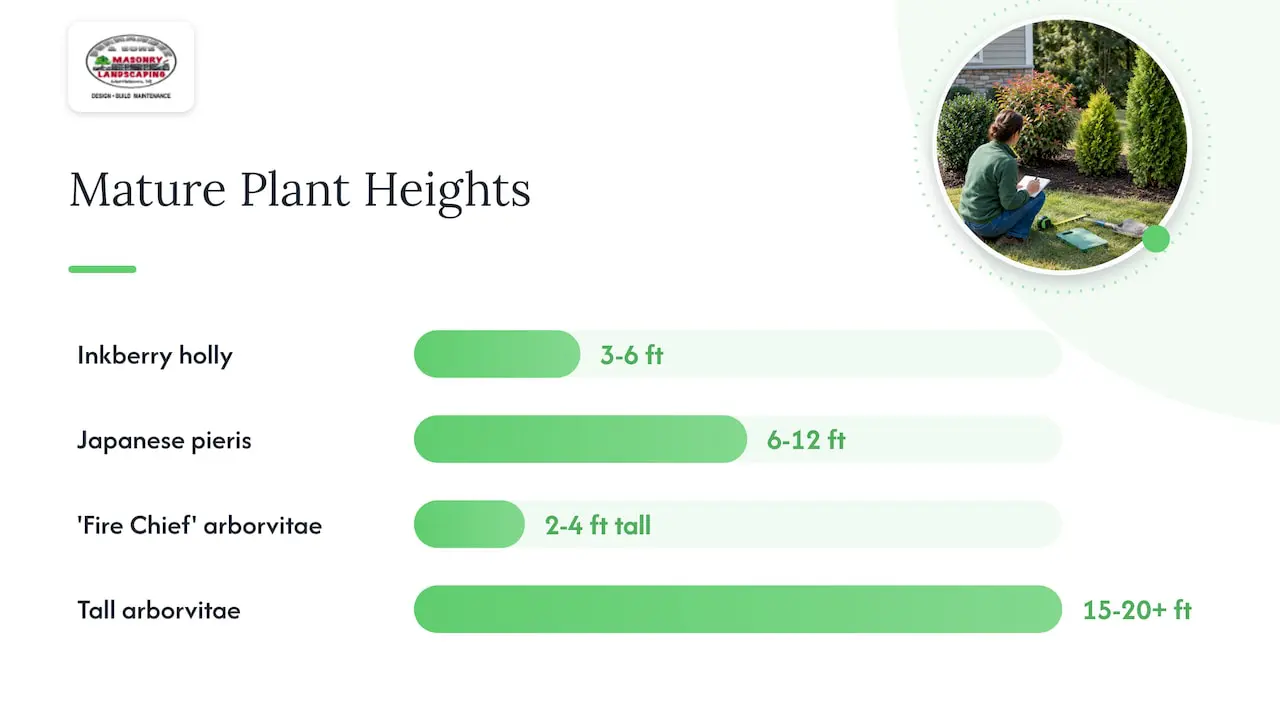
Inkberry holly grows 3 to 6 feet tall, occasionally reaching 10 feet, per Penn State Extension.
-
Japanese pieris can reach 6 to 12 feet, so it belongs at a corner or in a wide bed rather than under a window.
-
Clemson University’s plant catalog lists the compact ‘Fire Chief’ American arborvitae at 2 to 4 feet tall and wide, suited to foundation plantings and accents, according to its plant sale catalog. Tall arborvitae like those used for screening reach 15 to 20 feet or more and belong away from the house.
Spacing From Walls and Each Other
Plants need air movement and room for roots. For inkberry holly, Penn State Extension Master Gardeners suggest about 4 feet apart for a hedge, or 5 feet or more for individual specimens. Measure to the plant’s mature width, not its pot, and set the center far enough from the wall that the full spread clears the siding and the walkway.
Layering for Sightlines
A good foundation bed is layered: low evergreens under windows, medium shrubs at corners, and a taller accent near the entry or at the corner of the house. That keeps sightlines clear and gives the bed shape in winter, when perennials are cut back. Our front yard landscaping ideas for NJ homes show how these layers read from the street.
Deer, Salt, and Winter: The New Jersey Reality Check
Deer Pressure
Morris and Somerset County neighborhoods bordering preserves and parkland see heavy browsing. Rutgers is clear that no plant is truly deer-proof, but you can favor plants rated rarely or seldom severely damaged. In its deer resistance ratings, American holly and bayberry are rated rarely damaged in northern New Jersey. Inkberry holly is deer-resistant per Penn State. Eastern red cedar is also deer-resistant.
By contrast, arborvitae (Thuja occidentalis) is frequently damaged by deer browsing, according to Penn State Extension, and Virginia Cooperative Extension notes deer will readily browse yew. If you love these plants, plan on repellents or fencing for the first several years. For a full shortlist, see our guide to deer-resistant plants for New Jersey yards.
Road Salt
Beds beside driveways, walkways, and roads take salt from winter de-icing and plowing. The same Penn State guide calls arborvitae very sensitive to salt, while Eastern red cedar tolerates salt spray and soil-borne salt. Inkberry is salt-tolerant too. If your foundation bed borders a driveway that gets plowed, put the tolerant plants closest to the pavement and save sensitive ones for the protected side of the house. We also plow driveways and lots across our service area, so we plan beds with snow placement in mind from day one.
Native Options
The New Jersey Pinelands Commission’s native plants fact sheet lists inkberry and mountain laurel among evergreen shrubs for foundation use, and Eastern red cedar as an evergreen tree for buffer and specimen use. If native plantings are your priority, our guide to NJ native plants by sun exposure goes deeper.
Safety Note on Yew
Yews are a classic foundation plant, but they are extremely toxic to humans and livestock if ingested, according to Virginia Cooperative Extension. Do not plant them where children or pets might chew the foliage or seeds. If you have a play area or a dog that grazes, choose holly or boxwood instead.
Pruning and Winter Care That Keep Foundation Plants Healthy
If you choose plants by mature size, pruning becomes light. Still, a few rules help.
-
Timing: The University of Delaware Extension says most evergreens can be pruned in winter or early spring. Broadleaf evergreens are best pruned just before spring growth or right after flowering. Dead, diseased, or broken branches can come out anytime.
-
Avoid late-season cuts: The Morton Arboretum recommends avoiding late summer and fall pruning, and favors selective branch-by-branch cuts over shearing, which creates dense outer foliage and gets harder to maintain as the plant grows.
-
Respect the one-third rule: Mississippi State University Extension says narrowleaf evergreens lack latent buds, so drastic pruning can kill them. Never remove more than one-third of their foliage.
Preventing Winter Burn
The University of New Hampshire Extension notes that site exposure, moisture, wind, and winter conditions strongly affect evergreen health, and broadleaf evergreens are especially vulnerable to winter desiccation on windy, sunny sites. In practice, that means watering deeply before the ground freezes, keeping a 2 to 3 inch mulch layer off the stems, and not fertilizing late in the season. Placing rhododendron and pieris on the sheltered north or east side of the house also helps.
A Simple Planting Plan by Situation
Here is how we typically match plants to common Morris and Somerset County situations. Treat these as starting points and confirm with a site visit.
-
Sunny front wall, deer nearby: Inkberry holly and American holly at the corners, with compact boxwood or Japanese holly under windows.
-
Shady north wall, acidic soil: Pieris and rhododendron for height, mountain laurel for a native look, and a low boxwood or holly edge.
-
Driveway edge with plowing and salt: Inkberry, bayberry, or Eastern red cedar nearest the pavement.
-
Low-maintenance rental or commercial frontage: Slow-growing compact shrubs sized to the space, mulched beds, and a clear maintenance schedule. See our low-maintenance landscaping tips.
-
Beds above a retaining wall: Choose compact evergreens with fibrous roots and plan drainage behind the wall. Our guide to retaining wall plantings covers what to grow.
Our Perspective: Why Foundation Plantings Succeed or Fail Before the First Shrub Goes In
We see foundation plantings go wrong for the same few reasons: the wrong light assumption, a bed that doesn’t drain, and a plant chosen for how it looks in the pot. The shrubs themselves are rarely the problem. The planning is.
That is why we treat a foundation bed as part of the whole property rather than a row of plants. Grade, drainage, walkways, stone edging, and snow storage all affect which evergreens will still look good in year five. Because we handle masonry, landscape design, and seasonal maintenance, we can build the retaining wall, correct the drainage, set the plants, and care for them through the seasons under one roof.
Our approach is to walk the property with you, note the sun and soil, and recommend plants sized for the space so the bed looks finished without constant cutting back. Our free estimates and satisfaction guarantee mean you can see the plan before you commit.
Fernandez & Sons Masonry & Landscaping
Plan Your Foundation Planting With Fernandez & Sons
If you would rather not guess at light, pH, and mature size, we can do it with you. Our team provides landscape design, installation, and ongoing landscape maintenance for homeowners and commercial properties across Morris and Somerset Counties, including Parsippany, Morris Plains, East Hanover, and Dover. Start with our landscaping and design services page, or see everything we offer on the Fernandez & Sons home page. Estimates are free.

For a broader look at what a full project involves, read our New Jersey landscaping services guide. If your foundation bed will be paired with stone steps, a walkway, or a patio, our outdoor living spaces page shows how plantings and hardscape work together.
Quick Answers: Evergreen Foundation Plants in New Jersey
-
Best all-around choices: Inkberry holly, American holly, compact Japanese holly, and boxwood, matched to your light and soil.
-
Best for shade: Pieris, rhododendron, mountain laurel, compact holly, and lower-growing boxwood.
-
Best for deer: Inkberry holly, American holly, bayberry, and Eastern red cedar. Arborvitae and yew are browsed.
-
Best for road salt: Inkberry, bayberry, and Eastern red cedar. Arborvitae is very salt-sensitive.
-
Best soil step: Test pH. Below 6.0 suits rhododendron, pieris, and mountain laurel. Above 6.0 suits boxwood and yew.
-
Best pruning rule: Pick the right mature size, prune lightly in late winter or early spring, and never take more than one-third of narrowleaf evergreens.
Frequently Asked Questions About Evergreen Foundation Plants in NJ
What Are the Easiest Evergreen Plants for a Foundation Bed in New Jersey?
Inkberry holly, compact Japanese holly, and boxwood are common low-fuss choices when sized to the space. Inkberry also tolerates drought, occasional flooding, and salt exposure. Choose by mature size, since that does more to reduce upkeep than any other decision.
What Evergreens Can I Plant on a Shady North-Facing Wall?
Pieris, rhododendron, mountain laurel, compact holly, and lower-growing boxwood are the usual options. Yew also tolerates shade but is toxic if eaten and needs well-drained soil. Count your hours of direct sun first, since 3 hours and 5 hours can change the list.
Which Evergreen Foundation Plants Do Deer Leave Alone?
No plant is deer-proof, but Rutgers rates American holly and bayberry as rarely damaged in northern New Jersey, and inkberry holly is deer-resistant. Arborvitae and yew are commonly browsed. Heavy pressure may still call for repellents or fencing on new plants.
How Far From the House Should I Plant Foundation Shrubs?
Set each plant so its full mature width clears the wall, windows, and walkway, rather than measuring from the pot. For inkberry holly, extension guidance suggests about 4 feet apart for a hedge and 5 feet or more for specimens. A site visit lets us confirm spacing for your exact plants.
When Should I Prune Evergreen Foundation Shrubs?
Most evergreens can be pruned in winter or early spring, and broadleaf types just before spring growth or right after flowering. Avoid late summer and fall cuts. Dead or broken branches can be removed any time.
Ready to plan your foundation planting in Morris or Somerset County? Call Fernandez & Sons for a free estimate and let us walk your property with you.